


Welcome to your essential guide for managing crypto tax in Australia. Let's cut through the complexity and get straight to what you need to know about the Australian Taxation Office (ATO), your digital assets, and why a clear tax strategy is a necessity for every serious investor. As experts in Australian tax law, we'll provide the clarity you need.
Your Expert Guide to Navigating Crypto Tax in Australia

It's time to stop thinking of crypto as 'magic internet money'. In the eyes of Australian law, it’s a tangible asset with very real tax implications. Mastering the fundamentals is the first step toward investing with confidence and ensuring full compliance with your obligations.
If you’re new to the space or just need a refresher, our detailed guide explains exactly what cryptocurrency is and how it all works. Understanding the fundamentals makes the tax side of things much easier to digest.
It also helps to look at the bigger picture. The broader landscape of cryptocurrencies and how other countries are handling regulation helps explain why governments, including Australia's, are putting clear rules in place.
Taxable Events You Need To Know
In Australia, several common crypto activities will trigger a taxable event for the ATO. It's crucial to recognise these moments as they happen—not just when you’re scrambling at tax time.
Here are the key CGT events:
- Selling crypto for Australian dollars (AUD): This one’s the most straightforward. When you cash out your crypto back into Aussie dollars, you’ve triggered a taxable event and need to calculate the capital gain or loss.
- Trading one cryptocurrency for another: Swapping your Bitcoin for Ethereum isn't a tax-free move. The ATO treats this as selling one asset (Bitcoin) and immediately buying another (Ethereum), which creates a tax liability on the first coin.
- Using crypto to pay for goods or services: That coffee you bought with crypto? Or the new laptop? Both are disposals of your asset and are therefore taxable events.
Think the ATO isn't watching? Think again.
They've seriously ramped up their tracking efforts, using data-matching agreements to get detailed records from major exchanges, covering more than 1.2 million Australian users. This has led to a significant increase in crypto-related audits and the recovery of millions in unpaid taxes.
This guide will set the stage for a detailed breakdown of Capital Gains Tax (CGT), income treatment, and the absolute necessity of keeping good records. Armed with the right knowledge, you can manage your crypto tax obligations like a professional.
Right, let's get one thing straight about crypto tax in Australia. To make sense of any of it, you first need to understand a fundamental rule.
The Australian Taxation Office (ATO) does not see your crypto as money. Not at all.
Instead, the ATO treats crypto as a form of property. Think of it just like a parcel of shares, a block of land, or even a piece of art. This single idea is the bedrock of every crypto tax rule that follows.
Because your crypto is property, any time you dispose of it, you trigger what’s called a Capital Gains Tax (CGT) event. That’s the exact moment a potential tax bill is born. Getting your head around what counts as a 'disposal' is absolutely critical if you want to stay compliant and avoid a nasty surprise at tax time.
Don't just take our word for it. This is straight from the source—the ATO's own website confirms this treatment, making it crystal clear that disposals trigger CGT events.
As the screenshot shows, your gains are counted as assessable income, and your losses can be used to offset other capital gains. It’s the classic property treatment, applied to digital assets.
So, What Counts as a Crypto Disposal?
Here’s where a lot of people get caught out. A 'disposal' isn't just about cashing out your crypto for Aussie dollars. The ATO’s definition is much broader and covers many of the things you do with crypto every day.
Each of these actions is a CGT event you have to track:
- Selling crypto for fiat currency: This one’s the most obvious. You sell your Bitcoin (BTC) for Australian dollars (AUD). That’s a disposal.
- Trading one crypto for another: Swapping your Ethereum (ETH) for Solana (SOL) is also a disposal. You’re effectively 'selling' your ETH to 'buy' SOL, which creates a CGT event for the ETH you just traded away.
- Using crypto for goods or services: That coffee you bought with crypto? Or the new laptop? Both are disposals. You exchanged your crypto asset for something else, and that’s a taxable event.
The core takeaway is simple: almost anything you do beyond just buying and holding crypto is a disposal. This triggers a CGT event, meaning you have to sit down and calculate whether you made a capital gain or a capital loss on that transaction.
The Basics of a CGT Calculation
So a CGT event has happened. Now what? Your profit or loss comes down to two key numbers: the cost base and the capital proceeds.
Think of it like this: if you bought a painting for $1,000 and later sold it for $5,000, your gain is the difference between what you got for it and what it cost you. Simple.
Crypto works the exact same way.
- Cost Base: This is the total cost to acquire the crypto, calculated in Australian dollars. It includes not just the purchase price but also any associated costs, like exchange or broker fees.
- Capital Proceeds: This is what you received (or the AUD market value) when you disposed of the crypto.
Practical Example: You bought 0.1 BTC for $5,000, plus a $50 exchange fee. Your cost base is $5,050. A year later, you sold it for $7,000. Your capital proceeds are $7,000. You’ve made a capital gain of $1,950. That’s the amount that gets taxed.
What About the Personal Use Asset Exemption?
You might have heard whispers about the 'personal use asset' exemption, where you don’t pay tax on gains from assets you bought for personal enjoyment for less than $10,000.
Unfortunately, when it comes to crypto, this rule is almost never applicable.
The ATO's guidance on the tax treatment of crypto assets is very firm on this. They state that crypto is generally acquired and held as an investment, with the goal of making a profit. To qualify for the exemption, you'd have to prove you bought and used the crypto for a personal reason—not as an investment—within a very short time. It's an extremely high bar to clear.
It’s always safest to assume this exemption doesn’t apply to your crypto.
Understanding this property-based framework is your first big step. The next is figuring out if your activities make you an investor or a trader in the eyes of the ATO, as that can dramatically change how you’re taxed.
Actionable Call to Action:
Feeling overwhelmed by the rules? Don't leave your tax position to chance. Book a consultation with our expert crypto accountants at EndureGo Tax. We’ll help you classify your transactions correctly and ensure you’re fully compliant with ATO legislation.
Capital Gains vs Income: How Your Crypto Activity is Classified
When it comes to your crypto tax obligations, there’s one question that trumps all others: are you an investor or are you a trader?
It might sound like semantics, but the Australian Taxation Office (ATO) sees these two activities very differently. The answer determines whether you can access a significant tax discount or must pay tax at your highest marginal rate. It’s a distinction that can literally make or break your crypto profits.
This isn't about what you call yourself. It’s all about what your actions tell the ATO. Let's break it down from an expert perspective.
Are You an Investor or a Trader?
Most Australians dabbling in crypto fit neatly into the ‘investor’ category. An investor is someone who typically acquires crypto with the intention of holding it for a period, hoping its value grows over time. Their strategy is more passive, and they aren't trading day in, day out.
A trader, on the other hand, is essentially running a business. Their activity is frequent, organised, and has a clear strategy to generate profits from short-term market movements. For those diving into more advanced strategies, a solid grasp is needed for understanding cryptocurrency margin trading before you can even begin to classify it for tax.
The ATO looks at a few key signals to determine which camp you're in:
- Frequency and Volume: Are you making a handful of trades a year or dozens every week? High-frequency activity points towards a business operation.
- Level of Organisation: Do you have a business plan? Dedicated capital set aside? Are you using sophisticated software to track everything? These are all hallmarks of a business.
- Intention to Profit: While everyone wants to make money, traders rely on constant buying and selling for their regular income, not just hoping for long-term price appreciation.
Key Takeaway: The line between being an investor and a trader is all about your pattern of behaviour. A few buys and sells a year? You’re likely an investor. Daily or weekly trading with a clear strategy? That pushes you firmly into the trader category.
The financial stakes here are huge. ATO data shows that around 780,000 Australians have declared crypto gains or income. Of those, a significant majority were considered long-term investors, giving them access to tax discounts that traders cannot claim.
So, how do the tax rules differ? Let's get into the nitty-gritty.
Crypto Activity Tax Treatment: Investor vs Trader
The table below gives you a quick snapshot of how the ATO typically views different crypto activities depending on your classification. It’s a good starting point to see where you might land.
| Activity Type | Tax Treatment for Investor | Tax Treatment for Trader | Key Consideration |
|---|---|---|---|
| Buying & Selling Crypto | Subject to Capital Gains Tax (CGT). | Treated as business income. | CGT allows for the 50% discount if held >12 months; income does not. |
| Trading Crypto for Crypto | CGT event. Capital gain/loss is calculated. | Business income/expense. | Each trade is a taxable disposal, regardless of your classification. |
| Staking Rewards/Airdrops | Treated as ordinary income on receipt. | Treated as business income on receipt. | The value at the time you receive the crypto is what's taxed. |
| Making a Loss | Capital losses can only offset capital gains. | Business losses may be offset against other income (e.g., salary). | This is a key difference—traders have more flexibility with losses. |
As you can see, your classification sends your tax obligations down two very different paths. One person's tax-savvy hold could be another's high-tax-rate headache.
The Investor Advantage: The 50% CGT Discount
For investors, it’s all about Capital Gains Tax (CGT). Whenever you "dispose" of a crypto asset—by selling it, trading it, or spending it—you calculate your capital gain or loss.
Here’s the massive perk for investors: if you hold onto your crypto for more than 12 months before you dispose of it, you qualify for the 50% CGT discount.
That means you only pay tax on half of your profit. It's a game-changer and a powerful reason why so many people choose a long-term "HODLing" strategy.
The Trader Reality: Business Income Treatment
If your activity looks and feels like a business, the rules flip entirely. Your crypto is now treated as trading stock, not a personal investment.
This has two major implications:
- Profits as Income: Your net profit from trading gets added to your assessable income for the year. It's taxed at your marginal rate, which could be as high as 45% (plus the Medicare levy). The 50% CGT discount is off the table.
- Losses Can Be Offset: Here’s the silver lining. If your trading business makes a net loss, you may be able to use that loss to reduce your other income, like your salary (subject to certain rules).
The flowchart below gives you a simple visual of how common disposal events trigger a tax obligation.
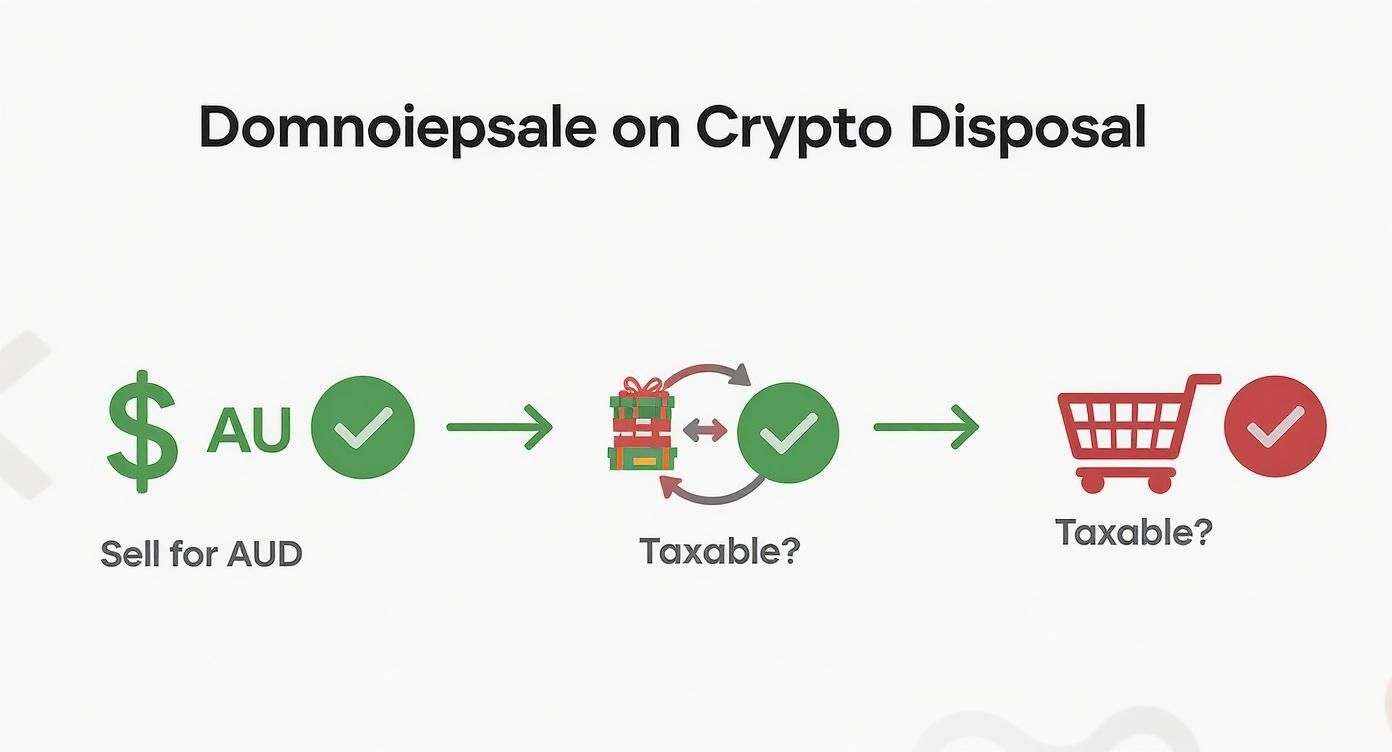
The message is clear: whether you sell for Aussie dollars, swap for another coin, or use it to buy a coffee, you’ve almost certainly triggered a taxable event.
What About Other Crypto Income?
It’s not just about buying and selling. You can earn crypto in plenty of other ways, and these are almost always taxed as ordinary income, no matter if you're an investor or a trader.
- Staking Rewards: The Aussie dollar value of your rewards at the moment you receive them is assessable income.
- Airdrops: Same deal as staking. The value of airdropped tokens when they land in your wallet is considered income.
- Mining: If you’re mining as a hobby, the value of the coins is income. If you're running a mining business, it's treated as business income.
Getting this classification right is non-negotiable. It shapes your entire tax strategy, what discounts you can claim, and the records you need to keep.
Actionable Call to Action:
Unsure if you're a trader or an investor? Don’t guess. Contact EndureGo Tax for a professional assessment of your crypto activities. We’ll provide clarity and ensure you're using the correct tax treatment to stay compliant and optimise your position.
Calculating Your Crypto Tax Step-by-Step
Alright, theory is one thing, but let's get practical. Knowing the rules is great, but applying them to your own crypto portfolio is where it really counts. As expert tax advisors, we believe in clarity through practical application.
Let's walk through some of the most common situations you'll face as a crypto investor in Australia. These examples will show you exactly how to calculate your crypto tax obligations, step-by-step.
We’ll stick to clear, round numbers to keep things simple. Once you get the hang of it, you can apply this same logic to your own transactions, no matter how complex they seem.
Practical Example 1: The Simple Buy and Sell
This is the bread and butter for many Aussie investors. You buy a cryptocurrency, hold it for a while, and then sell it back into Australian dollars.
Let's say you bought 1 Bitcoin (BTC) on 1 May 2022 for $40,000. You also paid a $200 fee on the exchange. Fast forward to 1 June 2024, and you sell that 1 BTC for a cool $70,000.
Determine your Cost Base: This is the total cost to acquire the asset.
- Purchase Price: $40,000
- Exchange Fee: $200
- Total Cost Base: $40,200
Identify the Capital Proceeds: This is simply what you received when you sold it.
- Capital Proceeds: $70,000
Calculate the Capital Gain: Now, just subtract the cost base from your proceeds.
- $70,000 (Proceeds) – $40,200 (Cost Base) = $29,800 (Total Capital Gain)
Apply the CGT Discount: Here's the good part. Because you held the Bitcoin for more than 12 months (from May 2022 to June 2024), you are eligible for the 50% CGT discount.
- $29,800 x 50% = $14,900
In this scenario, your taxable capital gain is $14,900. This is the final figure you add to your other income for that financial year.
Practical Example 2: The Crypto-to-Crypto Trade
This is where so many investors get tripped up. Swapping one crypto for another is absolutely a taxable event. The ATO views it as selling one asset to immediately buy another.
Imagine you trade 2 Ethereum (ETH) for 200 Solana (SOL) on 10 December 2024. Let's say your original cost base for the 2 ETH was $5,000. At the moment of the trade, the market value of that 2 ETH had grown to $8,000.
Identify the CGT Event: You disposed of your 2 ETH. That’s the taxable event.
Determine the Capital Proceeds: Your proceeds are the Australian dollar market value of what you gave up. In this case, the 2 ETH you traded away were worth $8,000.
- Capital Proceeds for ETH: $8,000
Calculate the Capital Gain on ETH:
- $8,000 (Proceeds) – $5,000 (Original Cost Base) = $3,000 (Total Capital Gain)
- Whether you can apply the 50% CGT discount will depend on how long you held that ETH before making the trade.
Crucial Point: You're not done yet. You now have to establish a cost base for your new SOL. The cost base for your 200 SOL is the market value of what you gave up to get them, which was $8,000. This is the number you'll use when you eventually sell or trade that SOL down the track.
Practical Example 3: Receiving Staking Rewards
When you earn crypto from staking, airdrops, or mining, the ATO treats it as ordinary income. The value is calculated at the exact moment you get control of the new coins.
Let’s say you received 100 ADA from staking on 15 March 2025. On that day, the market price of ADA was $0.70 per coin.
Calculate the Income: You must declare the Australian dollar value of these rewards as income on your tax return.
- 100 ADA x $0.70 = $70
- You will add $70 to your assessable income for that financial year. Simple as that.
Establish the Cost Base for the New Coins: This is a vital second step that many people miss. That $70 of income now becomes the cost base for those 100 ADA coins.
- Cost Base for 100 ADA: $70
When you later sell these specific 100 ADA, you'll use this $70 cost base to calculate any capital gain or loss. This prevents double taxation—you’re taxed as income when you receive it, and then only on the change in value when you dispose of it. For more detailed official guidance, you can refer to the ATO's legislation on transacting with cryptocurrency.
Manually tracking all these calculations across hundreds of transactions can become a nightmare. This is where using a specialised crypto tax calculator for Australia can save you a world of pain by automating the process and ensuring you stay compliant.
Actionable Call to Action:
Feeling unsure about your calculations? Don't risk an ATO audit. Book a consultation with an EndureGo Tax specialist today. We'll review your transactions, apply the correct tax treatments, and make sure you’re not paying a dollar more in crypto tax than you absolutely have to.
The Golden Rule of Crypto Record Keeping
If there’s one piece of advice every crypto tax expert gives, it’s this: your tax return is only as good as your records.
Meticulous, diligent record-keeping isn't just a good idea; it's the foundation of accurate crypto tax reporting and your number one defence against ATO scrutiny. Without it, you are exposed.
The Australian Taxation Office doesn't leave room for guesswork. They expect you to have a clear, organised trail of every single crypto transaction you make. Getting this right from day one is the single most effective way to avoid a massive headache—and potential penalties—when tax time rolls around.
Your ATO Record-Keeping Checklist
For every transaction, the ATO requires you to keep specific data points. Think of this as your non-negotiable checklist for staying compliant. Fumbling for this information years later can be a nightmare, so it's vital to capture it at the time of the transaction.
Here’s exactly what you need to record:
- Date of Transaction: The exact day you bought, sold, traded, or used the crypto.
- Asset Type: The specific cryptocurrency (e.g., Bitcoin, Ethereum, Solana).
- AUD Value: The market value in Australian dollars at the time of the transaction. This is crucial for calculating your cost base and capital proceeds.
- Transaction Purpose: What was the transaction for? A simple buy? A trade for another crypto? A purchase of goods or services?
- Associated Parties: Who was the other party involved? Usually, this will be the crypto exchange you used.
- Wallet Addresses: Keep a record of the public wallet addresses involved in the transaction.
Simply downloading a CSV file from your exchange often isn't enough. These reports frequently miss key details, especially if you’re moving assets between wallets or engaging in decentralised finance (DeFi).
Tools of the Trade: Spreadsheets vs. Software
So, how do you actually track all this? Your method will likely depend on your level of activity.
For the casual investor with only a handful of transactions per year, a detailed spreadsheet can do the job. You can create columns for each of the data points on the ATO checklist and manually update it every time you make a move. It’s simple, free, and effective for small-scale activity.
However, once you start trading more actively, a spreadsheet becomes a recipe for disaster. This is where specialised crypto tax software becomes essential. These platforms connect to your exchanges and wallets via API, automatically importing your transaction history and calculating your tax obligations for you. They are designed to handle the complexity of DeFi, staking rewards, and hundreds of trades with precision.
"The ATO’s data-matching capabilities are becoming more advanced each year. Assuming your crypto activity will go unnoticed is a risky strategy. Maintaining complete and accurate records is not just about compliance; it's about protecting yourself from an audit."
Why Exchange Reports Fall Short
Relying solely on the reports from your crypto exchange is a common but dangerous mistake. These reports are often incomplete for tax purposes, particularly in these situations:
- Transfers Between Wallets: Moving crypto from an exchange to a private wallet (like a Ledger or MetaMask) isn't a taxable event, but your exchange's report won't know what you did with it.
- DeFi and Staking: If you engage in liquidity pools, lending, or staking directly from a private wallet, your exchange has zero visibility of this activity.
- Multiple Exchanges: If you use several exchanges, you’ll have to manually combine all the data, which can be messy and lead to errors.
Given the increasing focus on compliance, understanding the ATO's new cryptocurrency audit processes is more important than ever. Proper records are your best defence. For authoritative guidance, the ATO itself provides clear expectations on what records you need to keep.
Actionable Call to Action:
Don't wait until tax time to get organised. Start your crypto records today. If you feel your transaction history is already too complex to handle, book a session with an EndureGo Tax crypto specialist. We can help you reconstruct your records and implement a system that makes future reporting a breeze.
Getting Your Tax Return Ready: A Final Checklist
Alright, we've covered a lot of ground. Now it's time to turn that expert knowledge into action. With the end of the financial year fast approaching, getting organised is your best strategy for a stress-free tax time.
Think of this as your pre-flight check before lodging with the ATO. Running through these steps will help you stay compliant, avoid costly mistakes, and ensure you're not paying a cent more in tax than you legally need to.
Your No-Nonsense Crypto Tax Action Plan
Here’s a straightforward plan to get your crypto tax reporting sorted, one step at a time:
- Gather Every Last Transaction: Pull together all your transaction records from every exchange and wallet you've ever used. This means buys, sells, swaps, staking rewards, airdrops, and every other disposal. Every single one matters.
- Calculate Your Gains and Losses: Go through each transaction where you disposed of a crypto asset and figure out the capital gain or loss in Australian dollars. Remember, a crypto-to-crypto trade is absolutely a disposal event.
- Pinpoint Your Crypto Income: Isolate and add up the value of any crypto you received from activities like staking, airdrops, or mining. This gets declared separately as ordinary income.
- Put Your Losses to Work: Tally up any capital losses from this financial year (or any you've carried forward) and use them to offset your capital gains. This is a crucial step to reduce your final tax bill.
Following this process methodically is your best defence against an ATO audit. Accuracy isn't just a best practice; it's a legal requirement under the Taxation Administration Act 1953.
The Two Things Every Serious Crypto Investor Should Do
While you can wrestle with spreadsheets and do all this manually, there are two moves that will save you time and provide serious peace of mind.
First, use a reputable crypto tax software. It’s built to automate the heavy lifting, crunch the complex numbers, and pull all your data into one place.
Second, and this is the big one, talk to a tax professional who actually understands crypto. Don't think of it as an expense—it's an investment in getting it right, protecting yourself, and ensuring your financial affairs are in order.
Actionable Call to Action:
Don't leave your crypto tax to guesswork. Schedule a consultation with an EndureGo Tax expert today. We'll make sure your return is accurate, optimised, and lodged correctly, so you can handle your tax obligations with complete confidence.
Your Top Crypto Tax Questions Answered
Diving into crypto tax can feel like navigating a maze. To provide expert clarity, we’ve put together a list of the most common questions we get from Aussie investors, with direct, professional answers to help you get it right.
What Happens If I Made a Loss on My Crypto?
It’s never fun to lose money on an investment, but a capital loss on your crypto has a specific function under Australian tax law. The first thing to know is you can't use that loss to reduce your regular income, like your salary. It's not a direct tax deduction.
Instead, a capital loss can be used to offset any capital gains you’ve made in the same financial year. This is a big deal. The loss can reduce gains from other crypto, shares, or even investment properties. If you don't have any capital gains to offset, you can carry the loss forward indefinitely and apply it against gains in future years. Just make sure you record it properly in your tax return.
Are NFTs Taxed the Same Way as Crypto?
Yes, for the most part, the ATO views Non-Fungible Tokens (NFTs) exactly like it sees Bitcoin or Ethereum. They are considered a Capital Gains Tax (CGT) asset.
This means the usual rules are in play. Whenever you sell, trade, or gift an NFT, you’re triggering a CGT event. You’ll need to work out whether you made a capital gain or a loss on the transaction. The only real exception is for artists or creators who mint and sell NFTs as part of their business—for them, the money coming in is treated as business income, not a capital gain.
Do I Pay Tax If I Just Buy and Hold Crypto?
No. Simply acquiring crypto and holding it in your wallet is not a taxable event in Australia. You do not owe the ATO anything while your assets are just sitting there, no matter how much they might appreciate in value on paper.
Your tax obligation only crystallises when you ‘dispose’ of the asset. This is the critical moment. It happens when you sell your crypto for Aussie dollars, trade it for another cryptocurrency, or use it to buy something. It's only at this point that your capital gain or loss is officially realised.
The ATO's stance is clear: tax is triggered by a transaction, not by unrealised paper gains. This principle is a cornerstone of managing your crypto tax obligations effectively.
What’s the Deal With the ATO’s ‘Personal Use Asset’ Rule for Crypto?
The ATO has a rule for 'personal use assets' where capital gains don't get taxed if the asset cost less than $10,000 and was acquired purely for personal enjoyment. While it sounds tempting to apply this to a small crypto trade, it’s almost impossible to do so.
The tax office has been very clear that cryptocurrency is rarely considered a personal use asset. Why? Because it’s almost always acquired as an investment or for speculation, with the goal of making a profit. To have any chance of qualifying, you’d need to prove you bought and used the crypto for a specific personal reason almost immediately. It’s safest to assume this rule doesn't apply to your crypto.
Navigating the fine print of crypto tax is a lot easier with an expert in your corner. The team at EndureGo Tax specialises in digital asset taxation, helping investors and businesses across Ashfield and the Northern Beaches stay compliant and keep more of their returns. Book your consultation today at https://www.endurego.com.au.
