


Navigating your crypto tax obligations in Australia can feel overwhelming, but it all stems from one core principle from the Australian Taxation Office (ATO). The ATO views cryptocurrency as property, not currency. This single rule is the key to understanding your tax responsibilities.
Think of your crypto not like the cash in your wallet, but rather like owning shares or an investment property. This simple shift in perspective is the foundation for getting your tax right and avoiding costly mistakes.
Understanding Your Australian Crypto Tax Obligations

The moment you ‘dispose’ of a crypto asset, the ATO considers it a taxable event. Just as you would pay tax on the profit from selling shares, the same logic applies when you sell, trade, or even spend your crypto.
Internalising this core concept—that crypto is property—is the most critical first step. As expert crypto accountants, we advise clients that ignoring this is a significant risk. The ATO employs sophisticated data-matching programs with Australian exchanges and is actively identifying individuals who have not reported their crypto gains.
The Two Main Tax Categories for Crypto
Your crypto activities will almost always fall into one of two buckets: Capital Gains Tax (CGT) or ordinary income. Correctly identifying which bucket your transactions belong in is essential for accurate reporting and avoiding common errors that can trigger an audit.
For most Australians who buy, hold, and eventually sell their crypto, any profit is treated as a capital gain. This is the most common scenario for crypto investors.
So, when does CGT kick in?
- Capital Gains Tax (CGT) applies when you:
- Sell crypto for Australian dollars (AUD).
- Trade one cryptocurrency for another (e.g., swapping BTC for ETH).
- Use crypto to pay for goods or services.
- Gift your crypto to someone else.
However, certain activities are treated as regular income instead:
- Ordinary Income rules apply when you:
- Get paid in crypto for business services.
- Earn rewards from staking or DeFi protocols.
- Receive an airdrop of new tokens.
- Run a crypto trading business with the primary goal of generating profit.
The ATO states this plainly in their legislative guidance: "If you are not carrying on a business of trading in crypto assets, the CGT rules will apply." This is a crucial distinction that dictates your reporting methodology.
Why This Distinction Matters
Here’s the critical point: correctly classifying your crypto activity directly impacts your final tax bill.
If your gains fall under CGT, you may be eligible for the 50% CGT discount provided you have held the asset for more than 12 months. This can literally halve the tax you owe on that profit.
On the other hand, income is taxed at your full marginal tax rate, with no discount available. For investors dealing with specific assets like stablecoins, a detailed resource such as the Stablecoin Tax Guide 2025 can provide deeper insights.
Once you master these fundamentals, you are in a much stronger position to manage your crypto tax with confidence. The key is to view every transaction through the ATO's lens: as the disposal of a property asset.
Feeling uncertain about how these rules apply to your specific trading history? Take control of your crypto tax obligations and book a consultation with our expert crypto accountants today. We will ensure you are fully compliant and leveraging every available tax concession.
How Capital Gains Tax Applies to Your Crypto
The greatest source of confusion for Australian crypto investors isn't if they pay tax, but when. Many assume a tax event only occurs when they sell crypto for Australian dollars. In reality, the Australian Taxation Office (ATO) has a much broader definition that often catches even experienced investors off guard.
The key term you must understand is ‘disposal’. Anytime you dispose of a crypto asset, you trigger a Capital Gains Tax (CGT) event. This is the moment the ATO requires you to calculate whether you’ve made a profit (a capital gain) or a loss.
Think of it this way: your crypto is an asset, just like a share in a company. When you sell that share, you pay tax on the profit. The principle is identical here, but the ATO’s definition of 'selling' is significantly wider.
What Is a CGT Event for Crypto?
A CGT event is far more than just cashing out. According to ATO legislation, a ‘disposal’ occurs in several common scenarios you may not have realised are taxable.
Here are the most frequent crypto tax events:
- Selling crypto for fiat currency: This is the obvious one, such as selling your Bitcoin for AUD.
- Trading one crypto for another: Swapping your Ethereum for Solana? That’s a disposal of ETH and an acquisition of SOL, creating a CGT event.
- Using crypto for goods or services: That coffee or new laptop you paid for with crypto? That's a disposal and therefore a taxable event.
- Gifting crypto to someone else: Yes, even generosity has tax implications. Transferring crypto to a friend is considered a disposal at its market value on the day of the transfer.
Essentially, any time you exchange your cryptocurrency for something else of value—whether it's cash, another coin, or a physical item—you have triggered a taxable event that must be reported.
The Power of the 50% CGT Discount
Now for the good news. The ATO offers a substantial incentive for long-term investors: the 50% CGT discount. This is one of the single most effective strategies to legally reduce your crypto tax liability.
If you hold a crypto asset for more than 12 months before disposing of it, you can reduce your taxable capital gain by half. This rewards a 'buy and hold' strategy and can make a significant difference to your final tax payment.
Let's examine a practical example:
Imagine you bought $2,000 worth of an altcoin.
- Scenario A (Held for 10 months): You sell it for $5,000. Your capital gain is $3,000, and you will pay tax on the full amount.
- Scenario B (Held for 13 months): You sell it for $5,000. Your capital gain is still $3,000, but because you held it for over a year, you can apply the 50% discount. Your taxable gain is now just $1,500.
That simple timing strategy just halved your tax bill. This is a crucial element of strategic crypto tax planning.
The Personal Use Asset Exemption Explained
You may have heard about an exemption for 'personal use assets', and it’s tempting to think your small crypto transactions might qualify. We strongly advise caution here, as the ATO applies very strict criteria.
The screenshot below from the ATO's official guidance illustrates when crypto might be considered a personal use asset.
The key takeaway? Crypto is generally not considered a personal use asset if it's kept or used primarily as an investment or as part of a profit-making scheme.
For a crypto asset to qualify for this exemption:
- You must have acquired it for less than $10,000.
- It must be used primarily for personal transactions, such as direct purchases of goods.
The ATO states that if you hold crypto with the intention of it appreciating in value, it fails the personal use test. For the vast majority of investors, this means the exemption will not apply.
Given these stringent rules, it is always safest to assume your crypto holdings are subject to CGT. In Australia, the ATO classifies cryptocurrency as property, which is why it is primarily taxed under CGT rules. When you dispose of crypto, any profit is reported as a capital gain, and your tax rate depends on your income bracket. You can learn more about the tax rates and regulations for Australian crypto investors.
Getting these rules right is vital. Misinterpreting a CGT event or incorrectly claiming an exemption can lead to stressful audits and penalties. If you are unsure how these rules apply to your portfolio, contact EndureGo Tax for a professional assessment. We will help you classify your transactions correctly and ensure you are in the best possible tax position.
Calculating Your Crypto Gains with Real Examples
Theory is one thing, but seeing how crypto tax works with real numbers is where it truly becomes clear. Let's walk through a few common scenarios that Australian investors face to see how the Australian Taxation Office (ATO) rules apply in practice.
First, remember that a tax event happens whenever you dispose of a crypto asset. This isn't just selling for cash. It includes trading one coin for another, spending it on goods or services, or even gifting it.
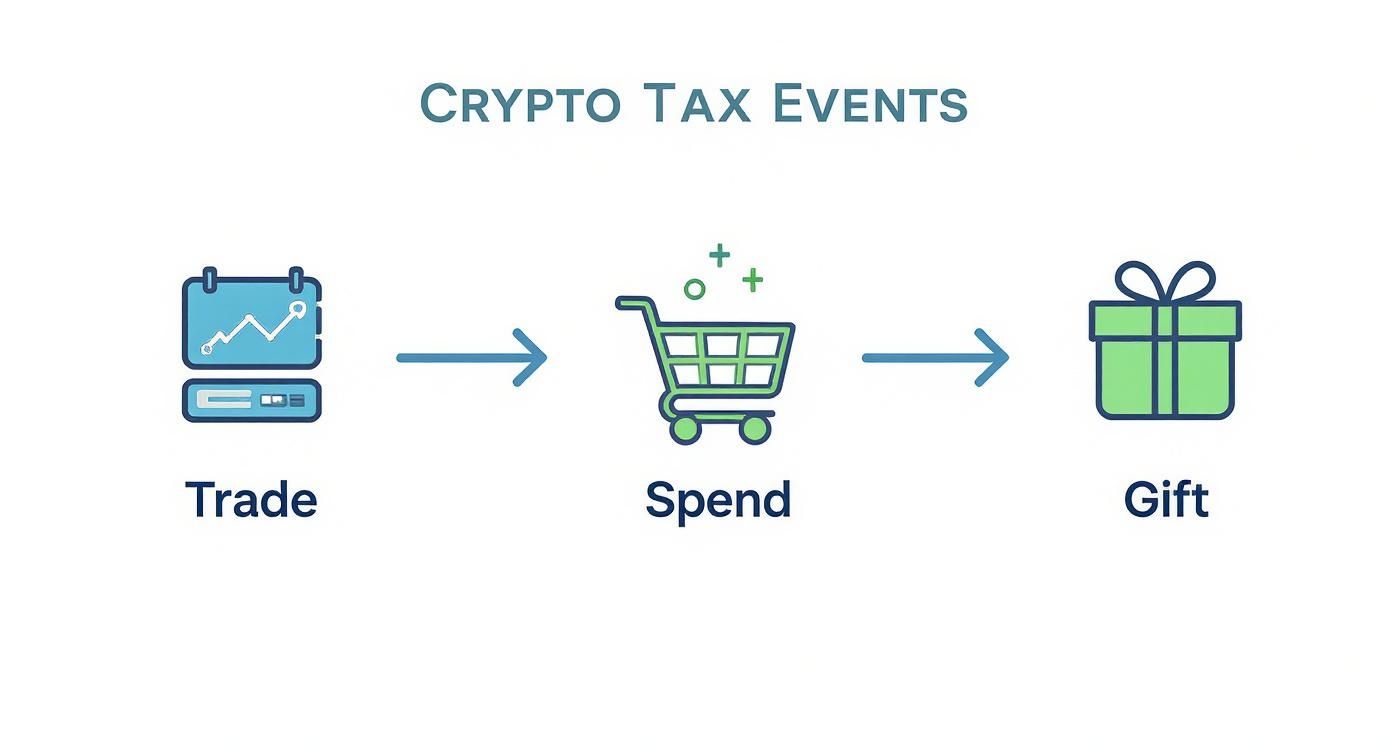
Whether you're swapping, spending, or gifting, the ATO views it as a disposal, meaning you must calculate your gain or loss.
Let's dive into the numbers with some practical examples.
Example 1: The Simple Buy and Sell
This is the most straightforward transaction. You buy some crypto, hold it for a period, and then sell it back into Australian dollars.
Because the asset is held for less than 12 months, the 50% Capital Gains Tax (CGT) discount does not apply.
- Purchase: Chloe buys $4,000 worth of Ethereum (ETH) on 1 October 2023. This amount is her cost base.
- Sale: She sells all her ETH for $6,500 on 15 June 2024.
- Calculation: $6,500 (Capital Proceeds) – $4,000 (Cost Base) = $2,500 Capital Gain.
Chloe must report a $2,500 capital gain on her tax return. This amount is added to her other income for the year (like her salary) and is taxed at her marginal rate.
Example 2: The CGT Discount in Action
Now, let's see what happens when Chloe plays the long game. This is where holding an asset for more than a year can make a substantial difference to your tax bill.
- Purchase: Same as before, Chloe buys $4,000 of ETH on 1 October 2023.
- Sale: This time, she waits and sells her ETH for $6,500 on 15 November 2024—more than 12 months later.
- Calculation: Her gross gain is still $2,500 ($6,500 – $4,000).
- Discount: Because she held the ETH for over a year, she can apply the 50% discount.
- Net Taxable Gain: $2,500 x 50% = $1,250.
By holding on for a few extra months, Chloe has legally cut her taxable gain from $2,500 down to $1,250. This demonstrates why tracking your purchase dates is absolutely crucial for effective tax management.
Example 3: The Crypto-to-Crypto Trade
This scenario trips up many investors. Trading one cryptocurrency for another is a CGT event, even though no Australian dollars were involved. You must determine the AUD market value at the exact moment of the trade.
- Acquisition: Ben buys $3,000 worth of Bitcoin (BTC) on 5 May 2024.
- Trade: On 20 June 2024, his BTC is now worth $5,000. He decides to swap it all for Solana (SOL).
- The CGT Event: The moment he trades, he has "disposed" of his Bitcoin.
- Capital Gain on BTC: $5,000 (Market Value) – $3,000 (Cost Base) = $2,000 Capital Gain.
Ben has a taxable gain of $2,000 on his Bitcoin, which he must report. Crucially, his cost base for the new Solana he just acquired is now $5,000—the market value at the time of acquisition. Tracking this is vital for when he eventually sells his SOL.
To put these common situations side-by-side, here’s a quick comparison table.
Crypto CGT Calculation Scenarios
| Scenario Detail | Cost Base (AUD) | Capital Proceeds (AUD) | Gross Capital Gain (AUD) | Applicable CGT Discount | Net Taxable Gain (AUD) |
|---|---|---|---|---|---|
| Simple Sale (Short-Term) | $4,000 | $6,500 | $2,500 | 0% | $2,500 |
| Simple Sale (Long-Term) | $4,000 | $6,500 | $2,500 | 50% | $1,250 |
| Crypto-to-Crypto Trade | $3,000 | $5,000 | $2,000 | 0% | $2,000 |
As you can see, the holding period and the type of transaction completely change the final tax outcome.
Attempting to calculate these figures across hundreds or thousands of trades is a monumental task. That’s why many savvy Australian investors use a purpose-built crypto tax calculator for Australia to automate the process and ensure every detail is accurate.
What About Tax on Staking, Airdrops and DeFi Rewards?
The world of crypto tax extends far beyond just buying and selling. If you are earning rewards from activities like staking, receiving airdrops, or participating in Decentralised Finance (DeFi), you are generating income that the Australian Taxation Office (ATO) treats very differently from capital gains.
Unlike the profit from a simple trade, these earnings are typically classified as ordinary income. This means you must declare them on your tax return and pay tax at your usual marginal rate, just as you would on a salary. Understanding this distinction is vital for maintaining compliance with the ATO.
Staking and DeFi Rewards Are Treated as Income
When you stake your crypto or provide liquidity to a DeFi protocol, any rewards you receive are considered income. The critical taxable moment is when you gain control over those new coins or tokens.
You must determine the fair market value of those rewards in Australian dollars (AUD) at the exact moment they are received into your wallet. That AUD figure is the amount you must declare as income.
The ATO is clear: if you earn crypto for services like staking, the monetary value of that crypto is ordinary income. According to the ATO's guidance, this value also becomes the asset's initial cost base for any future CGT calculations.
This concept of establishing a "cost base" is crucial. The income you declare becomes the purchase price for that asset. When you eventually sell or trade those reward tokens, you will use this value to calculate your capital gain or loss.
Let's look at a practical example of staking rewards.
- Scenario: You stake Cardano (ADA) and receive 100 ADA as a reward. On the day of receipt, the price of ADA is $0.65.
- Income Calculation: You must declare $65 (100 ADA x $0.65) as ordinary income on that year's tax return.
- Cost Base: The cost base for that specific parcel of 100 ADA is now set at $65. If you sell them later for $100, you will have a separate capital gain of $35 to report.
This two-step process—declaring income now and calculating CGT later—is fundamental to managing your crypto tax obligations correctly.
How Airdrops Are Taxed
Airdrops, where you receive free tokens from a project, generally follow the same principle. They are usually treated as income, with the AUD market value at the time of receipt being the amount you must report.
However, the specifics can become complex. For example, if you receive tokens from an 'initial allocation' during a blockchain fork without taking any action to earn them, the ATO may determine the cost base is zero. You can explore more detailed scenarios on the ATO's official guidance for transacting with cryptocurrency.
With the sheer complexity and variety of DeFi protocols and airdrop campaigns, maintaining meticulous records is non-negotiable. You must log the date, amount, and AUD value for every single reward you receive.
Staking, yield farming, and airdrops can be excellent ways to grow your portfolio, but they add a significant layer of complexity to your tax return.
Struggling to track your staking rewards or DeFi income? Don't leave it to chance. Book a consultation with EndureGo Tax today and let our crypto tax specialists handle the details for you.
Your Guide to Flawless Crypto Record Keeping
Let's be direct: accurate crypto tax reporting is impossible without meticulous record keeping. It is not just a recommendation; it is a legal requirement. The Australian Taxation Office (ATO) requires you to keep detailed records of every crypto transaction for at least five years after you lodge your tax return.
Think of your records as the evidence you would present to the ATO in an audit. These documents are your first and only line of defence. Without them, you cannot prove your cost base, substantiate your capital gains or losses, or validate your declared income.
This is not something to take lightly. The ATO has significantly increased its crypto compliance activities, compelling Australian exchanges to provide extensive user data. They are receiving transaction histories, wallet addresses, and account details, and using this information to data-match against tax returns to identify non-compliance.
What You Must Record for Every Transaction
To remain compliant with the ATO, every transaction requires a detailed entry. A vague memory or a simple note is insufficient.
Here is what you must log for each and every transaction:
- The date and time it occurred.
- The type of cryptocurrency (e.g., Bitcoin, Ethereum, Solana).
- The value in Australian dollars (AUD) at the exact moment of the transaction.
- The purpose of the transaction (e.g., swapping BTC for ETH, selling for AUD, buying an NFT).
- Details of the other party, which may be their public wallet address.
The core principle is evidence. Your records must be robust enough to substantiate every figure on your tax return. The ATO operates on proof, not trust.
Choosing Your Record-Keeping Method
Your method for tracking this information should align with your activity level. A casual investor who buys Bitcoin twice a year has different needs than a high-frequency trader engaging with multiple DeFi protocols.
There are two primary approaches.
1. The Spreadsheet Method
For someone with only a handful of crypto transactions annually, a simple spreadsheet can suffice. You can create columns for each piece of information listed above and manually enter the details after every trade.
While it's a no-cost solution, it is highly susceptible to human error. As your trading volume increases, this method quickly becomes unmanageable and overwhelming.
2. Dedicated Crypto Tax Software
If you are an active trader or involved in DeFi, staking, or NFTs, manual tracking is not a viable option. Specialist software becomes essential.
For anyone serious about accuracy and efficiency, exploring dedicated crypto tax software is a game-changer. These platforms connect directly to your exchange accounts and wallets via APIs, automatically importing transaction data. They then calculate your capital gains, losses, and income, generating tax reports ready for your accountant.
Ultimately, the best method is the one you will consistently use. Establish these habits now to prevent future complications and make your crypto tax obligations far less stressful.
If managing these records seems daunting, you don't have to do it alone. Book a consultation with EndureGo Tax, and let our specialists ensure your records are compliant and audit-proof.
When to Call in a Crypto Tax Professional
Let’s be honest, DIY tax software and spreadsheets are effective for straightforward situations. But crypto is rarely straightforward. At a certain point, the complexity increases to where engaging an expert can save you significant time, stress, and money.
Think of it as an investment in accuracy, compliance, and ensuring you are not overpaying the ATO.
Many investors reach a point where standard tax advice is inadequate. If any of the following situations resonate with you, it's a strong indicator that specialist advice is not just a luxury—it's a necessity.
Signs You Need an Expert
Navigating the grey areas of Australian crypto tax law is challenging. A specialist provides clarity where the rules are ambiguous and can help structure your activities for the most favourable tax outcome.
It’s likely time to seek professional advice if you are dealing with any of these:
- High-Volume Trading: With hundreds or thousands of transactions across multiple exchanges and wallets, the risk of error skyrockets. An expert utilises advanced tools and processes to ensure every transaction is categorised and calculated correctly.
- Complex DeFi Interactions: If you’re involved in liquidity pools, yield farming, lending, or borrowing, you are creating a series of complex tax events. A professional understands the specific tax treatment for these activities.
- Lost or Stolen Funds: Claiming a capital loss for hacked or stolen crypto is not as simple as writing it off. You need robust evidence and a correctly structured claim, which an expert can help you prepare.
- Running a Crypto Business: If your activities have transitioned from investing to operating a business, the tax rules change completely. A specialist will help you understand your obligations for income tax, GST, and allowable deductions.
The ATO makes a critical distinction between an investor and a trader, which impacts everything from your tax rates to record-keeping duties. Misclassification can be a costly mistake. A professional ensures you are categorised correctly from the outset.
Ultimately, a crypto tax professional provides peace of mind. You gain confidence that your reporting is accurate, compliant, and optimised to legally minimise your tax liability. It is the most effective way to avoid the pitfalls that could trigger a stressful ATO audit. For a deeper dive, you can learn more about how to deal with cryptocurrency tax effectively in our detailed guide.
If you feel even slightly uncertain about your crypto tax obligations, our advice is simple: don’t guess. Take action now and book a consultation with EndureGo Tax to gain the clarity and confidence you need.
Common Questions About Australian Crypto Tax
Even when you have a good grasp of the rules, crypto tax can present unique challenges. Let's address some of the most frequent questions we receive from Australian investors to resolve any remaining confusion.
What Happens If I Make a Capital Loss on My Crypto?
Incurring a loss on a crypto investment is disappointing, but it has a specific purpose from a tax perspective. While you cannot use that loss to reduce your regular taxable income (such as your salary), it remains highly valuable.
You must first use a capital loss to offset any capital gains made in the same financial year. This is not limited to crypto—it can offset gains from other assets, like shares. If your total losses for the year exceed your gains, you can carry forward the net capital loss indefinitely. It will be available to reduce capital gains in future years. It is essential to keep perfect records of these losses.
Do I Have to Pay Tax If I Just Buy and Hold Crypto?
No, you do not. The simple act of buying crypto with Australian dollars and holding it—known as 'HODLing'—is not a taxable event. The Australian Taxation Office (ATO) only requires a calculation when you ‘dispose’ of that asset.
A tax obligation is only triggered when you sell your crypto for cash, swap it for another coin, use it to purchase goods or services, or gift it to someone. Until one of these disposals occurs, any unrealised 'paper' gains are not subject to tax.
Is Using a Crypto Debit Card a Taxable Event?
Yes, absolutely. This is a significant pitfall that catches many people by surprise. Every single purchase you make with a crypto debit card constitutes a disposal of your cryptocurrency.
This means each coffee, grocery purchase, or online order is a separate Capital Gains Tax (CGT) event. For every transaction, you are technically required to calculate the capital gain or loss on the small fraction of crypto you just spent.
What If I Lost the Records for My Early Crypto Purchases?
Losing your early transaction records places you in a difficult position. The ATO expects you to make a genuine and reasonable effort to reconstruct them. You can start by attempting to download old transaction histories from the exchanges you used or by searching blockchain explorers if you have the relevant wallet addresses.
If those records are irrevocably lost, you may need to estimate your cost base using the best available data. Be aware, this is a high-risk strategy that can attract ATO scrutiny. This complexity is a key reason why many investors seek professional assistance, particularly with the ATO's new cryptocurrency audit processes intensifying.
Navigating the maze of crypto tax can be a headache, but you don't have to figure it all out alone. At EndureGo Tax, our specialists are here to give you the clarity and expert guidance you need to stay compliant and tax-efficient. Book your consultation today at https://www.endurego.com.au.
