


In Australia, the Australian Taxation Office (ATO) does not classify cryptocurrency as money. Instead, it is treated as property, akin to shares or real estate. This fundamental distinction is critical, as it means nearly every transaction you undertake can trigger a tax event.
Selling Bitcoin for Australian dollars? That’s a taxable event. Swapping Ethereum for an NFT? That is also a taxable event. Understanding the local crypto tax Australia regulations is not merely advisable—it is an essential requirement for every investor.
Your Essential Guide to Australian Crypto Tax
Navigating crypto tax in Australia can feel overwhelmingly complex. The Australian Taxation Office (ATO) has established a clear position: cryptocurrency is an asset. Consequently, just like profits from shares or an investment property, any gain you realise is subject to tax. This guide is your strategic roadmap, designed for investors, not tax agents.
We will deconstruct the two primary ways your crypto is taxed in Australia:
- Capital Gains Tax (CGT): This is the most common tax implication for investors. CGT applies whenever you sell, swap, gift, or spend your crypto. The significant advantage? If you hold an asset for more than 12 months, you may be eligible for a 50% discount on the taxable gain.
- Ordinary Income: This applies when you earn crypto. This includes activities such as staking rewards, mining income, airdrops, or being remunerated for services in crypto. This income is taxed at your standard marginal tax rate, which is identical to the tax rate applied to a salary.
Why This Matters More Than Ever
The era of crypto transactions operating in obscurity is over. The ATO now employs sophisticated data-matching technology to obtain detailed information directly from Australian crypto exchanges. They possess comprehensive data on who is trading and the volumes involved, making accurate reporting entirely non-negotiable.
The ATO views cryptocurrency as a form of property. This means its disposal is treated as a Capital Gains Tax (CGT) event under the Income Tax Assessment Act 1997. This principle is the bedrock of all crypto tax obligations in Australia.
Let’s examine a practical example. Suppose you purchased 1 ETH for $2,000 AUD. A few months later, you swapped it for Cardano (ADA) at a time when that ETH was valued at $3,000 AUD. Despite not converting to Australian dollars, you have triggered a CGT event and realised a $1,000 capital gain which must be reported.
This guide will equip you with the expertise to manage your tax obligations with confidence. While we focus on Australian rules, a comprehensive guide on navigating crypto trading and taxes can also provide a solid foundation for anyone in the crypto space.
Understanding these rules is not just about compliance; it is about strategic investing. By grasping the fundamentals, you can make informed decisions that legally minimise your tax liability and protect your hard-earned gains. If you feel overwhelmed, do not resort to guesswork. Secure your financial position by contacting a crypto tax professional to ensure your records are immaculate and you are leveraging every available tax strategy.
Capital Gains Tax (CGT): The Core of Australian Crypto Tax
For most Australians involved in the crypto market, this is where tax obligations become tangible. Nearly every action you take with your crypto—beyond simply acquiring and holding it—can trigger what the Australian Taxation Office (ATO) defines as a Capital Gains Tax (CGT) event.
While the term sounds technical, the concept is straightforward: a CGT event occurs whenever you ‘dispose’ of a crypto asset. This is a common pitfall for new investors who fail to realise that ‘disposing’ encompasses more than just cashing out to Australian dollars.
It occurs when you trade one coin for another, use Bitcoin to purchase goods, or gift crypto to a friend. Each of these actions is a taxable event requiring you to calculate whether you have made a capital gain or a capital loss.
The Most Common CGT Triggers
What precisely constitutes a ‘disposal’? Understanding this is the first and most critical step towards maintaining compliance. The definition is broader than many assume.
Here are the everyday scenarios that will trigger a CGT event:
- Selling Crypto for Fiat Currency: The most obvious trigger. When you sell Bitcoin (BTC) for Australian dollars (AUD), you have disposed of your asset.
- Swapping One Crypto for Another: Traded Ethereum (ETH) for Solana (SOL)? The ATO views this as a disposal of your ETH. You must calculate the gain or loss on your ETH at that exact moment.
- Using Crypto for Goods or Services: That coffee you bought with crypto? That’s a CGT event. You have disposed of your crypto in exchange for an item.
- Gifting Crypto to Someone Else: Generosity has tax implications. Giving crypto to a family member is also a disposal. You must use the market value of the crypto at the time of the gift to calculate your capital gain.
The ATO states clearly: “When you dispose of your cryptocurrency, you will make a capital gain or capital loss. This is the difference between what it cost you to get the cryptocurrency and what you receive when you dispose of it.” This is a foundational principle of the Income Tax Assessment Act 1997.
This table clarifies which activities are typically taxable CGT events, helping you track your obligations.
Common Crypto CGT Events vs Non-Taxable Activities
| Activity | Is it a Taxable CGT Event? | ATO Rationale |
|---|---|---|
| Selling crypto for AUD | Yes | You have disposed of the asset in exchange for fiat currency. |
| Swapping crypto for another crypto | Yes | You have disposed of one asset to acquire another. |
| Using crypto to buy things | Yes | The crypto is used as a form of payment, constituting a disposal. |
| Gifting crypto to someone | Yes | A change of ownership is a disposal, valued at market price. |
| Buying crypto with AUD | No | This is an acquisition, not a disposal. It establishes your cost base. |
| Holding crypto (‘HODLing’) | No | No disposal has occurred, so there is no CGT event to report. |
| Moving crypto between your own wallets | No | You still maintain beneficial ownership; the asset has not been disposed of. |
Understanding these distinctions is crucial. Simply acquiring and holding, or transferring coins between your own wallets, does not create a tax liability. It is the moment you sell, swap, spend, or gift it that the ATO requires a report.
Calculating Your Capital Gain or Loss
To determine your tax, you first need to establish your ‘cost base’. This is not merely the purchase price of the crypto; it includes any ancillary costs incurred during acquisition, such as exchange or brokerage fees.
Your capital gain or loss is the difference between your capital proceeds (what you received for it) and the total cost base.
Let’s walk through a practical example:
Suppose you purchased 0.5 BTC for $20,000 AUD and paid $100 in exchange fees. Your cost base is $20,100.
Eighteen months later, you sell it for $35,000 AUD.
The calculation is as follows:
$35,000 (Capital Proceeds) – $20,100 (Cost Base) = $14,900 (Capital Gain)
Because you held the Bitcoin for over 12 months, you are eligible for the 50% CGT discount. For long-term investors, this is a significant strategic advantage.
The Power of the 50% CGT Discount
One of the most effective strategies for legally reducing your crypto tax liability in Australia is utilising the 50% CGT discount. It serves as a powerful incentive for long-term investing.
If you hold a crypto asset for more than 12 months before disposing of it, you are only required to report half of the capital gain on your tax return.
Using our previous example:
Your total capital gain was $14,900.
With the 50% discount, your taxable capital gain is reduced to just $7,450.
This reduced amount is added to your other assessable income for the year (such as your salary) and taxed at your marginal rate.
Of course, CGT calculations can become complex, especially with numerous trades. For a more detailed breakdown, review our complete guide on how to calculate capital gains tax.
Mastering CGT is the cornerstone of effective crypto tax management. If you are uncertain about treating a specific transaction or applying the discount, do not leave it to chance. Book a strategy call with our crypto tax experts to ensure compliance and leverage every available financial advantage.
When Your Crypto is Taxed as Regular Income
While Capital Gains Tax (CGT) dominates discussions, it represents only one facet of crypto tax in Australia. Many common crypto activities are not considered investing by the Australian Taxation Office (ATO) at all—they are classified as earning ordinary income.
When this occurs, the crypto you receive is taxed at your personal income tax rate, identical to your employment salary. This is a critical distinction. Unlike a capital gain, there is no 50% discount for holding the asset for over a year. It is treated as income at the moment it is received. Understanding these scenarios is key to avoiding an adverse tax outcome.
This flowchart helps visualise the initial critical question: did you dispose of your crypto, triggering a potential CGT event, or are you simply holding it?
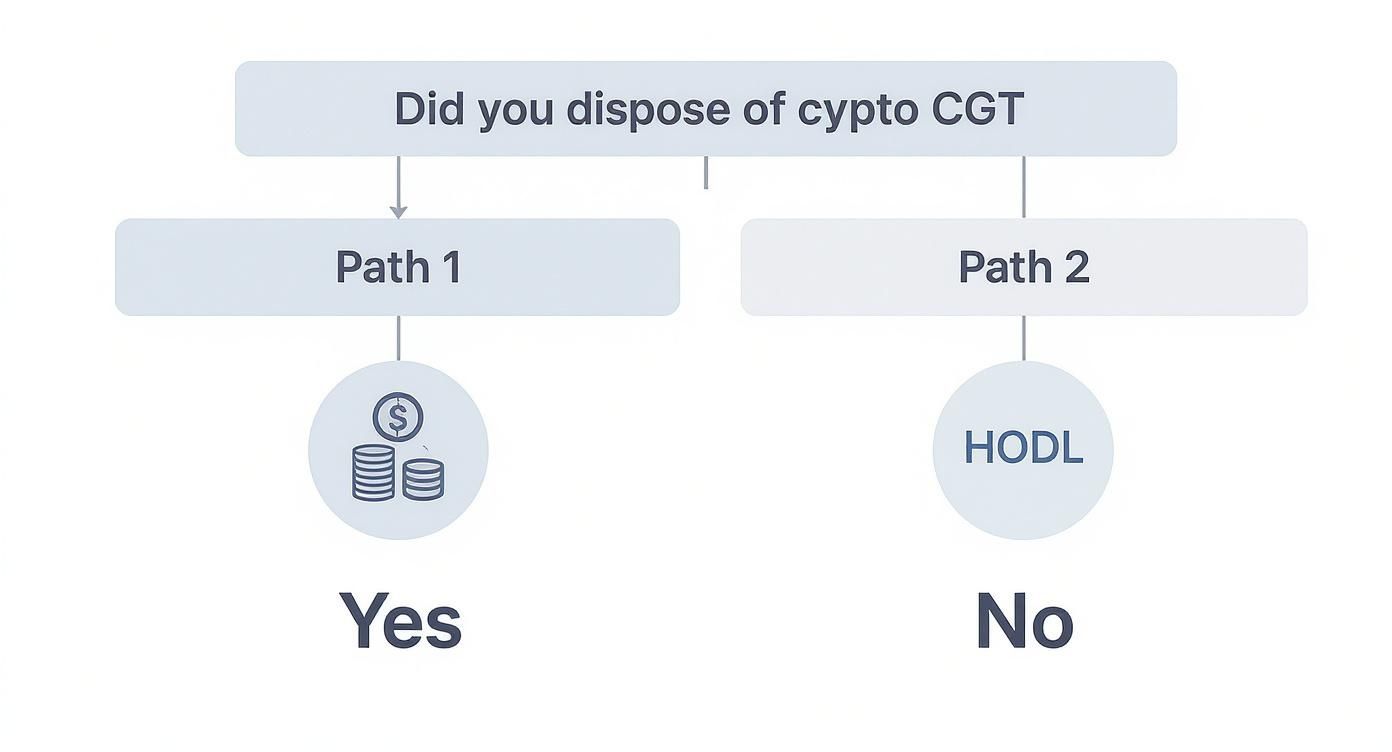
The flowchart is an excellent starting point for CGT, but it is vital to remember that earning crypto creates a separate income tax liability long before any disposal occurs.
Common Crypto Income Scenarios
Several popular activities in the crypto space fall squarely under the “ordinary income” classification. If you engage in any of these, the ATO requires you to declare the Australian dollar value of the crypto as income on your tax return.
Consider it analogous to earning interest in a bank account. That interest is income, and the same principle applies here.
- Staking Rewards: When you stake coins to validate transactions, any rewards received are income at the time they are paid to you.
- Airdrops: Receiving free tokens from an airdrop? This is considered income based on their market value when they arrive in your wallet.
- DeFi Lending and Interest: Any interest earned by lending your crypto on a decentralised finance (DeFi) platform is treated as income.
- Crypto Mining: If you mine crypto as a hobby, the value of the coins successfully mined is ordinary income.
Practical Example: Staking Rewards
Suppose you stake ETH and receive 0.1 ETH in rewards. On the day of receipt, the market value of that 0.1 ETH is $300 AUD. You are required to declare $300 as ordinary income on your tax return for that financial year.
Getting Paid in Crypto
An increasing number of businesses and freelancers are accepting payments in cryptocurrency. On this matter, the ATO’s position is unequivocal: being paid in crypto is no different from being paid in Australian dollars. You must record the AUD value of the cryptocurrency at the time of receipt and declare this amount as income.
According to the ATO, “If you receive cryptocurrency for goods or services you provide as part of a business, you need to include the value of the cryptocurrency as part of your ordinary income.” You can find detailed official guidance on transacting with cryptocurrency.
This income also establishes a new ‘cost base’ for that crypto. If you later sell or trade it for a higher value, you will have a capital gain to report in addition to the income already declared.
Investor vs Trader: Are You Running a Business?
This is the final, crucial distinction: are you a casual investor or are you operating a crypto trading business? To determine this, the ATO assesses factors like the volume and frequency of your trades, the existence of a business plan, and whether your activities are organised in a business-like manner.
If you are deemed to be running a business, your profits are treated as business income, not capital gains. This means you lose access to the 50% CGT discount, but conversely, you may be able to claim business-related expenses.
This difference can have a significant impact on your final tax liability. If you trade frequently and are unsure of your classification, it is imperative to seek professional advice. Misclassifying your activities can lead to serious compliance issues.
Uncertain whether your crypto activity constitutes income or a capital gain? The regulations can be complex. Book a consultation with our crypto tax specialists to ensure you are reporting correctly and maintaining compliance with the ATO.
Mastering Your Crypto Record-Keeping for the ATO
When dealing with crypto tax in Australia, accurate records are not just advisable; they are your primary compliance tool. The Australian Taxation Office (ATO) places the burden of proof firmly on the taxpayer, making meticulous record-keeping essential.
Without a clear transaction history, calculating your capital gains, losses, or income is an exercise in futility. The ATO expects this information to be readily available, and an inability to produce it during an audit can result in significant penalties.
What the ATO Expects You to Record
For every single transaction, the ATO requires a detailed log. This extends beyond simple buys and sells to include crypto-to-crypto swaps, staking rewards, airdrops, and even minor purchases. Your records must provide a complete narrative of your crypto activities.
For each transaction, you need to document:
- The date of the transaction.
- The value in Australian dollars (AUD) at the time of the transaction.
- The purpose of the transaction (e.g., investment, personal use).
- Details of the other party, even if it is only a wallet address.
This level of detail is non-negotiable and forms the foundation of your entire crypto tax calculation.
Choosing Your Accounting Method
When you sell crypto acquired at different times and prices, you need a consistent method to determine the cost base of the specific coins sold. The most common method accepted by the ATO is First-In, First-Out (FIFO).
FIFO assumes that the first coins you acquired are the first ones you dispose of.
Here’s a practical example:
Imagine you bought Bitcoin on two separate occasions:
- In January, you bought 1 BTC for $30,000.
- In June, you bought another 1 BTC for $50,000.
In November, you sell 1 BTC for $60,000. Using the FIFO method, the ATO assumes you sold the Bitcoin purchased in January.
- Capital Proceeds: $60,000
- Cost Base: $30,000
- Capital Gain: $30,000
Adhering to a consistent accounting method is crucial for accurate calculations year after year. For a deeper understanding of general business obligations, our guide on record-keeping requirements in Australia is an excellent resource.
The Power of Crypto Tax Software
While you could attempt to track transactions in a spreadsheet, this quickly becomes an administrative burden for anyone with more than a handful of trades. This is where specialised crypto tax software becomes indispensable.
These platforms integrate directly with your exchanges and wallets via APIs, automatically importing and categorising every transaction. They perform the necessary calculations, determining gains and losses using your chosen method and generating detailed reports ready for your accountant or tax return. This software saves countless hours and significantly reduces the risk of human error.
The ATO’s scrutiny is intensifying. Since 2019, they have been collecting bulk records from Australian crypto exchanges, including transaction histories, wallet addresses, and personal details. They then employ sophisticated data-matching technology to identify reporting discrepancies.
Meticulous records are your most effective tool for compliance and peace of mind. If you are struggling to get organised, do not wait for a notice from the ATO. Book a consultation with our expert crypto accountants today, and let us build an ATO-proof system that protects your assets and ensures you pay precisely the correct amount of tax.
How To Report Crypto on Your Australian Tax Return
Understanding the rules is one thing, but accurately reporting on your tax return is the final, critical step. This is where your diligent record-keeping pays dividends, translating theory into a confidently lodged return. Let’s outline the exact process for reporting your crypto activities to fulfill your crypto tax Australia obligations.
We will identify precisely where your crypto gains, losses, and income are declared on the tax return, aiming to eliminate the anxiety of tax time.

Declaring Capital Gains and Losses
For most Australian investors, crypto trades are treated as Capital Gains Tax (CGT) events. When lodging your return via myTax or with a tax agent, you must report your net capital gain or loss for the financial year.
This figure is the sum of all your capital gains for the year, less the sum of all your capital losses.
In the “Capital gains or losses” section of your tax return, you will need to provide two key figures:
- Total current year capital gains: This is the gross amount—the sum of all profits from disposing of your crypto before applying any discounts or offsetting losses.
- Net capital gain: This is the critical figure. It is the amount remaining after subtracting capital losses and applying the 50% CGT discount (for assets held over 12 months). This final amount is added to your assessable income.
Reporting Crypto as Income
If you earned crypto from staking, mining, airdrops, or as payment for services, the ATO views this as ordinary income, akin to a salary.
You must declare the Australian dollar value of the crypto at the moment you received it. This is reported under the “Other income” section of your tax return. It is best practice to add a clear description, such as “Cryptocurrency staking rewards,” and enter the total AUD value earned.
The ATO is explicit: “you must keep records of all your crypto asset transactions.” This is a mandatory requirement, not a suggestion. These records form the evidentiary basis of your tax return, substantiating every figure you declare.
Using Capital Losses to Your Advantage
Capital losses are a valuable tool for strategic tax management. A capital loss occurs when you dispose of a crypto asset for less than its cost base.
You can use these losses to offset capital gains realised in the same financial year.
Practical example: Imagine you realised a $5,000 capital gain from selling Bitcoin. However, you also incurred a $2,000 capital loss on an altcoin investment. You can use that loss to reduce your taxable capital gain to $3,000.
If your losses exceed your gains, you have a ‘net capital loss’. While this cannot be used to reduce your other income (like your salary), you can carry it forward indefinitely to offset capital gains in future financial years.
Your Actionable Steps for Lodgement
Ready to lodge? Follow this simple checklist:
- Finalise Your Records: Ensure every transaction for the financial year is logged and correctly categorised.
- Calculate Your Totals: Sum your total capital gains, losses, and any crypto-related income. A reliable crypto tax calculator for Australia can automate this step.
- Report the Figures: Enter the final numbers into the correct sections of your tax return—Capital Gains and Other Income.
- Lodge with Confidence: Submit your return, knowing it is accurate and substantiated by comprehensive records.
To streamline this process and enhance accuracy, consider specialised software. You can compare crypto tax software options to find a solution that suits your trading volume and style.
If you feel out of your depth, the most prudent course of action is to seek expert assistance. Book a consultation with our crypto tax experts to ensure your lodgement is accurate and fully compliant with ATO requirements.
Your Australian Crypto Tax Questions Answered
When it comes to crypto tax in Australia, it often feels like you’re left with more questions than answers. The rules can seem baffling, especially when you run into tricky situations like scams, NFTs, or the rare chance of an exemption.
This final section cuts through the noise. We’re tackling some of the most common and pressing queries to give you the clarity you need to stay on the right side of the ATO.
What Happens If I Don’t Declare My Crypto to the ATO?
Let’s be direct: ignoring your crypto tax obligations is a high-risk strategy. The Australian Taxation Office is not operating in the dark. It employs powerful data-matching programs to obtain information directly from Australian crypto exchanges, financial institutions, and international tax bodies to identify non-compliance.
If caught, the penalties can be severe, ranging from a percentage of the tax shortfall to more serious actions for deliberate tax evasion.
The best course of action is always proactive compliance. If you have made a past error, voluntarily disclosing it and amending your previous tax returns is the recommended approach. The ATO generally applies significantly lower penalties for voluntary disclosures compared to discoveries made during an audit.
Are NFTs Taxed the Same Way as Cryptocurrencies in Australia?
Yes, for the most part, the ATO treats Non-Fungible Tokens (NFTs) identically to other crypto assets for Capital Gains Tax (CGT) purposes. This means that when you sell, trade, swap, or gift an NFT, you will likely trigger a CGT event.
The calculation of your gain or loss is straightforward: it is the difference between the NFT’s cost base (what it cost you to acquire) and the capital proceeds (what you received upon disposal).
Practical Example: Selling an NFT
Suppose you minted an NFT for 0.1 ETH, which was worth $300 AUD at the time. A few months later, the project gains traction, and you sell the NFT for 1 ETH, now valued at $3,000 AUD. You have realised a capital gain of $2,700, which must be reported on your tax return.
The primary exception is if you are creating and selling NFTs as a business, in which case the proceeds are treated as ordinary income. Given the unique nature of NFTs, maintaining meticulous records is just as crucial as it is for fungible tokens like Bitcoin.
How Is a Loss From a Crypto Scam or Hack Treated for Tax Purposes?
This is a highly complex area. If your crypto is stolen in a verified scam or hack, you may be able to claim a capital loss. The operative word here is “may.”
The burden of proof rests entirely on you, and the evidentiary threshold is high.
You will need to provide the ATO with substantial evidence that your crypto is permanently and irretrievably lost. This could include:
- A formal police report detailing the incident.
- All correspondence with the relevant exchange or wallet provider.
- Blockchain transaction records that unequivocally show the theft.
The ATO assesses these claims on a strict, case-by-case basis. You cannot claim a loss for misplacing your private keys or losing a seed phrase. In the ATO’s view, the asset is not ‘disposed of’ in such cases—it is merely inaccessible. For the official position, you can review the ATO’s guidance on lost or stolen crypto.
Can I Use the Personal Use Asset Exemption for My Crypto?
It is extremely unlikely. The ‘personal use asset’ exemption is defined very narrowly and rarely applies to cryptocurrency in Australia.
To qualify, you would need to prove that you acquired the crypto with the sole, direct intention of using it to purchase a specific item for personal use—and that you did so almost immediately.
If you hold a cryptocurrency for even a brief period with any expectation that its value might increase, it is treated as an investment, and the exemption is voided. Given the inherently volatile and investment-driven nature of assets like Bitcoin and Ethereum, the ATO is virtually certain to reject a personal use claim.
Navigating the complexities of crypto tax can be a significant challenge. At EndureGo Tax, we specialise in assisting individuals and businesses in Ashfield and the Northern Beaches to manage their crypto tax obligations with expertise and confidence. Do not leave your financial standing to chance.
Book a consultation with our expert crypto accountants today and gain the peace of mind that comes from knowing your crypto reporting is accurate and fully ATO-compliant.
