


Figuring out the cost of managing tax affairs in Australia is more than just looking at an accountant's invoice. It’s a complex calculation involving professional fees, your own time, and the significant financial risk of non-compliance.
For an individual, this could be anything from a few hundred dollars for a simple tax return to several thousand if you’re juggling complex investment portfolios. Small businesses often invest a whole lot more for ongoing compliance and strategic advice that drives growth and minimises tax liabilities.
Understanding the True Cost of Your Tax Affairs

It’s a common mistake to view tax management as just another business expense. A more accurate perspective is to see it as a strategic investment in your financial integrity and peace of mind.
The real cost of managing tax affairs extends far beyond your tax agent's fees. Consider the hours you spend collating receipts, interpreting complex tax legislation, and navigating online lodgement portals. This "time tax" is a significant administrative burden that diverts your focus from core business activities or personal time.
The Hidden Costs and Risks
Beyond the visible fees, the true cost includes the financial consequences of errors. An incorrect tax return can trigger an Australian Taxation Office (ATO) audit, leading to penalties and interest charges that dwarf any initial savings from DIY attempts.
For instance, a sole trader who incorrectly claims personal travel as a business expense could face penalties of 25% to 75% of the tax shortfall, plus interest. Conversely, failing to claim a legitimate deduction is effectively an overpayment of tax.
This is where the value of expert tax management becomes clear—it's about mitigating these precise risks. It ensures:
- Accuracy: Every claim is substantiated and compliant, drastically reducing the likelihood of an ATO audit.
- Optimisation: Identifying every legal deduction and tax credit to ensure you pay the minimum tax required by law.
- Compliance: Meeting all lodgement deadlines and regulatory requirements to avoid late fees and penalties.
The Value of Professional Guidance
A qualified tax agent is an expert guide through the intricate landscape of Australian tax law. Their fee covers not just data entry, but their deep expertise in interpreting legislation, staying current with tax changes, and providing strategic advice tailored to your financial situation.
For example, a business with significant vehicle usage can incur substantial hidden costs from poor record-keeping. A professional will ensure you're correctly applying principles of understanding tax-efficient mileage tracking, which is a critical component in accurately calculating your tax management expenses and maximising deductions.
Ultimately, the objective is to shift your focus from cost to value. A robust tax strategy safeguards your financial health, ensuring you meet your obligations without overpaying. The fees for managing your tax affairs are generally tax-deductible under section 25-5 of the Income Tax Assessment Act 1997, further enhancing the value of professional services.
Typical Fee Ranges for Australian Tax Services
To provide a clear financial picture, here is a breakdown of typical fees for tax services in Australia. Note that these are estimates; your actual costs will depend on the complexity of your financial affairs.
| Taxpayer Type | Service | Typical Fee Range (AUD) |
|---|---|---|
| Individual (Simple) | Basic Tax Return (PAYG, simple deductions) | $150 – $400 |
| Individual (Complex) | Tax Return (investments, rental property) | $400 – $1,200+ |
| Sole Trader | Annual Tax Return & Financial Statements | $800 – $2,500 |
| Small Business (Company) | Annual Tax Return & Compliance | $1,500 – $5,000+ |
| Business Activity Statement | Quarterly BAS Lodgement | $250 – $750 per lodgement |
| Tax Planning & Advice | Strategic Consultation (per hour) | $200 – $500+ |
The investment scales with complexity. A PAYG earner will have a much lower cost of managing tax affairs than a company with multiple income streams. The key is to find the right level of professional support that delivers value far exceeding its price.
Take the first step towards financial clarity and compliance. Book an expert consultation with EndureGo Tax to secure your peace of mind and optimise your financial outcomes.
Key Factors That Drive Your Tax Management Costs
Ever wondered why a colleague pays just $150 for their tax return while your quote is closer to $500? The answer invariably lies in one word: complexity.
The cost of managing your tax affairs is not a standardised figure. It directly reflects the expertise and time required to ensure your lodgement is accurate and compliant with ATO regulations.
A simple PAYG tax return is analogous to a routine car service—predictable and straightforward. However, a return involving a business, multiple investment properties, and a share portfolio is more akin to a full engine rebuild, demanding specialised knowledge and meticulous attention to detail.
Your Income Sources and Financial Structure
The primary driver of cost is the complexity of your financial structure. Each additional income stream or investment adds layers of preparation time and risk, which is reflected in professional fees.
Key factors that increase complexity and cost include:
- Business or Sole Trader Income: This requires the preparation of financial statements, detailed navigation of business deductions (like home office expenses or asset depreciation), and correct reporting of GST and PAYG withholding.
- Investment Properties: Each property necessitates tracking rental income, managing expenses, calculating depreciation schedules, and considering future capital gains tax implications. For example, claiming repairs versus capital improvements requires expert distinction.
- Share Portfolios and Crypto Assets: Proper management involves meticulous tracking of every transaction to accurately calculate capital gains or losses, often requiring specialist software and knowledge of complex rules like the 30-day wash sale rule.
- Foreign Income: Earning income from overseas introduces complex reporting obligations and potential foreign tax credits, requiring specialist knowledge to ensure compliance and avoid double taxation.
The Quality of Your Record-Keeping
A factor entirely within your control is the quality of your records. Providing your accountant with organised, digital records is vastly different from delivering a shoebox of unsorted receipts.
Disorganised records force your accountant to act as a financial detective, piecing together your financial year. This investigative work is billed by the hour. Every minute spent sorting your paperwork directly increases your final invoice.
Meticulous organisation directly reduces your accounting fees. It allows your accountant to focus on high-value strategic advice rather than administrative data entry.
The Level of Advice You Need
Finally, consider the scope of service you require. Are you seeking basic compliance—simply lodging a form—or do you need proactive tax planning and strategic advisory services?
While basic lodgement is one service level, expert guidance on structuring investments, retirement planning, or legally minimising future tax is a premium service. A qualified professional provides immense value here, helping you make informed decisions that can result in thousands of dollars in long-term savings. Understanding these drivers empowers you to evaluate any quote and understand precisely what your investment covers.
Are your complex finances causing stress? Book a consultation with EndureGo Tax today. Our experts will simplify your tax affairs and provide the strategic clarity you need.
Decoding Tax Agent and Accountant Fee Structures

To make an informed decision, it's crucial to understand how accounting firms structure their fees. This knowledge is the first step in ensuring the cost of managing tax affairs aligns with the value you receive.
Most firms utilise one of several common pricing models. Each has its advantages and disadvantages; understanding them allows you to compare quotes effectively and avoid unexpected costs.
Common Pricing Models Explained
The traditional hourly rate bills you for the exact time your accountant spends on your file. While straightforward, it can be unpredictable—a complex ATO query can cause costs to escalate quickly. Gaining insight into how professionals perform calculating billable hours can provide valuable context.
Fixed-fee packages are increasingly popular for their predictability. You agree on a set price upfront for specific services, such as an annual tax return or quarterly BAS lodgements. This is highly beneficial for budgeting, as it eliminates uncertainty.
Finally, value-based pricing is often used for high-level advisory work. Here, the fee is linked to the outcome and value delivered—for example, the tax savings achieved through strategic business structuring—rather than the hours worked.
Why Fees Are on the Rise
If you've observed rising accountant fees, it reflects significant industry pressures. A recent survey of Australian accounting firms revealed that 80% planned to increase their fees in 2025, with 64% citing their own rising business costs as the primary driver.
The proportion of firms charging over $300 for a standard individual tax return also increased from 16% to 26% in a single year. This trend underscores how the escalating complexity of ATO compliance is driving up the cost of professional tax services nationwide.
This industry-wide shift highlights that you are paying for more than time. You are investing in a professional's expertise to navigate complex regulations and protect you from compliance risks.
Questions to Ask Your Potential Tax Agent
Before engaging an accountant, a transparent discussion about their fees is essential. If you're a business owner, our guide on the typical small business accountant cost can provide additional context.
Arm yourself with these critical questions for complete transparency:
- What is your pricing model? (Hourly, fixed-fee, or value-based?)
- What specific services are included in this quote? (Request a detailed breakdown.)
- What are your charges for out-of-scope services? (e.g., additional phone calls or ATO correspondence.)
- How will you communicate potential extra costs before they are incurred?
- Can we establish a fixed-fee agreement for predictable compliance work?
Securing clear answers to these questions builds trust and ensures the fee structure aligns with your financial needs.
Eliminate billing confusion and financial stress. Contact EndureGo Tax for a transparent, upfront quote and experience the peace of mind that comes with clear pricing.
Comparing DIY Tax Software vs. a Professional Agent
It's a classic tax-time dilemma: save money upfront with DIY software or invest in the expertise of a professional tax agent? The optimal choice depends entirely on your circumstances, as the true cost of managing tax extends far beyond a software subscription or an accountant's invoice.
Let's analyse two practical examples to illustrate the difference.
Meet Sarah the Graduate
Sarah is a recent university graduate in her first full-time PAYG role. Her financial situation is simple, with only a few standard work-from-home and uniform deductions to claim.
For Sarah, DIY tax software is an excellent, cost-effective solution. She can complete her return in a few hours for a software fee under $100. The process is straightforward, her risk of error is low, and the time commitment is minimal. For her, the DIY approach represents strong value.
Meet Tom the Tradie
Now, consider Tom, a sole trader running a carpentry business. His financial affairs are significantly more complex. Tom has multiple income streams, a work ute with various expenses to claim, a small share portfolio, and an apprentice.
If Tom attempts a DIY return, his "cost" balloons. He would likely spend 10-15 hours navigating complex business deductions, calculating capital gains on shares, and meeting his BAS obligations. The risk of missing a key deduction—or making an incorrect claim that attracts ATO attention—is substantially higher.
This image breaks down the typical annual costs for different tax management approaches.
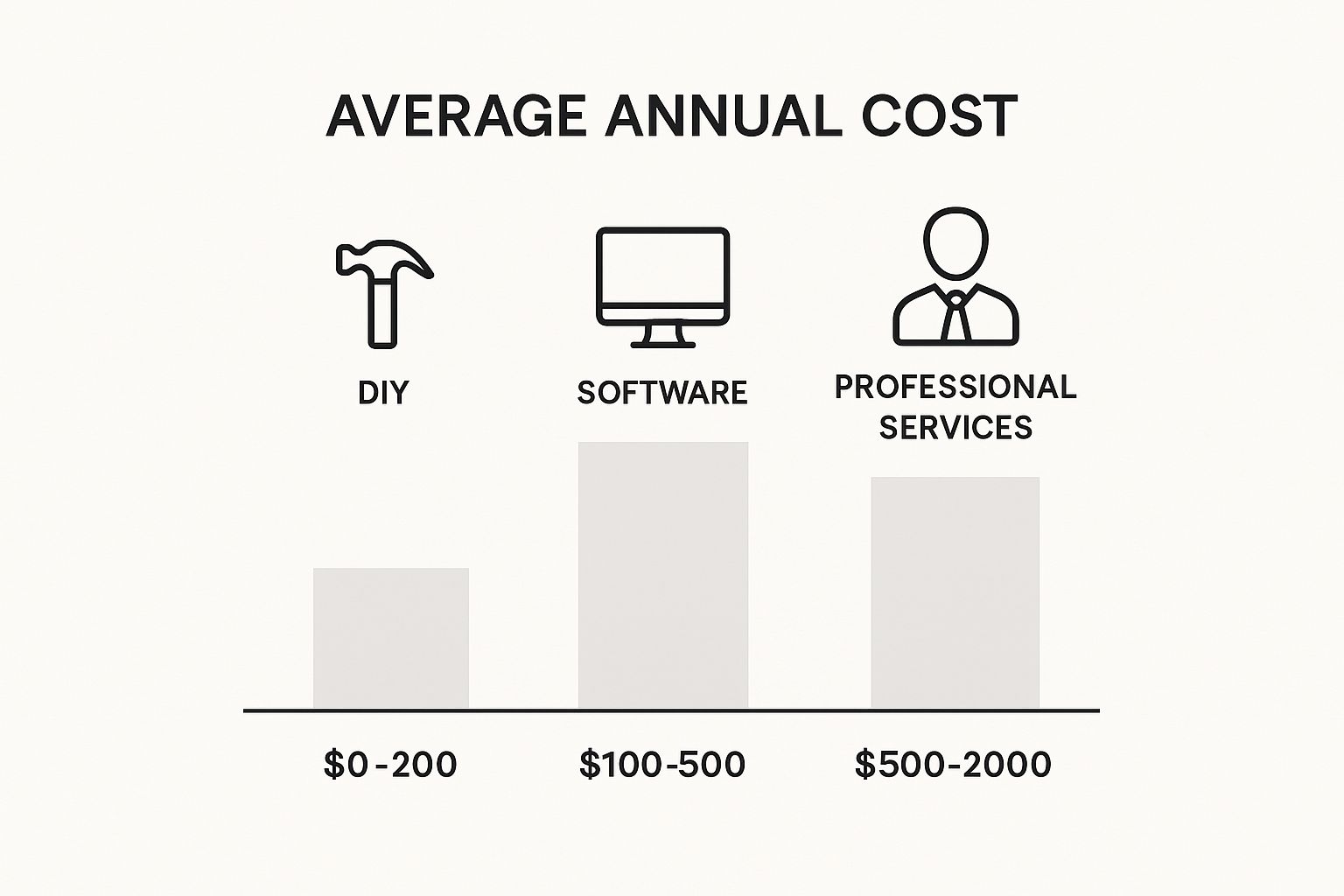
While the upfront professional fee is higher, it significantly reduces hidden costs, such as your time and the risk of an audit.
For Tom, paying a tax agent $800 – $2,500 is an investment, not an expense. The agent manages all complexity, ensures he claims every legal deduction, and frees up Tom's time to focus on his business. Furthermore, the agent's fee is tax-deductible, reducing the net cost.
This table highlights the trade-offs.
Cost-Benefit Analysis: DIY vs. Professional Tax Agent
| Factor | DIY Tax Lodgement | Professional Tax Agent |
|---|---|---|
| Upfront Financial Cost | Low (typically $0 – $150 for software). | Higher (from $150 for simple returns to $2,500+ for complex businesses). |
| Time Investment | High for complex returns (can be 10+ hours). Low for simple returns. | Minimal. Provide documents and answer questions. |
| Accuracy & Audit Risk | Higher risk of errors, missed deductions, or ATO red flags. | Low risk. Agents are current with tax laws and ensure compliance. |
| Tax Refund/Outcome | Potentially smaller refund due to missed deductions. | Maximised refund. An expert identifies all legal claims. |
| Stress & Peace of Mind | Can be stressful due to uncertainty about tax rules. | High peace of mind from expert handling. |
| Expert Advice | None. You must interpret tax law independently. | Access to strategic advice for future tax planning. |
Ultimately, engaging a professional is not just about this year's return; it's about optimising your long-term financial position. This is particularly true when selecting tools like the best accounting software for small business in Australia. The right software simplifies your accountant's work, directly saving you money.
The bottom line: honestly assess your financial complexity. If your situation is simple like Sarah's, DIY software is a smart choice. If it mirrors Tom's complexity, professional expertise is essential for achieving the best outcome and ensuring peace of mind.
How ATO Scrutiny Shapes Your Compliance Costs
If you feel your tax agent requests more documentation each year, you're not mistaken. This is a direct consequence of the Australian Taxation Office's (ATO) intensified scrutiny.
The cost of managing your tax affairs is heavily influenced by the national regulatory environment. When the government tightens its focus on tax compliance, your accountant is on the front line, and their diligence directly impacts your fees. This increased ATO focus, funded by the Federal Budget, equips them with sophisticated data-matching programs and enables more targeted audits, raising the stakes for every taxpayer.
The Ripple Effect of Increased Funding
This heightened surveillance creates a ripple effect that increases compliance costs. The recent budget, for example, allocated an extra AUD 1 billion to the ATO over four years to enhance its compliance activities. This funding is designed to close tax gaps, necessitating greater diligence from everyone.
What does this mean for you and your accountant?
- More Rigorous Checks: Your tax professional must spend additional time verifying every deduction, knowing the ATO's systems are cross-referencing data from employers, banks, and other government agencies.
- Increased Documentation Demands: Expect requests for more detailed records. Your agent is building a defensible case for your claims should the ATO initiate a review.
- Higher Professional Risk: The personal liability for tax agents increases. They must invest more in training and systems to protect both you and their practice.
This is not about arbitrary fee increases. It reflects the high level of due diligence required under the Tax Agent Services Act 2009 (TASA). Their professional registration and integrity are at stake.
From Capital Gains to Crypto Reporting
The ATO's focus areas evolve annually. One year it may be rental property deductions; the next, it could be undeclared capital gains from cryptocurrency. Each new area of focus compels tax agents to be more vigilant, which adds to the time—and therefore the cost—of preparing a defensible tax return.
Understanding this link is crucial. It clarifies that your fees cover not just data entry, but also expert navigation of a complex regulatory landscape. In this environment, tax compliance and why keeping your books clean matters becomes an essential practice. The meticulous work your agent performs is your primary defence against the ATO's powerful compliance engine.
Practical Ways to Lower Your Tax Management Costs
Controlling your tax accounting costs doesn't require cutting corners; it requires working smarter. You can take practical steps to lower your expenses without compromising on quality or compliance.
The single most effective strategy is maintaining clean, organised digital records throughout the year. For instance, using accounting software to categorise expenses as they occur eliminates the last-minute scramble that inflates your accountant's billable hours. Implementing systems for efficient job and cost tracking is the foundation of accurate financial records that save both time and money.
Proactive Steps for a Cheaper Tax Season
Before meeting your accountant, prepare a concise summary of your income, expenses, and significant financial events from the year. This simple document can significantly reduce their billable time.
Discuss fees upfront. Ask your tax agent about fixed-fee packages for standard services like tax returns or BAS lodgements to gain cost certainty and avoid billing surprises.
The ultimate cost-saving tip: The fees you pay for managing your tax affairs are generally tax-deductible under section 25-5 of the Income Tax Assessment Act 1997. This provision effectively reduces the net cost of professional advice.
By adopting these habits, you position yourself for a less expensive and far less stressful tax season.
Ready to implement a strategy that saves you money? Book a consultation with EndureGo Tax and discover how our efficient, expert service delivers maximum value.
Got Questions? We've Got Answers
The cost of tax compliance can seem opaque. To provide clarity, here are expert answers to frequently asked questions.
How Much Should I Pay For a Simple Tax Return?
For a straightforward individual tax return, you can expect to pay a fee between $150 and $400.
A 'simple' return typically involves a single PAYG income source, standard work-related deductions, and no other complex elements. The cost increases once you add factors such as a rental property, capital gains from shares or crypto, or any business income.
Are My Accountant Fees Tax Deductible?
Yes, absolutely. Fees paid to a registered tax agent for preparing and lodging your tax return are a tax-deductible expense.
This is legislated under section 25-5 of the Income Tax Assessment Act 1997. This deduction for the cost of managing your tax affairs reduces your taxable income, thereby lowering the net cost of professional services.
Is Tax Software a Better Deal Than an Accountant?
It depends entirely on your financial complexity. DIY software is a cost-effective option for simple financial situations where you are confident in your understanding of tax law.
However, for anyone with a business, investments, or multiple income streams, a qualified accountant provides indispensable value. They identify deductions and strategies that often save you far more than their fee, and critically, they protect you from costly errors and potential ATO penalties.
Why Did My Accountant Fees Go Up This Year?
Fee increases are rarely arbitrary. They typically reflect a combination of factors, such as general inflation impacting the firm's operating costs, increased ATO compliance requirements demanding more detailed work, or a change in your own financial circumstances. If you have started a side business, purchased an investment property, or engaged in share trading, your return has become more complex, and the fee will reflect the additional expertise required.
Ready to gain clarity on your tax obligations and ensure you’re getting the best possible outcome? The expert team at EndureGo Tax is here to provide the peace of mind you deserve with transparent, professional service.
