


Many Sydney business owners still assume there’s just one simple company tax due date. Then tax time hits, BAS becomes due, ASIC paperwork appears, cash tightens after paying wages and suppliers—and suddenly, that single “due date” turns into three separate deadlines, each with its own consequences.
This is exactly where problems start. A company tax return comes with a lodgement date, a payment date, and sometimes an extended deadline if you work with a registered tax agent. If you’re a tradie in Ashfield, a builder in Belrose, or you’ve recently transitioned from a sole trader to a company structure on the Northern Beaches, getting this wrong goes beyond admin. It directly affects your cash flow, your planning, and whether tax season feels controlled or chaotic.
Your Guide to Australian Company Tax Deadlines
I regularly see the same pattern. Business owners stay flat out on jobs, keep their BAS up to date, pay staff, renew insurances, and assume they can deal with the annual company tax return “sometime after Christmas.” That assumption creates problems.
Take a typical local scenario. A small construction company in Ashfield finishes the year with solid turnover but uneven cash flow. The director knows the financial year ends on 30 June but isn’t sure whether the company tax due date falls in October, February, or May. Different people have told him all three. That confusion doesn’t help when he needs to decide whether to replace a ute, hold funds for tax, or clear supplier accounts before year’s end.

The problem isn’t that the rules are impossible. It’s that there isn’t one universal company tax due date. The right date depends on how you lodge, whether prior returns are outstanding, and whether you’re on a tax agent’s list by the cut-off date.
A missed tax return doesn’t stay in the past. It changes the shape of the next compliance year.
That matters for local business owners because taxes don’t sit in a neat, separate bucket. They sit alongside BAS, PAYG, super, ASIC annual reviews, and everything else happening in the business. When your bookkeeper tells you one thing, your mate tells you another, and the ATO letter uses unclear language, you can easily delay the wrong task.
A practical approach makes a big difference. First, identify the exact deadline that applies to your company. Next, separate your payment planning from your lodgement planning. Then, treat tax dates as a cash flow issue—not just a paperwork task. Once you take these steps, the whole process becomes far less stressful.
The Core Deadlines Understanding Standard Due Dates
The first thing to understand is that lodging your company tax return and paying your company tax aren’t the same event.
Lodgement is handing in the completed paperwork. Payment is settling the bill that comes out of that process. A lot of business owners treat them as one date, and that’s where confusion starts.
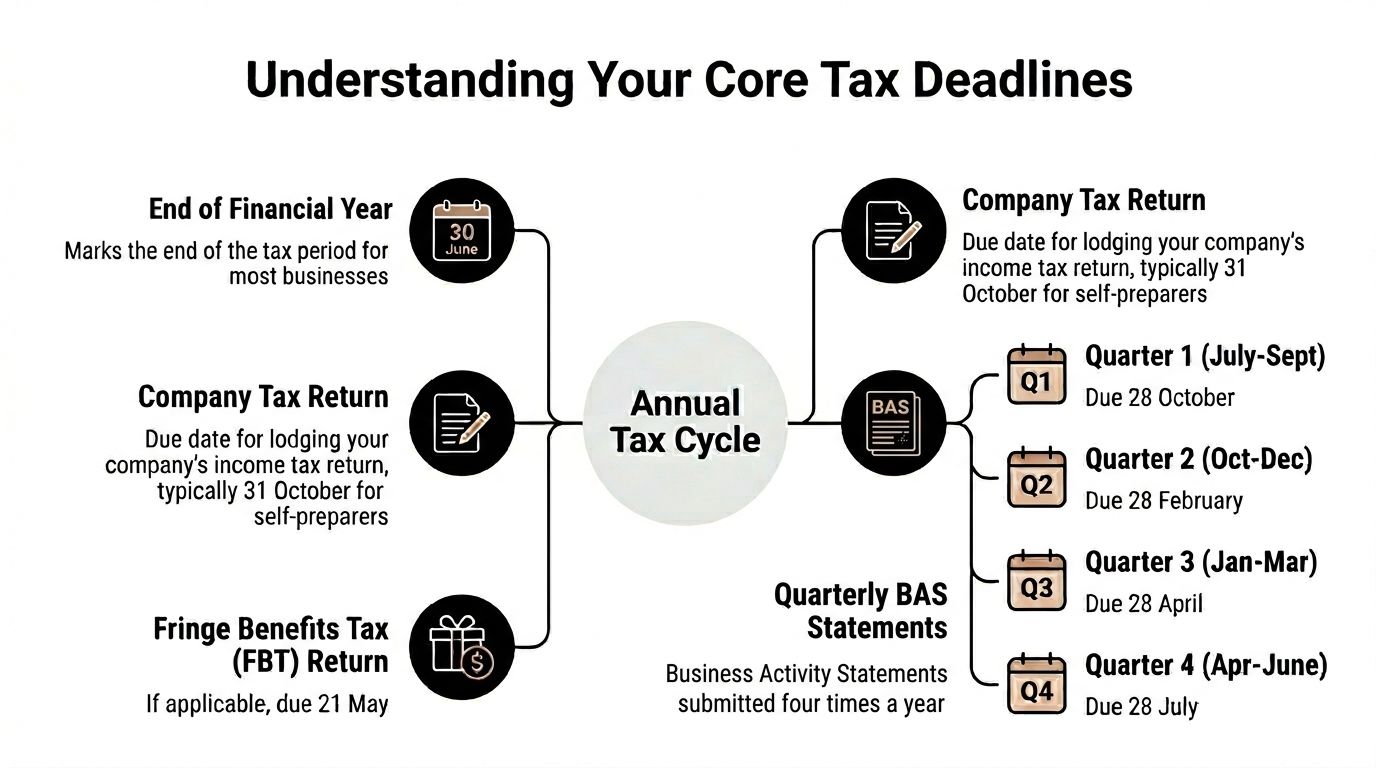
The dates most owners need to know
For most companies, the financial year ends on 30 June. From there, several deadlines can apply throughout the year depending on how the return is lodged and whether the company is up to date.
The infographic above gives a broad reporting picture, including BAS quarters and FBT where relevant. For company income tax, the key issue is the ATO’s tiered system.
According to the ATO’s company and super fund due dates for the registered agent lodgment program, companies with no prior-year arrears generally lodge by 28 February 2026, with payment due 1 December 2025. Companies with outstanding prior-year returns face an accelerated 31 October 2025 lodgement deadline, with payment also due 1 December 2025. The same ATO guidance shows this can compress the lodgement window by four months and gives compliant businesses a 120-day working capital advantage.
Why the ATO tiered system matters
The ATO’s tiered system plays a bigger role than most people realise. Many small businesses slip up here because they assume the current year’s company tax due date depends only on the current year. It doesn’t.
If you miss a prior-year return, the system tightens your next cycle. That means the current year becomes more difficult before you’ve even started preparing it. A business that’s already behind now has less time to catch up, less flexibility to plan cash flow, and more pressure on records and reconciliations.
Here’s the practical difference:
| Company position | Lodgement timing | Payment timing | Practical effect |
|---|---|---|---|
| Up to date with prior returns | 28 February 2026 | 1 December 2025 | More time to finalise records and plan cash |
| Prior-year arrears outstanding | 31 October 2025 | 1 December 2025 | Less time to prepare and more pressure on cash flow |
What works in practice
The businesses that handle tax season well usually do three things:
- Separate tax funds early. They don’t wait for the return to be finished before thinking about payment.
- Review prior-year compliance first. Before discussing the new company tax due date, they confirm that nothing old is still outstanding.
- Get records organised before spring. Job costing, bank reconciliations, loan accounts, and director drawings need attention well before panic season.
If you need a practical walkthrough of the process itself, this guide on how to lodge a company tax return is a useful starting point.
Practical rule: Before asking “when is my company tax return due?”, first ask “am I fully up to date already?”
That one question often changes the answer.
How a Tax Agent Changes Your Company Tax Due Date
Using a registered tax agent isn’t just about getting help with the paperwork. In many cases, it changes the timing in a meaningful way.
For small business owners, that difference can be the gap between a rushed year-end clean-up and a properly planned return. If your records include director loans, vehicle claims, stock issues, crypto activity, trust distributions, or cross-border transactions, more time matters.

The key cut-off date
The most important date in this part of the system is 31 October 2025.
Walker Hill’s summary of company tax return due dates explains that registered tax agents can secure a lodgement extension until 15 May 2026 for compliant clients—but only if the business registers with the agent by 31 October 2025. That same guidance highlights that this can provide up to 76 days of additional lodgement flexibility compared with the standard February deadline, which becomes especially valuable when finances are more complex, such as with crypto holdings or cross-border matters.
See the details in Walker Hill’s company tax return due dates guide.
That means the benefit isn’t automatic. It depends on action being taken early enough.
What does this change mean for a business owner?
The extension doesn’t remove your tax obligation. It changes the planning window.
That extra time can help with:
- Finalising incomplete records. This includes sorting loan accounts, missing expense support, or unreconciled bank items.
- Reviewing tax positions properly. Capital purchases, bad debts, stock adjustments, and private use corrections often need judgement, not guesswork.
- Coordinating with other obligations. BAS, payroll reporting, ASIC tasks, and year-end accounts all compete for attention.
A common mistake is contacting an accountant after October and assuming the May extension still applies. It may not. Once that cut-off has passed, flexibility can disappear.
Cost versus value
Some owners hesitate because they see a tax agent as an added expense. That’s understandable. But the right comparison isn’t “agent fee versus no fee”. The better comparison is:
| Option | What usually happens |
|---|---|
| Self-manage late | Rushed records, uncertainty about dates, higher chance of errors |
| Engage a tax agent early | Clear deadline position, more time to prepare, less reactive decision-making |
For a company with straightforward books, you gain time and certainty. For a company with more moving parts, you gain better decision-making. That can include deciding whether to write off assets, how to handle director transactions, or whether a tax loss or unusual transaction needs closer review.
Many local businesses work with EndureGo Tax to manage company tax returns, BAS, ASIC compliance, and more complex advisory matters across Ashfield and Belrose. The real advantage comes from handling tax and company compliance together, rather than treating them as separate silos.
If you want the extended company tax due date, don’t leave the agent appointment until summer. By then, the useful window may already be gone.
Connecting the Dots: BAS PAYG and Your Company Tax
Many business owners treat BAS and the annual company tax return as separate jobs. On paper, they are separate. In cash flow terms, they’re connected.
If you don’t connect them, the year feels like one surprise after another. If you do connect them, taxes get easier to manage.
BAS is the regular pulse of the business
Your Business Activity Statement usually captures GST, PAYG withholding, and sometimes PAYG instalments. It tells part of the ATO story during the year, while the company tax return finalises the income tax position after year-end.
That’s why a clean BAS history helps. If sales, wages, and GST coding are reasonably accurate through the year, the annual return is less likely to turn into a repair job.
For due dates and timing across the year, this resource on BAS lodgement due dates is useful to keep nearby when mapping your reporting calendar.
PAYG instalments work like a tax holding pattern
A simple way to think about PAYG instalments is this: they operate like a tax savings account, except the money is being paid through the system during the year rather than sitting untouched in your own bank account.
That changes the year-end result. Instead of facing the full tax burden in one hit, part of it may already have been covered progressively.
PAYG instalments can feel annoying quarter to quarter, but they often stop the final bill from becoming unmanageable.
This is especially relevant for tradies and growing service businesses. A strong year can feel great until the annual tax estimate lands. If no provision has been made and no instalments have been factored in, a profitable year can create a nasty cash squeeze.
Where BAS, PAYG, and the annual return meet
At year’s end, the return acts as the full reconciliation point. That’s when the company’s actual taxable income is worked out. Prior instalments and other amounts already reported during the year are then taken into account.
The practical takeaway is that each compliance task feeds the next one:
- BAS records trading activity during the year.
- PAYG instalments prepay part of the likely tax where applicable.
- The annual company tax return reconciles the final position.
If one part is weak, the next part gets harder.
A practical example
Say a Belrose electrician runs strong quarters, buys tools and equipment throughout the year, and starts drawing more from the company as profits improve. If the business lodges BAS on time but keeps patchy bookkeeping, preparing the annual return becomes harder. If the owner doesn’t anticipate PAYG instalments, the company may also be underprepared for the final tax outcome.
Now compare that with a business that reviews its numbers quarterly. That approach doesn’t eliminate tax, but it makes tax visible. And that’s a far better position to be in.
What tends to work better
Businesses usually cope better when they:
- Review profit quarterly rather than waiting for June.
- Match BAS coding to real business activity so GST, wages, and expenses aren’t constantly being corrected later.
- Treat tax provisions as part of overhead rather than whatever cash happens to be left.
What doesn’t work is hoping the annual return will sort everything out. By that stage, the year has already happened.
Penalties and Special Cases: Avoiding Common Traps
Missing a company tax due date isn’t just an inconvenience. It can cost money, create pressure with the ATO, and often point to wider compliance issues inside the business.
For small companies, the trap usually isn’t deliberate avoidance. It’s confusion. The owner thinks the accountant is handling it, the accountant is waiting on records, BAS is being lodged separately, ASIC notices go unread, and the annual return keeps getting pushed back.

The cost of missing the deadline
According to ATO data from 2025, 28% of small companies with turnover under $50M missed their tax deadline, and the average General Interest Charge penalty was $1,200. The same ATO research indicates poor awareness of how annual due dates interact with BAS and ASIC compliance is a frequent reason, particularly for tradies and newly incorporated businesses. The data sits within the ATO’s research and statistics.
That tells you this isn’t rare. It’s happening to ordinary small businesses.
Why do these misses happen
In practice, a few patterns show up again and again:
- New company structure confusion. A former sole trader still thinks and acts like the business is on an individual tax cycle.
- Prior-year issues left unresolved. Old lodgements aren’t cleaned up, so current deadlines become harder.
- ASIC and tax are handled separately. The company stays registered, but records, officeholder details, and tax reporting aren’t managed together.
- Records are incomplete. Loan accounts, cash expenses, or private use adjustments are left until the last minute.
Special cases owners often ask about
Not every company has a simple trading profile. Some need extra care.
Companies that made a loss
A loss-making company still generally needs to lodge. No profit doesn’t mean no obligation. The ATO still expects the return, so the loss position and compliance history are properly recorded.
Newly incorporated businesses
This issue shows up often across the Inner West and Northern Beaches. A sole trader incorporates, opens a company bank account, and starts invoicing under the company name—but keeps the same old habits. They mix expenses, start BAS and payroll, and still don’t clearly understand the annual company tax due date. That gap creates most of the stress.
Disaster and relief situations
The ATO can provide relief when natural disasters or similar events affect your business. Don’t assume the standard process still applies if your business has been directly impacted.
The ATO’s disaster guidance confirms that after the 2025 NSW floods, it automatically provided lodgement and payment relief in many affected cases. However, 42% of impacted small companies didn’t fully use that relief and ended up incurring avoidable penalties. Always check the ATO’s “dealing with disasters” guidance to understand what support applies to your situation.
Relief measures only help if you know they apply and your records are clear enough to act on them.
Legislation and formal authority matter
When deadlines are disputed, penalties arise, or lodgements are overdue, don’t rely on forum answers or what another business owner says. Check the ATO position and the law behind it.
For formal legal authority on income tax administration, the ATO’s legislative references under the tax law framework are where you should anchor decisions, especially if the issue involves objections, late lodgement consequences, or technical treatment of company matters.
If late tax starts overlapping with director obligations and ATO enforcement, it’s also worth understanding how escalation can happen. This guide on how to deal with a director’s penalty notice effectively is relevant where unpaid obligations are building up.
What helps
A calm, clean-up beats a panicked reaction.
Start with the oldest unresolved issue first. Confirm what’s lodged, what isn’t, what the ATO has issued, and whether ASIC records are current. Once that foundation is right, the current company tax due date becomes much easier to manage.
Your Next Steps for Stress-Free Tax Compliance
Most company tax problems don’t start with the tax return itself. They start with uncertainty. Wrong date. Missing records. No tax provision. Assumptions about what the accountant or bookkeeper is doing.
The fix is a short list of actions done early and in the right order.
A practical checklist
Confirm your actual company structure
If you’ve recently moved from sole trader to company, make sure your invoicing, bank account, bookkeeping file, payroll, and tax registrations all match that structure.
Check whether any prior-year returns are still outstanding
This is one of the first things to verify because old arrears can affect current obligations and timing.
Map your whole compliance calendar
Put company tax, BAS, PAYG, super deadlines, and ASIC annual review tasks in the same calendar. When owners see them together, planning gets easier.
Set aside tax progressively
Don’t wait for the completed return to decide whether cash is available. Tax should be treated as money held for a future obligation, not spare cash.
Review records before the busy season
Bank reconciliations, software files, loan accounts, and expense support should be reviewed well before everyone starts scrambling.
Keep supporting documents organised
Good records reduce rework and make it easier to back up deductions. If you want a practical guide, this article on what receipts to keep for taxes is a handy reference for building a cleaner document trail.
What works and what doesn’t
The businesses that stay in control usually make tax a routine operational process. They review figures during the year, not only after 30 June. They ask questions before a deadline, not after they’ve missed one.
What doesn’t work is treating tax as a once-a-year clean-up job. That approach leads to rushed estimates, weak documentation, and avoidable stress.
Good compliance is rarely about doing one heroic thing in April or May. It’s about making fewer bad decisions from July onward.
If you want less stress
If your records are behind, your company is new, or you’re unsure which company tax due date applies, the best move is to sort it out before pressure builds. The right advice at the right time usually saves far more stress than trying to untangle everything after a notice arrives.
Frequently Asked Questions About Company Tax Due Dates
What if I’ve already missed my company tax due date
Act quickly. Don’t wait for the problem to get older.
First, confirm what’s outstanding. That includes the return itself, any notices from the ATO, and whether payment has also become overdue. Then get the records together and move toward lodgement. The fastest path is usually better than spending weeks worrying about the perfect path.
Does a company still need to lodge if it made a loss
Usually, yes. A loss doesn’t remove the lodgement requirement.
The ATO still needs the company return lodged so the tax position is recorded properly. This also helps preserve a clean compliance history, which matters for future deadlines and dealings with the ATO.
I used to be a sole trader, and now I’ve incorporated. Why is this more confusing than expected
Because you’ve changed legal structure, not just your trading name. The company has its own obligations.
That often means separate bookkeeping, separate registrations, separate annual obligations, and a different reporting rhythm from your old sole trader setup. A lot of new directors underestimate this shift and end up mixing old and new records.
Can natural disasters or serious disruptions change the due date
Yes, they can. In affected situations, the ATO may provide automatic lodgement and payment deferrals.
The ATO notes that following the 2025 NSW floods, relief was automatically granted in relevant cases, but 42% of affected small companies failed to take full advantage of it, which meant unnecessary penalties still arose. A tax agent can help identify whether relief applies and what still needs to be done.
Should I wait until tax time to ask for help
Usually not. Earlier is better.
If you ask early, there’s more room to clean up records, confirm your status, and avoid rushed decisions. If you wait until the last minute, your options narrow and the process often becomes more expensive and more stressful.
If you want clarity on your actual company tax due date, help with BAS and ASIC obligations, or support cleaning up overdue returns, speak with EndureGo Tax. We help business owners in Ashfield, Belrose, and across Sydney get compliant, stay organised, and reduce the stress that comes with tax deadlines.
