


If you run a small company in Sydney, there’s a good chance ASIC paperwork sits in the same pile as supplier invoices, insurance renewals and “I’ll deal with that later” admin. That works right up until an ASIC notice lands in your inbox or mailbox and suddenly the issue becomes urgent.
For tradies, shop owners, consultants and family businesses, company secretarial services australia isn’t about corporate theatre. It’s about keeping your company records right, lodging what must be lodged, and avoiding penalties that come from missed dates or outdated details. It also matters more when your company structure connects to tax, BAS, investment property, SMSF reporting or crypto activity.
Busy owners in Ashfield, the Inner West and the Northern Beaches usually don’t need a boardroom-heavy service. They need practical help. Someone who can keep ASIC records straight, explain what actually matters, and make sure the company side lines up with the tax side.
The ASIC Letter No Business Owner Wants to Receive
The letter usually arrives at the worst time. You’re on-site, chasing debtors, ordering stock, or trying to get payroll out. Then you see ASIC on the envelope and your mind goes straight to fines, overdue lodgements, or whether something’s been missed for months.
For a lot of small business owners, that stress starts because the company was set up properly years ago, then left on autopilot. The registered office changed. A director moved house. Shares were reallocated informally. Minutes were never written up because everyone “agreed over the phone”. Nothing feels dramatic until ASIC asks questions.
That’s why I treat company secretarial work as practical risk control, not optional admin. If your company records are current, your annual review is handled, and your key decisions are documented, most ASIC notices become routine instead of alarming.
What usually goes wrong
Small proprietary companies often run into the same problems:
- Old company details: ASIC still has an old address, old officeholder details, or outdated shareholder records.
- Missed review items: The annual statement turns up, nobody checks it properly, and the due date passes.
- Poor documentation: Major decisions are made, but there’s no written resolution or meeting minute.
- Disconnected advice: Your tax accountant knows one version of the structure, but ASIC shows another.
Practical rule: If you’d struggle to explain your current company structure from a single file today, your records probably need attention.
When ASIC issues a serious notice, it can spill into broader director risk. If you’re already dealing with pressure around company debts, this guide on handling a Director Penalty Notice is worth reading early, not after the deadline has passed.
For most small businesses, the fix is straightforward. Get the records reviewed, clean up what’s missing, set reminders properly, and make someone responsible for the compliance calendar.
What Are Company Secretarial Services Exactly
Think of company secretarial work as the legal and administrative backbone of your company. It’s the ongoing work that keeps the company itself in good standing, separate from the day-to-day work of earning income.
Under the Corporations Act 2001, appointing a company secretary is mandatory for public companies and optional for proprietary companies, but all companies still need to keep the right books and records and lodge required documents with ASIC to stay compliant, as ASIC sets out in its guide to company books and records obligations.
For a small business owner, that usually comes down to four practical areas.
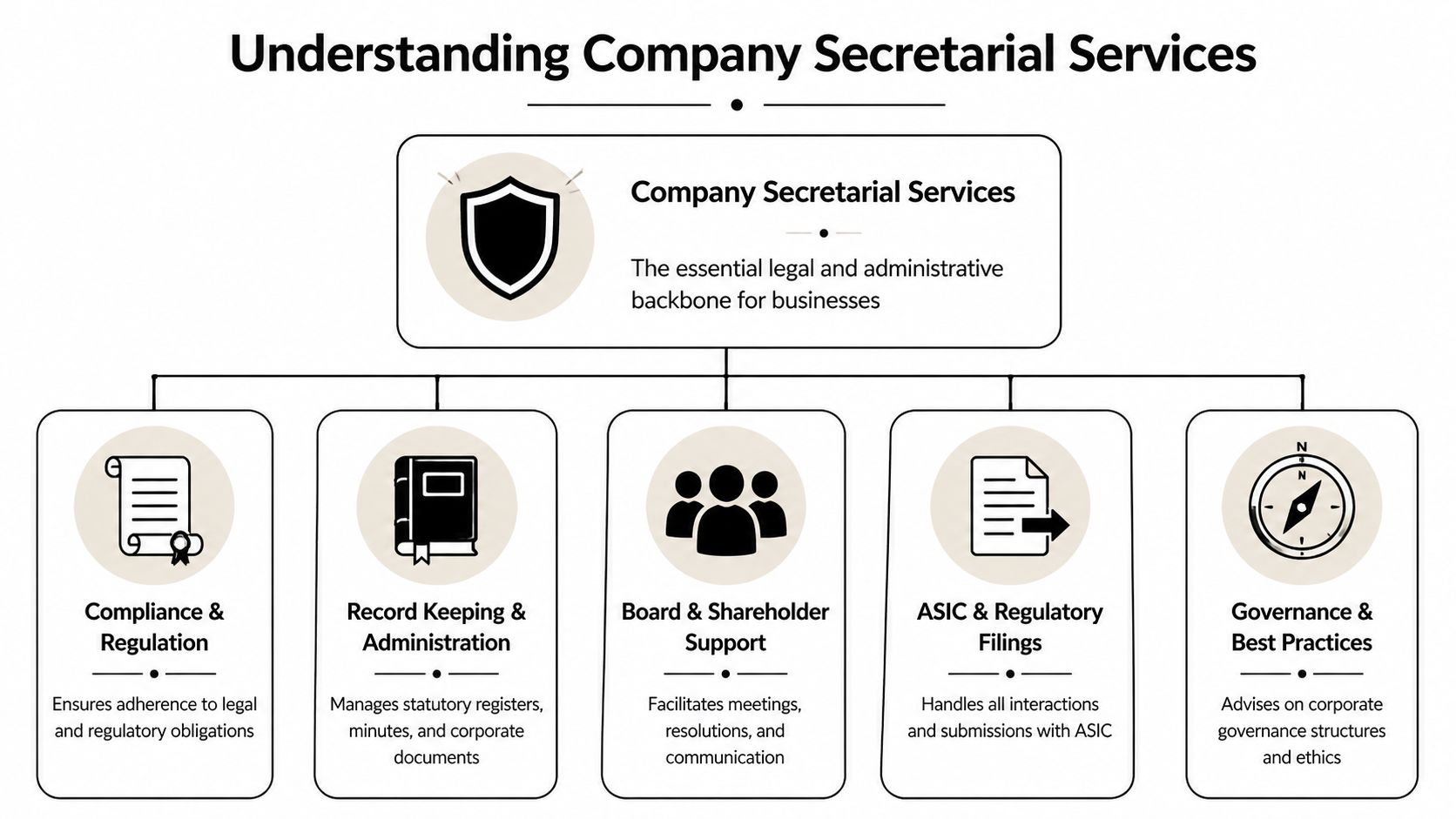
ASIC filings and communications
ASIC expects your company details to be current and your required lodgements to be made on time. If your registered office changes, a director resigns, or shareholder details need updating, those changes have to be processed correctly.
A common example is a director changing residential address and assuming updating a driver licence or bank record is enough. It isn’t. If the company record stays wrong, official notices can go to the wrong place.
Statutory registers and company records
Every company needs its internal records kept in order. That includes registers for directors, shareholders and other core company details.
These aren’t documents you prepare once and forget. They need to match the company’s actual position. If there’s ever a dispute between owners, or you need to confirm who holds what, these records become very important.
Minutes and resolutions
Good record-keeping isn’t only for large boards. Small companies should still document decisions properly. That includes appointing or removing officeholders, issuing shares, approving changes to company details, or recording important business decisions.
A quick phone call agreement may work operationally. It doesn’t replace a proper company resolution.
If you want a practical breakdown of what sits inside the role, these company secretary duties and responsibilities give a useful overview.
Processing company changes properly
Many small business owners often find themselves in a difficult position. They make a real change in the business but never complete the company paperwork.
Examples include:
- Adding a new business partner through shares without updating the register properly.
- Changing the registered office after moving premises.
- Appointing a family member as a director without dealing with the ASIC side.
- Restructuring ownership for tax or asset protection reasons, but leaving old company details in place.
That’s what company secretarial services australia should handle in practice. Not glossy governance talk. Essential paperwork that keeps your company compliant.
Key ASIC Deadlines and Costly Penalties to Avoid
ASIC deadlines are easy to miss because they don’t usually feel urgent when they arrive. A review notice gets opened between jobs, then buried under everything else. By the time someone looks at it again, the due date has passed and the penalty has already attached.
That’s why deadlines need a system, not memory.
The annual company review is the big one for many small proprietary companies. You need to review the company details ASIC has on file, confirm what’s correct, and deal with any changes properly. There’s also the annual review fee, which small business owners often confuse with a fine. It isn’t the same thing. The annual review fee is a standard obligation. The penalty starts when required lodgements are late.
The late fee problem
According to the verified ASIC penalty schedule referenced by Sprintlaw, late ASIC filings attract fines starting at $387 for individuals and up to $2,062 for companies per late document, with higher penalties for longer delays, as noted in this summary of Australian corporate secretarial obligations and ASIC penalties.
That matters because these costs usually come from ordinary oversights, not dramatic misconduct.
| ASIC Late Lodgement Penalties (2026) | Penalty Fee |
|---|---|
| Late document for an individual | From $387 |
| Late document for a company | Up to $2,062 |
| Longer delays | Escalating penalties apply |
What owners should watch closely
The risky moments are usually predictable:
- Annual review period: If nobody checks the ASIC statement, old details stay old.
- Company changes: Director appointments, resignations, address changes and share changes need proper follow-through.
- Busy trading periods: Compliance work often gets pushed back when business is flat out.
- Mail handling issues: If ASIC notices go to an old address, you may not know there’s a problem until it’s expensive.
Keep one person clearly responsible for ASIC deadlines. Shared responsibility usually means no responsibility.
There’s also a bigger consequence than the fee itself. The same verified source notes that ASIC deregistered over 100,000 companies in 2022-23 for failing secretarial obligations. That’s not a theoretical risk for businesses that ignore ASIC correspondence for too long.
What works is simple. Put ASIC dates on a compliance calendar, review each notice when it arrives, and fix discrepancies straight away. What doesn’t work is assuming the accountant will “probably see it” unless you’ve engaged someone to manage the company secretarial side.
How to Budget for Secretarial Services
Small business owners usually ask the right question first. “What will this cost me each year?” The better question is, “Which pricing model will stop problems without over-servicing a simple company?”
A lot of company secretarial services australia content is written for larger entities with more layers, more meetings and more complex ownership. That’s not how most Sydney small companies operate.
The three pricing models you’ll see
Fixed annual fee
This suits owners who want standard compliance handled for a known yearly amount. It often works well when your company doesn’t change often but you still want annual reviews, record maintenance and basic ASIC support covered.
The upside is predictability. The downside is that some providers make the package look cheap, then charge extra for every actual change.
Pay as you go
This can work if your company is very stable and you’re disciplined enough to deal with compliance promptly. You pay when something happens, such as a director update or share change.
In practice, this model often looks cheaper than it really is. Owners delay updates because they don’t want another bill, and that delay creates compliance problems.
Bundled with accounting and tax
This is usually the most practical model for smaller businesses because the same adviser can see both sides of the picture. If the company structure changes, the tax records, ASIC records and annual compliance can stay aligned.
That matters more if you have BAS obligations, trust distributions, investment property issues, capital gains tax exposure, or crypto transactions sitting around the same structure.
What’s normal and what’s not
Moore Australia notes that large corporate secretarial providers may charge $2,000 to $10,000 per year, and that these models are often unsuitable for the 98.8% of Australian enterprises that are small businesses. The same source also notes that a bundled option from a local ASIC agent and accountant can offer better value for smaller operators, as outlined in its overview of corporate secretarial service pricing and fit for small business.
A sensible budget decision comes down to fit:
- Simple company, few changes: Fixed annual can work well.
- Rare changes, owner likes handling admin: Pay as you go may be enough.
- Tax complexity or multiple moving parts: Bundled compliance is usually cleaner.
What doesn’t work is paying premium corporate rates for services you’ll never use, such as elaborate board support or registry-heavy administration that belongs in a much larger business.
Your Checklist for Engaging a Provider
Choosing a provider isn’t just about price. You’re handing over part of your legal compliance, so you need someone who’ll keep the company records accurate and tell you when action is needed.
This checklist keeps the conversation practical.

Questions worth asking before you sign
Are you a registered ASIC agent
This is one of the first things to verify. If you want to understand what that status means, review this explanation of an ASIC registered agent. It helps separate genuine compliance support from general admin assistance.Do you work with small proprietary companies like mine
A provider who mainly services large public or complex group structures may not be a good fit for a tradie business, family company or local investment vehicle.What’s included in the annual fee
Ask them to spell it out. Annual review support, maintaining registers, minutes, ASIC changes, director updates, share changes, business name renewals if relevant. If it’s vague, expect surprise invoices later.How do you handle reminders and notices
Good providers don’t just react. They remind you before dates become problems and tell you what they need from you.
Ask about the tax connection
This point gets missed often. Your provider should be able to explain how company record changes interact with tax reporting.
Ask questions like:
- If I change directors or shareholders, does that affect anything in my tax setup?
- If I’ve restructured ownership, who makes sure ASIC and tax records match?
- If I’ve got investment property or crypto activity, who checks the company details still line up?
The best compliance relationship is boring. Notices get handled, records stay current, and nothing becomes urgent.
Watch for these warning signs
- Slow answers: If they take days to answer a basic compliance question before engagement, it won’t improve later.
- Corporate language with no specifics: If they talk about governance at length but can’t explain a common small business scenario clearly, that’s a problem.
- No clear ownership: You should know who is doing the work and who to contact.
- No document process: If they don’t ask for your constitution, current registers, ASIC records or prior company documents, they may be guessing instead of reviewing.
A good provider acts like a steady compliance partner, not a last-minute form lodger.
Local Compliance for Ashfield and the Northern Beaches
A local business in Ashfield doesn’t always have the same issues as a larger corporate group in the CBD. The same goes for a company in Belrose or across the Northern Beaches. The structures are often leaner, the owners are hands-on, and the company paperwork usually sits alongside tax, BAS and personal asset decisions.
That’s why generic company secretarial services australia advice often misses the underlying risk. The company record doesn’t exist in isolation. It connects to how the business operates.

Inner West scenarios
In Ashfield and the Inner West, I often see owner-managed companies where the business started in a straightforward manner, then became more complex over time. A spouse gets added informally. A different trading location is used. A trust or property investment is brought into the broader picture. The company paperwork often lags behind the actual structure.
For a tradie, builder, consultant or retailer, that disconnect matters when finance is being sought, when the business is sold, or when the ATO reviews records that don’t line up with ASIC.
Northern Beaches scenarios
On the Northern Beaches, it’s common to see business owners with investments, family entities, or newer asset classes like cryptocurrency sitting alongside the operating company. That doesn’t automatically create a problem. The issue starts when the company details held by ASIC don’t match the way the structure is described in tax records or declarations.
The ATO states that it uses extensive data matching and information sharing, and the verified guidance for this article notes that ATO and ASIC data-sharing protocols have expanded, increasing scrutiny where company registered details and tax declarations don’t line up. For business owners dealing with investment property or cryptocurrency, that makes integrated support more important, as outlined in the ATO’s page on data matching protocols and analytics capability.
Why local context matters
A local accountant who also handles ASIC compliance can often spot issues earlier because they can see the whole file:
- The company side: officeholders, addresses, shareholding, minutes
- The tax side: company returns, BAS, CGT events, trust links
- The practical side: how the owner trades day to day
That joined-up view is useful when the business isn’t a textbook structure, which is most small businesses.
Achieve Stress-Free Compliance with EndureGo Tax
The hardest part of ASIC compliance usually isn’t the form itself. It’s knowing what applies, what’s been missed, and whether the company records still match the reality of the business.
For small businesses, the practical answer is to stop treating ASIC work as separate from the rest of your compliance. When company records, tax reporting and business changes are handled together, fewer things fall through the cracks.
That’s where an integrated approach makes sense. A local accountant who is also a registered ASIC agent can handle annual company obligations, record updates, and the tax consequences that often sit behind those changes. EndureGo Tax provides that combined support for small businesses in Ashfield and Belrose on the Northern Beaches, including company tax returns, BAS, trust and SMSF compliance, and ASIC secretarial work through its registered agent service.
What this looks like in practice
A workable setup usually includes:
- A proper review of current company records
- A clear list of missing or outdated items
- Ongoing handling of standard ASIC obligations
- Coordination between ASIC changes and tax reporting
- A direct contact when something changes in the business
Clean company records save time twice. Once when you avoid the compliance mess, and again when your tax work doesn’t need to be rebuilt around bad ASIC data.
What business owners should do next
If your company has had any changes in directors, shareholders, addresses, business activity, property ownership links, or crypto-related tax issues, it’s worth getting the file reviewed before the next ASIC deadline arrives.
If nothing has changed, that’s still worth checking. Many problems come from assuming the records are current because nobody has looked at them in a while.
The aim isn’t to make compliance complicated. It’s to make it routine, accurate and low-stress so you can get back to running the business.
If you want practical help with ASIC compliance, company records, tax lodgements, or an integrated review of your structure, book a consultation with EndureGo Tax. We help small business owners in Ashfield, the Inner West and Belrose Northern Beaches keep their company and tax obligations aligned, so there are fewer surprises and less admin to chase.
