


To legally change your business name in Australia, you need to do more than just pick a new name and run with it. The process involves a few crucial checks upfront, followed by registering it with the Australian Securities and Investments Commission (ASIC) and linking it to your ABN.
Getting this right keeps you compliant and prevents serious legal clashes down the track. This guide provides the expert advice and actionable steps you need to navigate the change successfully.
Your Essential Pre-Change Checklist
Before you get too attached to a new name for your business, you need to do your homework. This isn't just bureaucratic box-ticking; it's the foundation that prevents future legal headaches, wasted marketing dollars, and brand confusion.
Nailing this from the start ensures your transition is smooth and legally sound.
The Australian business landscape is packed, making a unique brand name more valuable than ever. We see established businesses rebranding all the time to cut through the noise or pivot in their market. This is why securing a distinct identity is so important.
Is the Name Actually Available? Check with ASIC
First things first: is your dream name even up for grabs? The Australian Securities and Investments Commission (ASIC) manages the national business names register, and this is your source of truth.
You’ll need to search the ASIC Connect portal to make sure another business isn’t already trading under the exact name or one that sounds way too similar.
Practical Example: A Perth-based electrician trading as "Sparky Solutions" wants to rebrand to "West Coast Electrical". A quick search on ASIC's register reveals a "West Coast Electrics" is already registered to a contractor in Geraldton. That simple check just prevented a costly and confusing brand clash, forcing a return to the drawing board before any money was spent.
Here's a look at the Australian Business Register, a tool you'll use to check details linked to an ABN.
This search portal is a critical first step for confirming the current details of any existing business entity.
Know the Difference: Business Name vs. Company Name vs. Trademark
It’s vital to get your head around the different types of names. They offer different levels of protection and have separate legal meanings. Getting this wrong can give you a false sense of security about your brand's legal standing.
- Business Name: This is your trading name, registered with ASIC. It lets you operate under a name that isn't your own (for a sole trader) or your company's legal name. Critically, it offers no ownership rights.
- Company Name: This is the legal name of a Pty Ltd company registered with ASIC. Changing this is a more formal process. A key difference is that your company name must be completely unique. You can learn more about how this fits into different setups by exploring business structures in Australia.
- Trademark: This is the big one. A trademark provides legal ownership and exclusive rights to use a brand (like a name or logo) for specific goods or services. It's registered with IP Australia. A registered business name can still infringe on someone else’s trademark.
A common pitfall is assuming that registering a business name with ASIC gives you ownership. It doesn't. It only gives you the right to trade under that name. True brand ownership comes from trademarking.
Lock Down Your Digital Identity First
These days, your online presence is just as important as your physical one. Before you even think about registering your name with ASIC, you absolutely must check the availability of the matching domain name and social media handles. A crucial part of this is understanding domain name ownership, because securing your new online identity is non-negotiable.
Practical Example: You successfully register "Coastal Plumbing Solutions" with ASIC, only to find coastalplumbingsolutions.com.au is taken and the Instagram handle is used by a competitor. You’ve just created a massive brand disconnect and are forced into a compromised digital identity.
Always, always secure your domain and key social media handles before you commit financially and legally to the new name. This is a non-negotiable step in any modern business name change strategy.
Making It Official with ASIC and the ABR
You've done the groundwork and picked the perfect new name. Now it's time to roll up your sleeves and tackle the official government paperwork. This is the part that makes your new identity legally binding with the Australian Securities and Investments Commission (ASIC) and the Australian Business Register (ABR).
Just a heads-up, this isn't a one-size-fits-all process. How you go about it depends entirely on your business structure.
The Path for Sole Traders and Partnerships
If you’re a sole trader or in a partnership, you can breathe a sigh of relief. The process is pretty straightforward. You’re not actually changing your core business entity; you’re just registering a new trading name and linking it to your existing Australian Business Number (ABN).
You'll need to jump onto the ASIC Connect portal to register the new name you've already researched. Once ASIC gives it the green light, they'll link it to your ABN, and voilà, it's your new official trading name.
One small thing people often forget: make sure you cancel your old business name once you’ve fully switched over. Otherwise, you’ll be stuck paying renewal fees for a name you don’t even use anymore, which is just money down the drain.
The Formal Process for Companies
For proprietary limited (Pty Ltd) companies, things are a bit more formal and involved. Changing your company's legal name isn't just a simple admin update; it’s a legal change to the company itself, governed by corporate law.
This is a two-step dance that thousands of Aussie businesses do each year. First, under the Corporations Act 2001, your company has to pass a special resolution. This isn't a simple majority vote; it needs approval from at least 75% of the votes cast by the company members.
Once that’s done, you need to lodge a Form 205 (Notification of resolution) with ASIC to make it all official.
It's also worth noting that the government is phasing out unregistered "trading as" names. After 1 November 2025, these old names won't show up on ABN Lookup anymore. This makes it absolutely critical for all businesses, especially companies, to get their trading names properly registered with ASIC.
Expert Tip: Document everything. Seriously. Keep signed copies of that special resolution and all your meeting minutes. If ASIC ever decides to audit you, having a clear paper trail is your proof that you’ve followed all the right governance steps.
Updating Your Details on the Australian Business Register
No matter your business structure, there's one final crucial step: updating your details on the Australian Business Register (ABR). This ensures your ABN record matches your new operating name, which is vital for everything tax-related.
While registering a new business name with ASIC should automatically link to your ABN, don't just assume it has. It’s on you to log in to the ABR portal and double-check everything. Make sure your new business name, address, and contact details are all up to date. This simple check keeps things clean for your GST, BAS, and all dealings with the ATO.
This flowchart gives you a quick visual recap of the essential checks you should have already nailed before you even think about official registration.
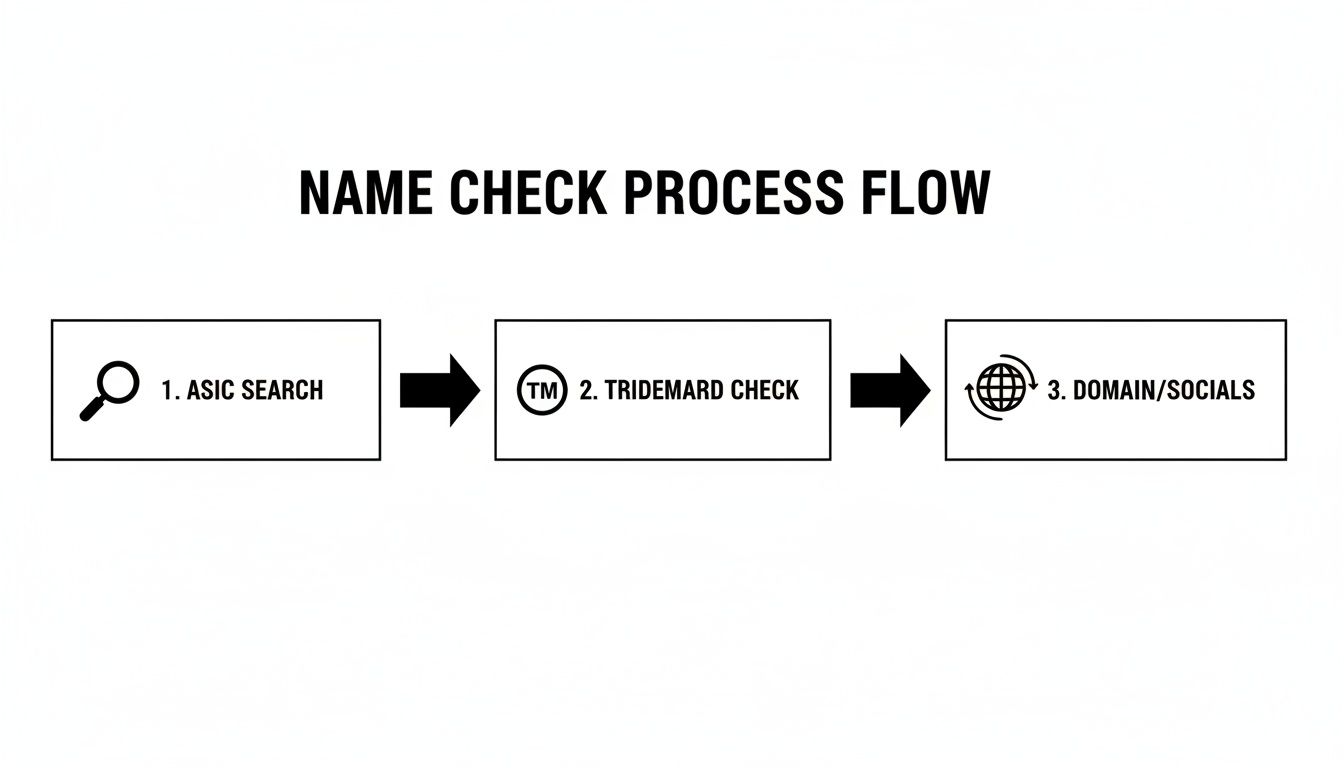
As you can see, the ASIC search, trademark check, and digital presence checks are non-negotiable steps you need to take in that order.
Using the ASIC Connect Portal
The ASIC Connect portal is where all the magic happens. It's your go-to for checking name availability, registering your new name, and eventually, cancelling the old one. Getting familiar with it will save you a headache or two.
Here’s a quick rundown of what you’ll do there:
- Registration: The online form is pretty intuitive. It'll walk you through the steps, asking for your ABN and the name you want to register.
- Linking: Always double-check that the new name is correctly linked to your ABN. This is how the government connects your public identity to your tax entity.
- Cancellation: Once you're no longer using the old name, don't forget to formally cancel it. It’s a simple request in the portal. And if you spot an error in your details that needs fixing, you can learn more about lodging an ASIC Form 492.
Getting these official steps right is the backbone of a successful rebrand. As registered ASIC agents, we handle these lodgements and compliance tasks every single day. If you’re feeling a bit lost in the maze of forms, resolutions, and government portals, give our team at EndureGo Tax a shout. We can manage the entire ASIC process for you, making sure your business name change is compliant, correct, and completely stress-free.
Updating Your Name Across Your Business Ecosystem
Legally registering your new business name with ASIC is a huge milestone, but honestly, it's just the starting pistol. Now the real work begins. This is where you roll out your new identity across every single touchpoint of your business, making sure everything is consistent and you avoid the chaos that comes from a disjointed brand.
Think of it like this: the government now knows your new name, but you need to tell everyone else—from your bank and insurer to your customers and suppliers.

Critical Administrative Updates You Can't Ignore
First things first, tackle the core financial and legal pillars of your business. Getting these wrong can lead to bounced payments, invalid insurance, and some serious payroll headaches. This part is all about keeping the engine running smoothly while you change business name details.
Start with your bank. You can't just start slapping the new name on invoices and hope the money lands in the right account. You’ll need to physically visit a branch with your updated ASIC Certificate of Registration to formally change the account name. This simple step prevents payment rejections and keeps your cash flow healthy.
Next up, your insurer. Your public liability, workers' comp, and professional indemnity policies are all linked to your old business name. A quick phone call and an emailed copy of your new registration certificate will get you an updated Certificate of Currency, ensuring you remain fully covered. No gaps, no risks.
Expert Tip: Don’t forget your accounting software. Whether you use Xero, MYOB, or something else, updating your business name in the system is crucial. It ensures your invoices are accurate and your Single Touch Payroll (STP) reporting to the ATO is compliant. A mismatch here can flag errors and cause compliance issues you just don't need.
A Tradie's Action Plan for a Smooth Transition
Let's make this practical. Imagine "Dave's Dynamic Drilling," a sole trader, rebrands to "Precision Concrete Cutters" to better reflect his niche. His legal registration is done. Now what?
Here's a smart, prioritised checklist he might follow:
Financial & Legal First (Week 1):
- Visit the bank with his new business name certificate to update the business account.
- Email his insurer to get a new Certificate of Currency under "Precision Concrete Cutters."
- Log in to Xero, update the business details, and refresh the invoice templates.
Supplier & Client Comms (Week 1-2):
- Update his details with key suppliers like Kennards Hire and his concrete supplier so their invoices are addressed correctly.
- Send a professional email to his regular clients, explaining the name change and reassuring them it's the same great service.
- Update any existing long-term contracts or service agreements to reflect the new name.
Marketing & Brand Assets (Week 2-4):
- Update his website, Google Business Profile, and social media pages.
- Get new quotes for vehicle signage and schedule a time to get his ute re-wrapped.
- Order new business cards, work shirts, and update his email signature.
This phased approach stops him from getting overwhelmed. It ensures the most critical financial tasks are handled immediately, minimising disruption to his daily operations and cash flow.
To make it even clearer, here’s a prioritised checklist you can use to stay on top of everything. It breaks down the most urgent tasks from the ones that can wait a week or two.
Your Critical Post-Change Update Checklist
| Priority Level | Area of Business | Specific Task Examples | Why It's Critical |
|---|---|---|---|
| High | Banking & Finance | Visit bank to update account name; update details in Xero/MYOB; notify payment gateways (Stripe, PayPal). | Prevents rejected payments, ensures cash flow, and maintains accurate financial records for the ATO. |
| High | Legal & Insurance | Notify insurer for updated Certificate of Currency; update any existing legal contracts or agreements. | Ensures you are fully insured under the new name and that all contracts remain legally valid and enforceable. |
| High | Government & Payroll | Check ABN details are updated on the ABR; update business name in your payroll system for STP reporting. | Maintains compliance with the ATO and ensures employee records and superannuation payments are correct. |
| Medium | Suppliers & Clients | Inform all key suppliers of the name change; send a formal notification email to all current clients. | Avoids confusion with invoicing and payments, and maintains professional relationships. |
| Medium | Digital Presence | Update website, social media profiles (Facebook, Instagram, LinkedIn), and Google Business Profile. | Ensures brand consistency and makes it easy for new and existing customers to find you online. |
| Low | Marketing & Branding | Order new business cards; update vehicle signage; get new uniforms; update email signatures. | Solidifies your new brand identity in the market, but won't stop you from operating in the short term. |
Sticking to a list like this helps you work through the changes methodically, so nothing important gets missed in the shuffle.
Updating Contracts and Agreements
This is an area where business owners often slip up. All your legal documents—from client contracts and supplier agreements to employee contracts and your commercial lease—must be updated to reflect your new legal trading name.
Operating under a new name without updating your contracts can, in some cases, create legal loopholes or even make them unenforceable. It’s best practice to issue a formal addendum or variation for each existing agreement, which both parties sign. This officially acknowledges the name change while keeping the original terms of the contract intact.
Don't Forget Your ABN Details
While you don't need a new Australian Business Number, you absolutely must ensure your ABN record is updated. The process of registering a new name with ASIC should automatically link it to your existing ABN, but it's your responsibility to double-check this on the Australian Business Register (ABR).
For a complete walkthrough on why this number is so critical, check out our comprehensive ABN registration guide.
A quick search on the ABR website will confirm that your new name is publicly and officially associated with your ABN. This is essential for tax purposes and for other businesses that need to verify your details. This simple check gives you peace of mind and ensures your entire business identity is aligned.
Protecting Your New Brand and Intellectual Property
Getting your new name registered with ASIC is a huge tick off the compliance list, but here’s a costly mistake I see people make all the time: thinking the job is done.
Registering your business name gives you the right to trade under it. That's it. It offers almost zero legal ownership or protection for the brand you’re about to build. To properly secure your new identity after you change business name, you need to dive into the world of intellectual property.
This is the part where you go from just using a name to legally owning it. It’s absolutely critical to get your head around what is intellectual property protection, because without it, another business could legally launch with a similar name and ride on the coattails of your hard work.
The Power of a Trademark Over a Business Name
If there's one thing you take away from this guide, let it be this: the single most important step in protecting your new brand is lodging a trademark application with IP Australia.
Think of it like this. Your ASIC business name registration is like a library card—it lets you operate, but plenty of other people can have one too. A trademark is like owning the copyright to the book itself. It’s yours, and yours alone.
Here’s how they stack up:
- Business Name Registration (ASIC): This is just a licence to trade. It stops someone from registering the exact same name in Australia, but that’s where the protection ends. It does nothing to stop similar-sounding names or copycat logos.
- Trademark Registration (IP Australia): This gives you legal ownership and exclusive rights to use your brand (name, logo, slogan) for specific goods or services, which are sorted into 'classes'. Crucially, it gives you the legal firepower to shut down anyone using a confusingly similar brand.

Choosing the Right Trademark Classes
When you file for a trademark, you can't just claim it for everything under the sun. You have to nominate the specific classes of goods or services your brand covers. Nailing this is vital for making your protection count.
Practical Example: A new online store, "Outback Apparel," sells clothing and camping gear.
To protect their brand properly, they'd need to register their trademark in a few key areas:
- They’d start with Class 25 to cover clothing, footwear, and hats.
- Then, they should look at Class 22 for things like ropes and tents.
- And probably Class 18 to cover leather goods like backpacks.
By locking down the right classes, Outback Apparel stops another company from launching "Outback Activewear" in the clothing category. They've protected their patch.
Securing Your Complete Digital Footprint
Your brand isn't just a name; it’s your entire presence, and that includes your digital real estate. Inconsistent online branding is a recipe for customer confusion and leaves the door wide open for competitors.
Before you pop the champagne on the name change, you need to lock down the matching digital properties.
Your
.com.audomain name and your main social media handles are non-negotiable. Think of them as the modern-day version of your shopfront sign—they must align perfectly with your trademarked brand name.
Securing these assets builds a defensible online identity. It makes it much harder for copycats or impersonators to trick your customers and reinforces the trust you're working so hard to build.
Common Pitfalls and When to Call an Expert
Changing your business name feels like it should be a simple admin task, but honestly, it’s a minefield of hidden traps. We've seen even the most careful business owners get tripped up, landing themselves in a mess of legal headaches and surprise costs.
Getting this wrong is more than just a paperwork blunder. It’s about making sure your new brand is built on a solid legal and financial footing. Let's walk through the mistakes we see time and time again, and when it’s smarter to just call in a pro.
Mistakes That Can Derail Your Name Change
One of the most common slip-ups is picking a name that’s too generic or descriptive. Sure, "Sydney's Best Plumber" sounds great for marketing, but it's next to impossible to trademark. That leaves the door wide open for a competitor to launch "Sydney's Best Plumbing Services," confusing your customers and leaving you with no legal power to stop them. A strong name is distinctive, not just a description of what you do.
Another big one? Forgetting to notify the Australian Taxation Office (ATO) and update all your internal systems. This isn't just an admin oversight; it can have serious knock-on effects for your Business Activity Statements (BAS) and GST reporting. Under tax law, your registered business name must match the name on your tax invoices for them to be valid. Any mismatch can cause issues with claiming GST credits and is a surefire way to attract unwanted attention from the ATO.
Finally, people often forget to formally cancel their old business name. If you leave it active, you’re still on the hook for renewal fees and any other obligations tied to it. It’s a recipe for administrative chaos and can even leave you exposed to liabilities linked to that old identity.
Invalidating Contracts and Agreements
Here’s a risk that many business owners seriously underestimate: accidentally voiding your contracts. All your existing agreements—with clients, suppliers, even your commercial lease—are under your old business name.
If you just start trading under the new name without formally updating these documents, you’re creating legal loopholes. In a worst-case scenario, a difficult client could argue their contract is with "Old Tradie Co," not "New Tradie Co," and try to wiggle out of their obligations.
The only way to handle this properly is to issue a formal addendum or deed of variation for each major contract. This is a document signed by both parties that legally confirms the name change while keeping all other terms of the original agreement intact.
When to Bring in the Experts
Look, if you’re a sole trader with a straightforward setup, you might be able to handle this yourself. But there are some definite red flags that should tell you it’s time to call a professional. Knowing when to get help will save you a world of time, money, and stress down the line.
You should get expert help when:
- Your business structure is complex. If you’re a company, trust, or a partnership with multiple directors, the legal and financial stakes are much higher. An accountant or ASIC agent will make sure all the corporate governance, like passing special resolutions, is handled by the book.
- You plan to seek investment or sell the business. Any potential investor or buyer is going to do their homework. Inconsistencies in your business name history or legal docs can sink a deal or seriously devalue your business.
- You have existing legal agreements. Got complex client contracts, commercial leases, or supplier agreements? A legal professional needs to review and amend them to make sure they’re still valid and enforceable after you change business name.
- You need to protect your brand. If brand ownership is a big deal for you, hiring a trademark lawyer or specialist is a no-brainer. They’ll conduct the right searches and manage the application with IP Australia, giving you the best shot at securing those exclusive rights.
Juggling ASIC regulations and ATO compliance while trying to run your business is tough. As registered ASIC agents and tax experts, our team at EndureGo Tax deals with this stuff every single day. If you’re facing a complex situation or just want the peace of mind that it’s all done right, book a consultation with us today. We’ll handle the entire process, so you can get on with your work.
Got Questions About Changing Your Business Name?
You're not alone. When it comes to something as important as your business name, a lot of questions pop up. We've tackled the most common ones we hear from tradies and small business owners to give you clear, straight-up answers.
What’s the Real Cost to Change a Business Name in Australia?
This really comes down to your business structure.
If you’re a sole trader or in a partnership, you’re just registering a new trading name. The ASIC fee for that is pretty reasonable: $42 for one year or $98 for three years.
But if you're running a Pty Ltd company, it's a bit more involved. You need to officially change the legal company name by lodging an ASIC Form 205, which will set you back $474.
Don't forget the other costs that sneak up on you! Think about updating your ute signage, ordering new work shirts, and maybe even getting that new name trademarked. Trademark registration with IP Australia starts from $250 per class, so factor that into your budget.
Can I Just Start Trading Under the New Name Without Registering It?
Short answer: absolutely not.
In Australia, it’s illegal to operate under a name that isn’t registered with ASIC. The only exception is if you're a sole trader using your own first and last name, like "John Smith Plumbing."
The government has been cracking down on unregistered 'trading names', so getting it officially registered is non-negotiable. Trying to wing it can land you with hefty fines, and you won't be able to open a business bank account or get a loan. You have to follow the proper steps first.
The Business Names Registration Act 2011 makes it crystal clear: failing to register your business name can lead to serious financial penalties. It's a fundamental step in being legally compliant and protecting your new brand. You can find more detail on this directly from the Australian Taxation Office.
How Long Does This Whole Name Change Thing Actually Take?
The official paperwork part is surprisingly fast.
Registering a new business name on the ASIC portal can often be done on the same day. For a company name change, ASIC usually processes the Form 205 within a couple of business days.
The real-time sink is everything else. Updating your bank, letting suppliers know, getting new quotes and invoices printed, and telling all your clients… that's where the work is. Realistically, you should plan for this to be a one to two-month project from start to finish. Rushing it just means things get missed.
Do I Need a New ABN When I Change My Business Name?
Nope, and this is a common mix-up. Your Australian Business Number (ABN) is tied to your business entity (you as a sole trader, or your company), not the name you trade under.
Once you register the new business name with ASIC, it will automatically link to your existing ABN. Your main job is to log into the Australian Business Register (ABR) and double-check that your details are updated and the new name is showing correctly.
Jumping through the hoops of an ASIC company name change or making sure your ABN details are spot on can feel like a headache you don't need. As registered ASIC agents, EndureGo Tax handles this stuff every day, making sure the transition is smooth and 100% compliant.
If you want peace of mind that every box is ticked correctly, we’re here to help.
Book a consultation with our experts today and let us sort the paperwork so you can get back to building your new brand.
