


When it comes to tax, there aren't many free lunches. But the CGT exemption for your main residence is about as close as it gets. It’s hands-down Australia's most powerful tax break for homeowners, letting you sell your family home without paying a cent of Capital Gains Tax (CGT) on the profit.
Simply put, if the property you’re selling has genuinely been your home for the entire time you've owned it, any increase in its value is completely tax-free. As tax experts, we see this as a foundational element of wealth creation for Australian families, but navigating the rules is crucial.
Unpacking the CGT Main Residence Exemption

Think of the main residence exemption as a financial shield around your home. As your property's value climbs over the years, this shield protects that growth from the Australian Taxation Office (ATO). When it's time to sell, you pocket the full capital gain. It’s a cornerstone of financial security for countless Australians.
Just how significant is this tax break? The Treasury estimated it cost the government around AUD 47.5 billion in lost revenue for 2023–24, making it Australia's single biggest tax concession. It's a massive benefit.
But this shield isn't automatic. You must meet specific conditions to qualify.
The Core Concepts: Dwelling and Main Residence
To leverage the exemption effectively, you first need to understand two key terms the ATO uses. Getting these right is the first step to securing a tax-free sale.
- What is a 'Dwelling'? The ATO is specific here. A 'dwelling' is a building (or part of a building) used for accommodation, like a house, apartment, or strata unit. It also includes the land right under it and any adjacent land up to two hectares, as long as it's all used for private, domestic purposes. This is detailed in the Income Tax Assessment Act 1997.
- What makes it a 'Main Residence'? This is less about the physical building and more about your life. It's not just an address. The ATO looks for real-world proof you actually live there. Think about things like where your mail goes, the address on your driver's licence and electoral roll, where you keep your personal belongings, and where your family lives. It has to pass the "sniff test" of being your genuine home.
Understanding the main residence exemption makes more sense when you know the basics of capital gains tax on home sales. Getting these rules right from the start means you can make the most of this powerful tax shield when you eventually sell. Our goal is to cut through the jargon and give you a clear path forward.
How Do You Qualify for the Full Main Residence Exemption?
So, you want to sell your home and pocket the profits, completely tax-free? It’s one of the most generous tax breaks the ATO offers, but getting the full CGT exemption on your main residence isn't a given.
Think of it less as an automatic right and more as a status you must earn—and be able to prove. The Australian Taxation Office (ATO) needs to see clear, real-world evidence that the property was genuinely your home, not just an investment with a mailbox.
Your actions throughout the entire time you own the property are what really count.
The ATO's "Is It Really Your Home?" Test
To get the green light from the tax office, you need to tick a few common-sense boxes that show your life truly revolves around the property. Just owning it or crashing there on weekends isn't going to cut it.
The fundamental requirements are pretty straightforward:
- You and your family have to actually live there. This is the big one. It needs to be your home base.
- Your stuff needs to be in it. Your furniture, clothes, and personal belongings should be at the property. It’s a dead giveaway if the place is empty or styled with rental furniture.
- It’s your mailing address. All your important mail—bank statements, car registration, utility bills—should be coming to this address.
- You're on the electoral roll at that address. This is a formal declaration of where you live and one of the first things the ATO will check.
The tax law is clear: a dwelling only gets the full main residence exemption if it's been your home for the entire time you've owned it. To verify this, the ATO looks for objective proof like where your belongings are kept, your registered address, and whose name is on the utility bills. For a deeper dive, you can learn about the rules that shape this exemption and special cases like the six-year rule.
Building Your Proof: Don't Just Say It, Show It
If the ATO ever decides to take a closer look, simply saying "that was my home" won't be enough. You need the paperwork to back it up. The smartest move is to build a file of evidence from the day you move in.
Practical Example: The Miller Family's Evidence File
When Sarah and Tom Miller bought their house in Ashfield, they set up a digital folder from day one. In it, they saved scans of:
- Every electricity, gas, and internet bill addressed to them at the new property.
- Copies of their updated driver's licences and electoral roll confirmations.
- The home and contents insurance policy they took out for the house.
- Receipts from local businesses, like their membership at the nearby gym.
By doing this, they created an undeniable timeline proving the property was their genuine home. When they eventually sell, claiming the full CGT exemption on their main residence will be a breeze.
Main Residence Eligibility Checklist
To make it crystal clear, the ATO is looking for a pattern of behaviour. They want to see that your day-to-day life is anchored to the property. This checklist breaks down exactly what they look for.
| Eligibility Factor | Description | Practical Example |
|---|---|---|
| Living in the Dwelling | You and your family must occupy the home on a daily basis. | You sleep there most nights and have family meals at the property. |
| Personal Belongings | The home contains your furniture, clothing, and personal items. | Your wardrobe is in the bedroom, and your kids' toys are in the living room. |
| Registered Address | All official correspondence is sent to the property's address. | Your bank statements, driver's licence, and car registration list this address. |
| Electoral Roll | You are registered to vote using the property's address. | You update your details with the Australian Electoral Commission (AEC). |
| Utility Connections | Gas, electricity, and internet services are connected in your name. | You have copies of utility bills addressed to you at the property. |
| Community Ties | You have connections to the local area. | Your children attend the local school, or you're a member of a local club. |
Ultimately, no single factor is decisive, but a strong combination of these indicators makes your claim watertight.
Watch Out for the Two-Hectare Land Limit
Here’s a detail that often trips people up: the size of your land. The main residence exemption generally covers the house itself plus a maximum of two hectares (about five acres) of the land it sits on.
This land must be used for private, domestic purposes—think garden, swimming pool, or a tennis court. If your property is larger than two hectares, you’ll likely only get a partial exemption. CGT will apply to the profit you make on the portion of land over the two-hectare limit.
Navigating these rules can feel like a headache, but it all comes down to a simple idea: live in your home and keep the proof. If your situation is a bit more complex, don't risk Australia's best tax concession. Talk to a tax expert to ensure you've got all your bases covered.
Tapping Into the 6-Year Rule
Life has a habit of throwing curveballs. You might land a dream job interstate, decide to take a few years off to travel the world, or need to move temporarily to look after family. For homeowners, these situations bring up a big question: what do you do with your property?
Selling isn't always the right move, but letting it sit empty feels like a waste. This is exactly where a powerful rule in Australian tax law can be a game-changer.
The '6-year absence rule' is one of the most valuable parts of the main residence exemption. Put simply, it lets you move out of your home, rent it out, and still treat it as your main residence for tax purposes for up to six years. If you sell within that window, you can often still claim the full exemption and pay zero capital gains tax.
It’s an incredible piece of legislation that offers huge flexibility, turning a potential tax headache into a smart financial opportunity.
How the 6-Year Rule Works in Practice
First things first: you can’t use the rule unless you’ve actually established the property as your main residence. This isn't just a box-ticking exercise; you need to have genuinely lived there, meeting all the criteria we covered earlier.
Once that’s done and you move out, the six-year clock starts ticking the moment you start using it to earn income (like renting it out).
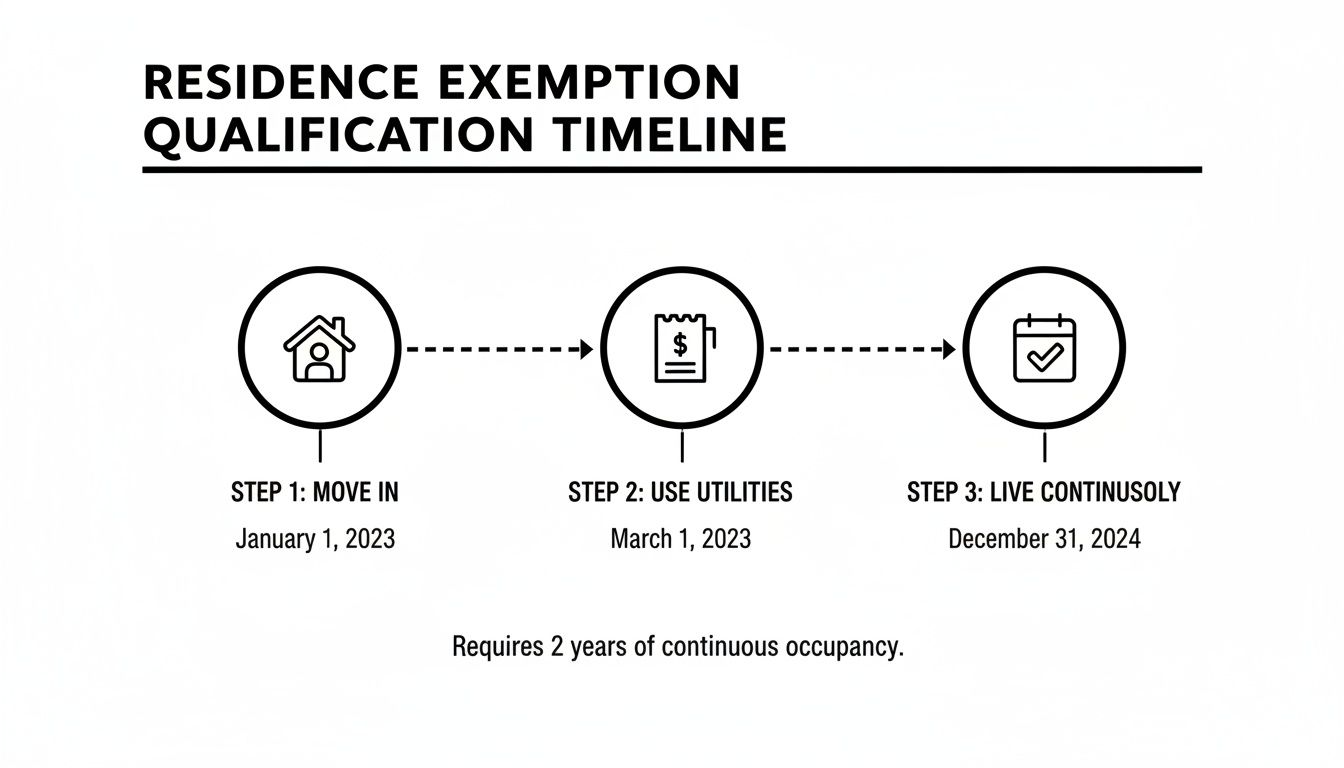
As the timeline shows, qualifying for the exemption begins with real actions like moving your stuff in and getting the power connected. This sets a clear 'start date' for your home being your main residence, which is the essential first step.
Practical Example: The Interstate Work Contract
Imagine a professional named Chloe who lives in Melbourne. She bought her home in 2018. In 2022, she gets a fantastic three-year work contract in Sydney. Instead of selling up, she decides to rent out her Melbourne place.
- 2022: Chloe moves to Sydney, and tenants move into her Melbourne home. The six-year clock officially starts.
- 2025: Her contract wraps up, and she moves back home to Melbourne. She has used up three of her six available years.
- 2026: A year later, Chloe decides to sell her Melbourne home. Because she sold it within the six-year window and didn't nominate another property as her main residence, the entire capital gain is 100% tax-free.
She perfectly used the main residence exemption to cover her time away, all while earning rental income.
The Critical Pitfall You Must Avoid
The 6-year rule comes with one massive string attached that trips a lot of people up.
While your original home is being treated as your main residence under this rule, you cannot claim any other property as your main residence.
This is a non-negotiable condition. If you buy a new home in the city you've moved to and live in it, you instantly lose the ability to apply the 6-year rule to your original property from that point on. You can own ten other properties, but only one can be your main residence for tax purposes at any given time.
For a deeper dive into the specific conditions, our guide on the main residence exemption 6-year rule breaks it down even further.
The Australian Taxation Office is clear on this: "If you use your former home to produce income, you can treat it as your main residence for up to 6 years after you stop living in it." This is outlined in section 118-145 of the Income Tax Assessment Act 1997.
Hitting the Reset Button for Future Flexibility
Here’s where the 6-year rule gets even better: the clock can be reset. If you move back into your original home and properly re-establish it as your main residence, the six-year count stops and resets to zero.
Practical Example: Resetting the Clock
Let’s go back to Chloe.
- Chloe moved back into her Melbourne home in 2025.
- She lives there for a couple of years.
- In 2028, she decides to take a two-year trip overseas and rents out her home again.
Because she moved back in and made it her home again, a brand-new six-year period kicks off in 2028. This powerful 'reset' feature allows homeowners to use the rule multiple times, providing incredible long-term flexibility.
To make the most of this, meticulous record-keeping is a must. You need to keep documents showing when you lived in the property, when it was rented out, and any vacant periods. Given the huge tax savings on the line, chatting with a tax professional is always a smart move to make sure you're getting it right.
Calculating a Partial CGT Exemption
While a full Capital Gains Tax (CGT) exemption is the dream, life and how we use our properties are rarely that simple. It’s common for homeowners to find themselves in a situation where only a partial CGT exemption on their main residence applies. This usually happens when your home has pulled double-duty at some point during your ownership.
Knowing how to figure out your liability in these scenarios is crucial. The ATO uses a straightforward, pro-rata method to work out what slice of your capital gain is taxable and what portion is shielded. It’s a formula-based approach that takes out the guesswork.
This calculation typically comes into play in a few common situations: you first rented out a property before moving in, you used part of your home to generate income, or you went over the six-year absence rule.
When Your Home Was First an Investment
A well-trodden path to homeownership is buying a property and renting it out for a few years before you actually move in. This creates two distinct periods in your ownership journey: an income-producing period and a main residence period.
When this happens, the ATO requires you to split the capital gain based on the number of days the property was not your main residence.
Practical Example: The Rent-Vestor
Let's look at Michael. He bought an apartment on 1 July 2014 for $400,000 and rented it out straight away. On 1 July 2019, he moved in and it officially became his home. He then sold it on 30 June 2024 for $700,000, netting a total capital gain of $300,000.
- Total Ownership Period: 10 years (3,652 days).
- Non-Main Residence Period: From 1 July 2014 to 30 June 2019 = 5 years (1,826 days).
- Calculation:
- ($300,000 Total Gain) x (1,826 Non-Main Residence Days ÷ 3,652 Total Ownership Days) = $150,000
In Michael’s case, $150,000 of his capital gain is assessable for CGT. The other half is covered by the main residence exemption. For a deeper dive, you can explore our guide on how to calculate capital gains tax.
When Your Home Is Used for Business
Another scenario we see all the time is using part of your home to run a business. Think a dedicated home office for a consultant, a workshop for a tradie, or a studio for a creative professional. If you claim tax deductions for the running costs of that part of your home (like interest on your mortgage or electricity), you generally lose the main residence exemption for that portion of the property.

Before you even touch the CGT numbers, it's vital to accurately determine your home's value. This step establishes the crucial "sale price" figure you'll need for your calculations.
The ATO makes this clear in section 118-190 of the Income Tax Assessment Act 1997. If you use any part of your home to produce assessable income and could claim a deduction for interest on money borrowed to acquire the home, the exemption does not apply to that part.
Calculating CGT for Business Use
The calculation here usually looks at two things: the percentage of your home's floor area used for the business, and how long you used it for that purpose.
Practical Example: The Home Office
Meet Sophia, an architect. She has used 15% of her home's floor area as her dedicated office for the entire 12 years she has owned it. She sells her home and makes a capital gain of $500,000.
- Taxable Portion: 15% of the total gain.
- Calculation: $500,000 x 15% = $75,000
Sophia's assessable capital gain is $75,000. The remaining $425,000 is completely tax-free under the main residence exemption.
Take Action and Get Clarity
Working out a partial exemption can get messy, especially if your situation involves multiple periods of different use. Here’s what you should do:
- Gather Your Records: Pull together all your documents showing purchase and sale dates, property valuations, and records of any rental or business use.
- Measure Your Space: If you used your home for business, get the tape measure out and accurately calculate the floor area percentage that was used.
- Seek Expert Guidance: A simple mistake here can be costly. The rules are very specific, and getting it wrong can lead to a painful and unexpected tax bill.
These calculations are not something you want to leave to chance. Getting a tax professional involved ensures your numbers are spot-on and compliant with ATO rules, giving you complete peace of mind when it's time to sell.
The Tricky Stuff: Special Rules and Common Traps to Watch Out For
The main residence exemption is one of the most generous tax breaks you can get, but it’s not always straightforward. Life throws curveballs, and the tax rules have to keep up. This is where things can get complicated, and a simple misunderstanding can lead to a surprise tax bill you really didn't see coming.
From inheriting the family home to navigating a divorce, certain life events have their own specific set of ATO rules. Getting your head around how these apply to your cgt exemption for a main residence is the key to protecting your biggest asset.
What Happens When You Inherit a Home?
Inheriting a property is an emotional time, and the last thing you want to worry about is Capital Gains Tax. The CGT rules for inherited homes depend almost entirely on how and when the person who passed away originally got the property.
It generally boils down to a couple of scenarios:
- If they bought it before 20 September 1985: This is what we call a 'pre-CGT' asset. If you inherit a pre-CGT home, you're usually in the clear and won't pay any CGT, provided you sell it within two years of the person's death.
- If they bought it on or after 20 September 1985: If the property was their main residence right up until they passed away and they weren't using it to earn an income (like renting out a room), you can also get a full exemption. Again, the catch is you generally need to sell within that same two-year window.
What if you hold onto it for longer than two years, or what if they were renting it out? That's when things get more complex, and a partial exemption might apply. The ATO has very specific guidance on this, which you can find in Division 128 of the Income Tax Assessment Act 1997.
A Word of Warning for Foreign and Temporary Residents
This is a big one. The rules for non-residents have changed dramatically in recent years. What used to be a fairly straightforward partial exemption has now become much stricter.
Essentially, for properties sold after 30 June 2020, foreign residents are generally no longer eligible to claim the main residence exemption at all. There are some very limited exceptions for major life events, but for the most part, the door has been closed. This was a major policy shift, and you can dig into the reasoning and fiscal impact in the various parliamentary reports on housing and foreign investment.
Building or Renovating Your Dream Home?
So, you've bought a block of land and you're building from scratch. Does the exemption only kick in once you're living there? Not necessarily. This is where the 'four-year rule' comes in, and it’s a lifesaver for anyone building or doing a major reno.
The ATO gives you a grace period. You can treat vacant land as your main residence for up to four years before the dwelling is actually ready to live in, as long as you are building, repairing, or renovating it.
The key conditions are that you have to move in as soon as it's practical to do so and then genuinely use it as your main home. This handy provision, detailed in section 118-150 of the tax act, means the clock on your cgt exemption on your main residence can start ticking even before the walls are up.
Dealing With a Marriage or Relationship Breakdown
Separation is tough enough without a tax headache on top. Thankfully, the system has special 'rollover relief' provisions to prevent CGT from making a difficult situation even worse.
If your home is transferred to your ex-spouse or partner as part of a formal separation agreement or court order, any CGT is effectively paused. The person who receives the property also inherits its full history, including the original purchase price and dates. This means the main residence exemption can continue to apply seamlessly, as if ownership never changed hands, preventing a nasty tax event right when you least need it.
Getting these special rules right isn't just about ticking boxes for the ATO; it's about smart financial planning. A small mistake can have big consequences. If any of these situations sound familiar, don't guess. Reach out to a qualified tax expert for clear advice tailored to your life, ensuring you protect your exemption and your finances.
When to Seek Expert Tax Advice
Knowing the rules for the CGT exemption on your main residence is one thing. Applying them perfectly to your unique financial situation? That’s another challenge altogether.
While getting your head around the basics is a great start, the stakes are just too high to rely on guesswork—especially when we’re talking about your most valuable asset. Smart tax planning isn’t something you do the night before you sell; it’s a strategy you should be thinking about years in advance.
Trying to fix a complex tax issue after you’ve sold your property is like trying to patch a roof in the middle of a storm. It’s far more effective to see the problems coming and structure your affairs correctly from the get-go. This is especially true in those grey areas where the rules aren't so black and white.
Red Flags: When You Absolutely Need to Call a Pro
Certain life events or property situations crank up the complexity and should be an immediate sign to pick up the phone and speak with a qualified tax agent or property accountant.
- You have a partial exemption on your hands: If you’ve ever rented out a room, run a business from home, or used it as an investment property, a precise calculation isn't just a good idea—it's mandatory.
- You inherited the property: The rules for inherited homes are notoriously tricky. The tax outcome hinges on specific dates and how the person who left you the property originally used it.
- The 6-year rule might apply to you: This is a fantastic concession, but maximising it without accidentally voiding your exemption requires very careful planning and solid records.
- You're a non-resident for tax purposes: Recent changes to the law have seriously limited the main residence exemption for Aussies living abroad.
Honestly, these scenarios are just the tip of the iceberg. Any situation that’s more complicated than the simple "I bought it, lived in it the whole time, and then sold it" model really needs a professional set of eyes on it.
Getting the Most Out of Your Consultation
To make a meeting with a tax professional truly worthwhile, you need to come prepared. When you have your information in order, you empower your advisor to give you sharp, actionable advice that’s right for you.
The Australian Taxation Office’s official guidance on the main residence exemption is laid out in the Income Tax Assessment Act 1997. An expert's job is to translate that dense legislation into a clear plan based on your personal history and records.
Before you walk into that appointment, get these documents together:
- Purchase and Sale Contracts: Anything showing the key dates and prices.
- Your Ownership Timeline: A clear record of when you lived in the property versus when it was rented out, vacant, or used for something else.
- Business Use Details: If you ran a business, note down the floor area you used and for how long.
- Renovation Costs: A folder with receipts for any major capital improvements is gold.
Taking control of your tax outcome starts by knowing when to ask for help. By seeking expert advice, you swap uncertainty for confidence, ensuring you get the best possible financial result while staying on the right side of the ATO.
Don’t leave Australia’s most generous tax break to chance. If you're in Ashfield or the Northern Beaches and need clarity on your CGT, book a consultation with us today. It’s the best way to secure your financial peace of mind.
Got Questions? We’ve Got Answers.
When you start digging into the CGT exemption for your main residence, a few common "what if" scenarios always pop up. Let's tackle some of the most frequent questions homeowners ask us.
Can I Have Two Main Residences at Once?
Straight up, no. For tax purposes, you can only nominate one property as your main residence at any given time.
But the Australian Taxation Office (ATO) isn't completely inflexible. They know that life involves moving house. So, there's a handy six-month overlap rule for when you're selling your old place and buying a new one.
You can treat both properties as your main residence for up to six months, provided the old home is sold within that window and the new one genuinely becomes your new home. This little concession is outlined in the Income Tax Assessment Act 1997.
What If I Knock Down and Rebuild My Home?
This is where the ATO's 'four-year rule' comes into play. It’s designed specifically for people who are building, repairing, or renovating their home.
Essentially, you can treat a block of land as your main residence for up to four years while the work is being done.
To qualify, the property must have been your main residence right before you started demolition. Once the build is complete, you have to move back in as soon as you reasonably can and live there for a decent amount of time.
Does the 6-Year Absence Rule Still Work if My Property Is Empty?
Yes, it does—and in this case, the rule actually gets a lot more generous.
If you move out of your home but don't rent it out to produce any income, you can continue to treat it as your main residence indefinitely. That’s right, no time limit.
The six-year clock only starts ticking the moment a tenant moves in and you start earning rental income. The one catch? This indefinite exemption only works as long as you don't nominate another property as your main residence in the meantime.
Feeling a bit tangled in the rules? That's completely normal. This is where getting the right advice makes all the difference. At EndureGo Tax, our local accountants in Ashfield and the Northern Beaches are here to give you the clarity you need.
Let’s figure it out together. You can book a consultation with us today.
