


Let’s clarify a crucial point from the outset, as it’s a common source of confusion: Australia does not have a separate, standalone Capital Gains Tax rate.
Instead, any net capital gain you make is added to your regular taxable income for the year and taxed at your personal marginal tax rate. Mastering this concept is the key to understanding how CGT truly functions within the Australian tax system.
How Capital Gains Tax Really Works in Australia
Think of your annual income as a single pool. Your salary, business profits, and other earnings flow into this pool. When you sell an asset for a profit, the Australian Taxation Office (ATO) simply views that capital gain as another stream of income to be added to the same pool.
It is not taxed separately with a special “gains tax.” It increases your total income for the year, meaning the gain is taxed at the same progressive rates as everything else. The trigger for this is known as a Capital Gains Tax (CGT) event.
What Is a CGT Event?
A CGT event is the specific moment a capital gain or loss is realised for tax purposes. While selling an asset for more than you paid is the most common example, it is far from the only one.
Under Australian tax law, several other situations are also classified as CGT events, including:
- Selling an asset: This is the primary trigger, applying to assets like shares, investment properties, or cryptocurrency.
- Gifting an asset: If you transfer an investment property to a family member, the ATO treats it as a disposal at its current market value.
- An asset being lost or destroyed: Receiving an insurance payout for a destroyed investment can also trigger a CGT event.
- Receiving a non-assessable payment: This can occur when a company you own shares in makes a distribution that isn’t a standard dividend.
For a deeper dive into these fundamentals, you can learn more about what capital gains tax is and how these events function. This infographic also provides a great visual summary of the process.
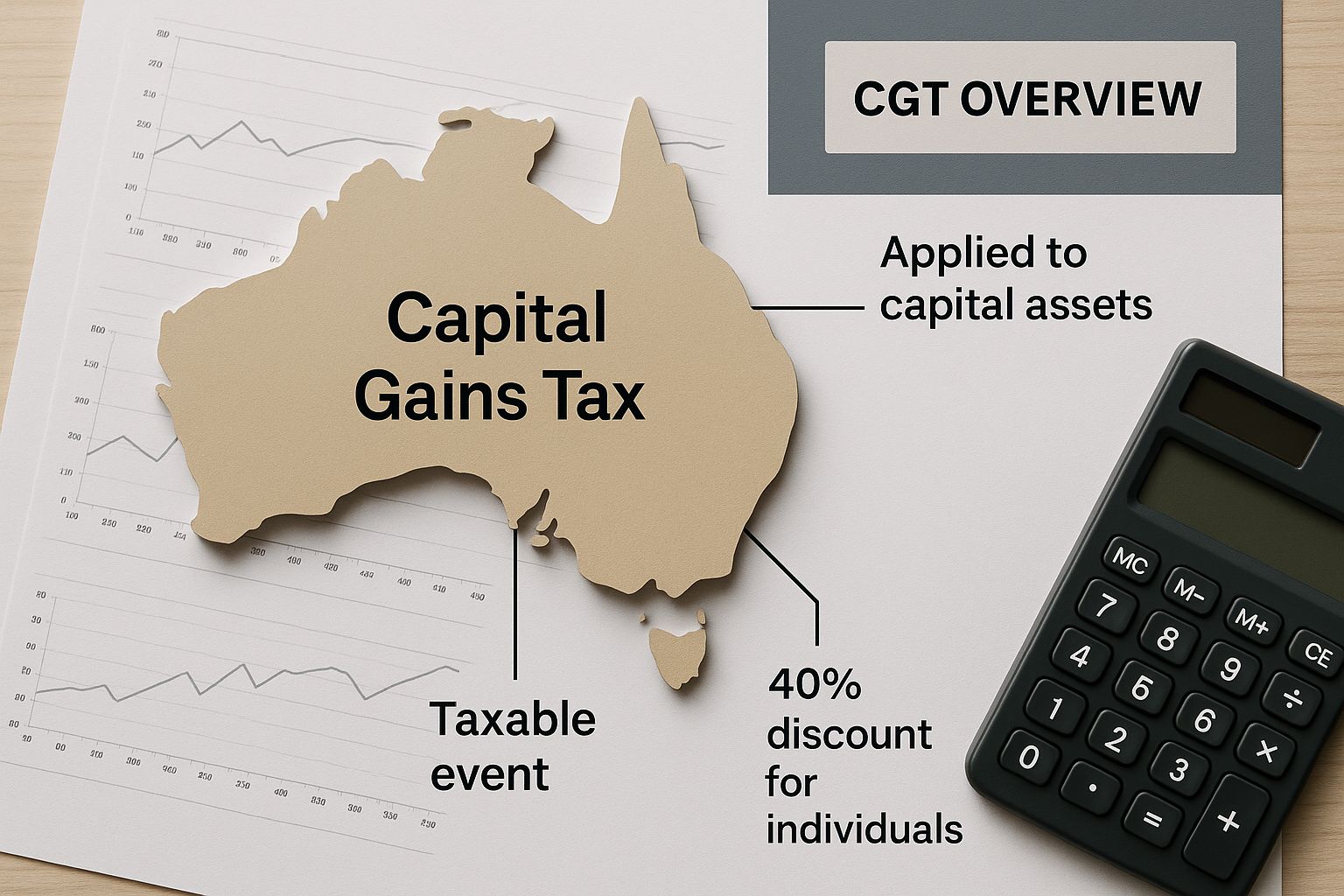
As you can see, CGT isn’t an isolated tax; it’s woven directly into your overall income assessment.
A Practical Example of How CGT Impacts Income
Let’s analyse a practical scenario. Sarah, a graphic designer, earns $90,000 a year. She decides to sell some shares she purchased two years ago, realising a $20,000 profit (her capital gain).
Because she held the shares for more than 12 months, she is eligible for the single most powerful tool for reducing a CGT liability: the 50% CGT discount. This means only half of her gain, or $10,000, is assessable.
Her total taxable income for the year is not just her salary. It becomes:
$90,000 (salary) + $10,000 (assessable capital gain) = $100,000
This additional $10,000 is taxed at her marginal tax rate. There is no special, separate rate applied to it.
The CGT Calculation at a Glance
This table simplifies the journey from raw capital gain to the final amount added to your assessable income.
| Step | Action | Practical Example |
|---|---|---|
| 1 | Determine Capital Proceeds | You sell shares for $50,000. |
| 2 | Calculate the Cost Base | The shares originally cost you $30,000 (including brokerage fees). |
| 3 | Calculate the Capital Gain | $50,000 (Proceeds) – $30,000 (Cost Base) = $20,000 Gain. |
| 4 | Apply any Capital Losses | Let’s assume you have no capital losses to apply. |
| 5 | Apply any Discounts | You held the shares for over 12 months, so apply the 50% discount. |
| 6 | Determine the Net Capital Gain | $20,000 x 50% = $10,000. This is the amount added to your income. |
This process shows that the final taxable figure is often much smaller than the initial profit, especially when strategic discounts are applied. Understanding that a capital gain is just another slice of your income pie is the foundational step to mastering CGT. It shifts your focus from searching for a specific tax rate to strategically managing your overall taxable income and, crucially, the timing of your asset disposals.
Calculating Your Capital Gain or Loss with Confidence
Accurately calculating your Capital Gains Tax (CGT) liability hinges on mastering two key figures: your capital proceeds and your cost base. The capital proceeds are typically straightforward—it’s the sale price. The real work, and where many inadvertently overpay tax, is in constructing a comprehensive cost base. This figure is far more than just the initial purchase price; the Australian Taxation Office (ATO) permits the inclusion of a wide range of expenses, which directly reduces your taxable gain.
Unpacking the Five Elements of the Cost Base
The ATO officially divides the cost base into five distinct elements to help you capture every allowable expense, as detailed in the Income Tax Assessment Act 1997.
- Acquisition Costs: The money paid for the asset itself, such as the purchase price of shares or a property.
- Incidental Costs: Direct costs associated with buying and selling. This includes stamp duty, legal fees, surveyor costs, real estate agent commissions, and advertising expenses.
- Ownership Costs: Non-deductible expenses incurred during ownership. For an investment property, this could be council rates, land tax, or insurance premiums, but only if you have not already claimed them as an annual tax deduction.
- Capital Improvement Costs: Money spent to enhance the asset’s value, for example, the cost of a major kitchen renovation on an investment property.
- Title Costs: Expenses incurred to preserve or defend your ownership, such as legal fees from a boundary dispute.
Practical Example: Calculating an Investment Property Gain
Let’s walk through a real-world scenario. David bought an investment property in 2015 and sold it this financial year.
- Capital Proceeds (Sale Price): $850,000
Now, we construct his cost base, element by element:
- Element 1 (Purchase Price): $500,000
- Element 2 (Incidental Costs): $20,000 for stamp duty and $2,500 in legal fees on purchase. Upon selling, he paid $17,000 in agent commission and $3,000 in legal fees. Total incidental costs: $42,500.
- Element 4 (Improvement Costs): $30,000 for a new deck added in 2019.
His total cost base is $500,000 + $42,500 + $30,000 = $572,500.
The capital gain is calculated by subtracting the cost base from the proceeds:
$850,000 – $572,500 = $277,500
This $277,500 is David’s gross capital gain. As he held the property for over 12 months, he can apply the 50% CGT discount, reducing his assessable gain to $138,750.
What Happens When You Make a Capital Loss?
Not every investment yields a profit. If your capital proceeds are less than your cost base, you have realised a capital loss.
The golden rule is: capital losses can only be used to offset capital gains. You cannot use a capital loss to reduce your taxable income from your salary or business.
However, a capital loss is not wasted. If you have no capital gains to offset in the current year, the loss can be carried forward indefinitely to be used against future capital gains.
For instance, if you have a $5,000 capital loss this year and no gains, you can carry it forward. If next year you realise a $15,000 capital gain, you can use that prior year loss to reduce the gain to $10,000 before applying any discounts.
It’s also crucial to know how different investment types handle their gains. If you have a diverse portfolio, understanding capital gains distributions from mutual funds is a critical piece of the puzzle.
Your Actionable Takeaway Today
Do not wait until tax time to start excavating old records. The single most effective action you can take now is to create and maintain a detailed cost base spreadsheet for every CGT asset you own. Log every expense as it occurs—from initial purchase to final sale—and keep digital copies of all receipts. This simple discipline will streamline tax preparation and ensure you never pay a dollar more in tax than legally required.
Using the 50% CGT Discount to Your Advantage
The 50% CGT discount is the most powerful tool available to long-term investors in Australia for reducing their tax liability. Understanding this concession is often the difference between a significant tax bill and a manageable one. It is a strategic advantage deliberately built into the tax system to reward patient investors.
The government’s logic is to incentivise long-term investment over short-term speculation. By offering this substantial tax break, it directly slashes the effective capital gains tax rate in Australia that you ultimately pay.

The Golden Rule of Eligibility
To qualify for the discount, there is one non-negotiable rule: you must own the asset for more than 12 months before the CGT event.
A single day can make a profound difference. Sell an asset at 11 months and 28 days, and 100% of your gain is subject to tax. Wait a few more days to cross the 12-month threshold, and you instantly cut your taxable gain in half.
Who Can Claim the 50% Discount?
This is a critical detail, as eligibility varies by entity. The discount is available to:
- Individuals: The primary beneficiaries.
- Trusts: Including Self-Managed Super Funds (SMSFs), though the rates differ.
- Complying Superannuation Funds: They receive a discount, but it is less than 50%.
For individual Australian taxpayers who have held an asset for over a year, the capital gain is reduced by 50%. For super funds, the discount is 33.3%. You can explore how Australian capital gains tax encourages long-term holding if you are interested in the policy background.
Crucially, companies are not eligible for the CGT discount. This is a major consideration when determining the optimal structure for holding your investments.
The Critical Order of Operations
The ATO requires a specific order of calculation. Many taxpayers get this wrong and miscalculate their liability.
Key Takeaway: You must apply any capital losses first. This includes losses from the current year and those carried forward from previous years. Only after you have reduced your gross capital gains with all available losses can you then apply the discount to the remaining amount.
Let’s illustrate with a practical example. Imagine you realised a $30,000 capital gain on shares held for two years. You also sold other assets for a $5,000 capital loss.
- Step 1 (Apply Losses First): $30,000 (Gain) – $5,000 (Loss) = $25,000.
- Step 2 (Apply Discount Second): $25,000 x 50% = $12,500.
Your final assessable capital gain, the amount added to your income for the year, is $12,500. You cannot apply the discount to the larger $30,000 figure first.
CGT Discount Impact on Your Taxable Gain
This table demonstrates the dramatic effect of the discount on a $40,000 capital gain.
| Taxpayer Type | Capital Gain | Taxable Gain (Held < 12 Months) | Taxable Gain (Held > 12 Months) |
|---|---|---|---|
| Individual | $40,000 | $40,000 | $20,000 (50% discount) |
| Super Fund | $40,000 | $40,000 | $26,680 (33.3% discount) |
| Company | $40,000 | $40,000 | $40,000 (No discount) |
For an individual, patience transforms a $40,000 taxable event into a much more manageable $20,000 one, potentially saving thousands depending on their marginal tax rate.
What to Do Next
Your immediate action item is to review your portfolio. Compile a list of your assets, note their purchase dates, and identify any nearing the 12-month ownership milestone. Strategic foresight allows you to make informed selling decisions that legally minimise your tax burden, making this valuable CGT concession work for you.
CGT Exemptions Every Investor Should Know
While the 50% discount is a powerful tool for reducing your capital gains tax, certain exemptions can eliminate it entirely. Understanding these rules is a game-changer, as it can save you from a substantial and often unexpected tax bill.
The most significant and widely known of these is the main residence exemption. This cornerstone of Australian property ownership allows most individuals to sell their family home without paying any Capital Gains Tax. It is designed to ensure you are not taxed on the sale of your primary home, but the rules can be complex.
The Main Residence Exemption in Detail
To qualify for the full exemption, the property must have been your main residence for the entire period you owned it. Furthermore, you cannot have used it to produce income, such as by running a business from a dedicated home office or renting out a room.
For most homeowners, this is a straightforward benefit. You buy a home, live in it, and when you sell, the profit is yours, tax-free. But specific rules apply if you move out temporarily.
Using the Six-Year Absence Rule
Life events often necessitate moving out of your home. The ATO accommodates this with the six-year absence rule. This provision allows you to move out of your main residence and rent it out for up to six years without losing the full exemption, provided you do not claim another property as your main residence during that same period.
If you move back in before the six years expire, the clock resets, potentially allowing for another six-year absence period in the future.
Practical Example: Sarah bought her Sydney home in 2016. In 2020, she accepted a three-year work contract in Perth and rented out her Sydney property. She returned in 2023. If she sells her home in 2025, the entire capital gain is tax-free because her income-producing absence was well within the six-year limit.
When a Partial Exemption Applies
The main residence exemption is not always an all-or-nothing proposition. A partial exemption, which can still significantly reduce your tax, often applies in two common scenarios:
- Using Your Home for Business: If you use part of your home exclusively to run a business and claim related occupancy expenses, that portion of your home is not covered by the exemption for that period. Upon sale, you must calculate the capital gain attributable to the business-use percentage of the property.
- Moving Into an Investment Property: If you bought a property and rented it out for five years before moving in and making it your main residence for the next ten years, you will only receive a partial exemption upon sale. The capital gain must be apportioned based on the time it was an investment versus your home.
Other Important CGT Exemptions
Beyond your family home, several other key exemptions can shield you from CGT.
- Pre-CGT Assets: Any asset acquired before 20 September 1985 is generally exempt from CGT. This date marks the commencement of Australia’s CGT regime. The legislative basis for this is in Part 3-1 of the Income Tax Assessment Act 1997.
- Inherited Assets: While inheritance law can be complex, you generally do not pay tax upon receiving an asset. CGT may apply when you eventually sell it, with the tax treatment depending heavily on when the deceased originally acquired the asset.
- Small Business CGT Concessions: For business owners, four valuable concessions can reduce, defer, or eliminate CGT on the sale of active business assets. The eligibility rules are strict but are essential to explore with a tax professional when selling a business.
Navigating these exemptions requires careful planning. If your situation involves a property with mixed use, a temporary absence, or inherited assets, seeking professional advice is critical.
A qualified accountant at EndureGo Tax can help you navigate the rules and ensure you claim every exemption you’re entitled to. Book a consultation today to secure your financial peace of mind.
Proactive Strategies to Legally Minimise Your CGT
Understanding how to calculate Capital Gains Tax is foundational; actively and legally minimising it is the next level of financial expertise. This requires shifting from a reactive, year-end approach to proactive portfolio management. By implementing the right strategies, you can significantly reduce the impact of the capital gains tax rate in Australia on your investment returns. These are not loopholes but legitimate methods integrated into our tax system.
Master the Art of Tax-Loss Harvesting
Tax-loss harvesting is a powerful and widely used strategy. The concept is simple: you deliberately sell an underperforming asset to realise a capital loss. This loss then becomes a valuable tool for tax planning. You can use it to offset capital gains realised from selling other, more profitable investments. By offsetting gains with losses, you directly reduce your net capital gain—the final amount added to your taxable income.
Practical Example:
This financial year, you sell shares in Company A for a $10,000 profit. You also hold shares in Company B that are currently showing an unrealised loss of $8,000. By selling the Company B shares, you “harvest” that loss. The $8,000 loss directly offsets your $10,000 gain, leaving a net capital gain of just $2,000 to be taxed.
This strategic selling is a cornerstone of sophisticated portfolio management, turning a negative position into a tax-saving positive.
Time Your Asset Sales Strategically
Timing is a critical factor in managing CGT. When you sell a profitable asset determines the financial year in which the gain is assessed and, consequently, how much tax you pay.
If you anticipate a lower income next financial year—due to a career break, reduced work hours, or retirement—it could be highly advantageous to delay selling the asset until after 30 June. By pushing the CGT event into a year where you fall into a lower marginal tax bracket, the rate applied to that gain decreases significantly.
It is also beneficial to understand the tax implications of specific trading strategies, such as the covered call tax treatment, to ensure complete financial optimisation.
Choose the Right Investment Structure
The structure through which you own an asset has a profound impact on your final tax bill. The ATO treats legal structures very differently, particularly for CGT.
- Individuals: Benefit from the full 50% CGT discount. The disadvantage is that gains are taxed at personal marginal rates, which can be as high as 45% (plus levies).
- Companies: Pay a flat corporate tax rate but are not eligible for any CGT discount. This often makes them unsuitable for holding long-term growth assets.
- Trusts: Offer significant flexibility, allowing for the distribution of gains to beneficiaries in lower tax brackets, thereby minimising the overall tax paid by the family group.
- Self-Managed Super Funds (SMSFs): In the accumulation phase, SMSFs are taxed at only 15% on gains and receive a 33.3% CGT discount, resulting in an effective tax rate of just 10% on long-term assets. In the pension phase, the tax rate on gains can be 0%.
Strategic structuring is a key wealth-building strategy. For further insights into advanced methods, see our guide on a proven effective tax strategy that will save 90% capital gains tax.
Use this information as your starting point. Your next step should be to book a consultation with a qualified financial advisor who can analyse your specific circumstances and develop a tailored strategy.
Your Top CGT Questions, Answered
Navigating Capital Gains Tax can be daunting, but practical examples clarify its real-world application. Let’s address some of the most frequent questions from investors to help you understand how the capital gains tax rate in Australia applies to your situation.
How Is CGT on an Investment Property Calculated?
For an investment property, the calculation begins with establishing a comprehensive cost base. You start with the sale price and subtract every allowable cost incurred throughout the ownership period.
The cost base for a property includes much more than the purchase price:
- Stamp duty paid on acquisition.
- Legal and conveyancing fees (for both purchase and sale).
- The cost of capital improvements, like a new kitchen or deck.
- The real estate agent’s commission on sale.
After subtracting this total cost base from your sale price, you have the gross capital gain. If you owned the property for over 12 months, you can then apply the 50% CGT discount to halve that gain. If the property was your main residence for a period, a more detailed calculation is required to claim a partial exemption.
Do I Pay Tax on Inherited Assets?
Generally, you do not pay tax upon inheriting an asset. The CGT event occurs when you later sell or dispose of that asset. The amount of tax payable depends on when the deceased originally acquired it.
The Australian tax system has specific “look-back” rules for inherited assets, outlined in Division 128 of the Income Tax Assessment Act 1997, which you can review on the ATO’s legal database.
If the asset was acquired before 20 September 1985, your cost base is its market value on the date of the deceased’s passing. If acquired on or after that date, you inherit the deceased’s original cost base. This distinction can significantly impact your final tax liability.
What Records Must I Keep for the ATO?
Meticulous record-keeping is your primary defence against overpaying CGT and is a legal requirement. You must retain all relevant records for at least five years after the financial year in which you report the capital gain.
Your essential record-keeping checklist must include:
- Purchase and sale contracts showing dates and prices.
- Receipts for all cost base elements, including legal fees, stamp duty, renovation invoices, and agent commissions.
- Proof of ownership and documentation proving any periods the property was your main residence.
Without these records, you cannot substantiate your cost base. In an audit, the ATO may assess your gain based only on purchase and sale prices, potentially resulting in an excessive and incorrect tax assessment.
Navigating CGT exemptions, cost base rules, and strategic tax planning requires expert guidance. The team at EndureGo Tax specialises in providing clear, actionable advice for individuals and businesses in Ashfield Inner West, Sydney. We ensure you meet all your obligations while legally minimising your tax liability.
Book a consultation today at https://www.endurego.com.au to take control of your tax position and secure your financial future.
