


Staying on top of your Business Activity Statement (BAS) is a non-negotiable for every Australian business. Getting it wrong can mean penalties from the ATO, and getting it right starts with one thing: knowing your BAS due dates for 2026. As expert tax professionals, we understand that mastering these deadlines is fundamental to maintaining your business’s financial health.
The key deadlines depend entirely on your reporting cycle. Most small businesses operate on a quarterly schedule, larger enterprises are typically monthly, and a select few lodge annually. Nailing these dates means you can lodge and pay on time, keeping your business in the ATO’s good books and optimising your cash flow.
Your Essential 2026 BAS Due Dates Quick Reference
To maintain compliance, you must first identify which reporting schedule applies to your business. The Australian Taxation Office (ATO) sets firm deadlines for lodging your BAS and paying any tax you owe, like GST and PAYG withholding.
While many business owners lodge their own statements, engaging a registered BAS agent provides access to valuable lodgement extensions, offering crucial flexibility. For a comprehensive overview of all your tax obligations, you might find our complete guide on Australian tax due dates helpful.
This timeline provides a clear visual of the recurring deadlines for each BAS cycle throughout 2026.
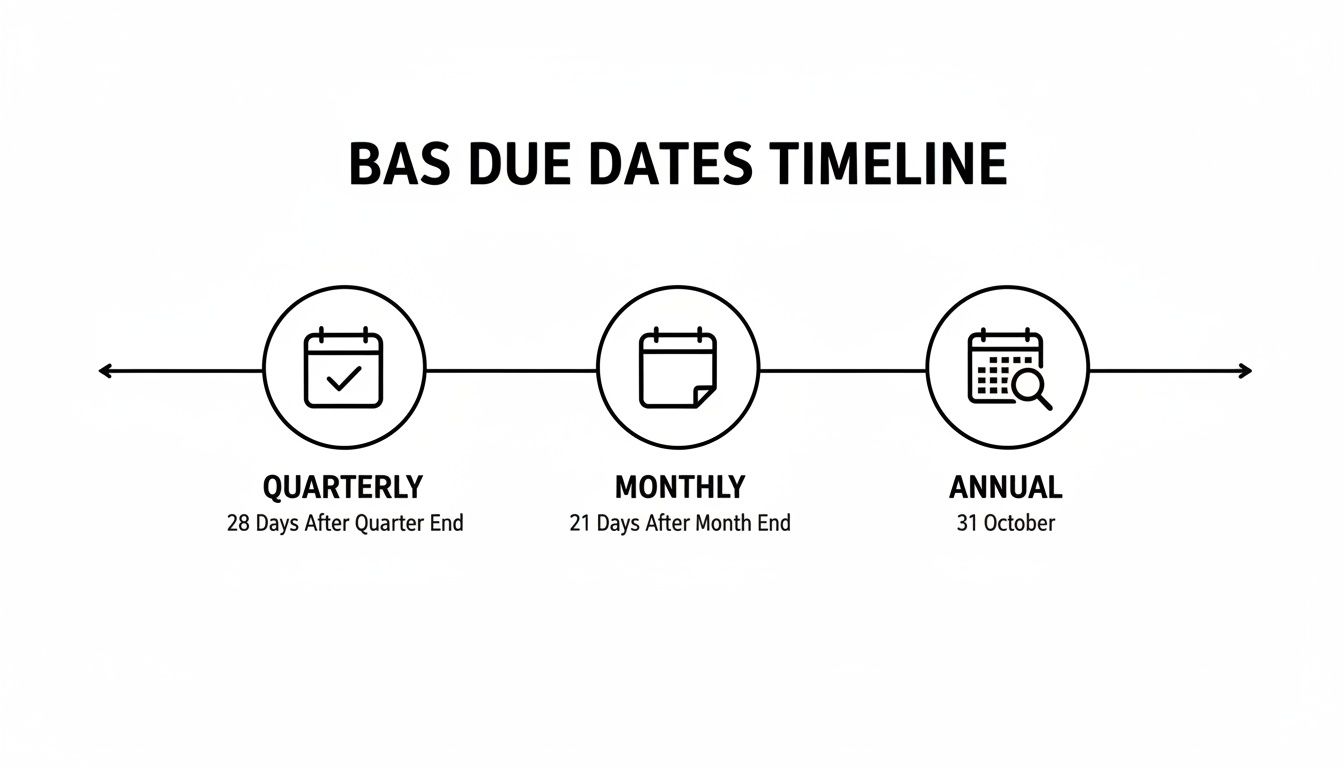
You can see the steady rhythm of the monthly deadlines compared to the more spaced-out quarterly dates. It’s the perfect way to start mapping out your compliance calendar for the year ahead.
2026 BAS Lodgement and Payment Due Dates
Here is a quick-reference table outlining the lodgement and payment dates for all reporting cycles. Consider this your definitive source for planning your 2026 tax compliance schedule. These dates are set by the ATO and are strictly enforced, so we strongly advise entering them into your calendar now.
| Reporting Period | Lodgement Due Date (Self-Lodger) | Lodgement Due Date (via Registered Agent) |
|---|---|---|
| Quarterly | ||
| Q1 (Jul-Sep 2025) | 28 October 2025 | 25 November 2025 |
| Q2 (Oct-Dec 2025) | 28 February 2026 | 28 February 2026 |
| Q3 (Jan-Mar 2026) | 28 April 2026 | 26 May 2026 |
| Q4 (Apr-Jun 2026) | 28 July 2026 | 25 August 2026 |
| Monthly | The 21st day of the following month | The 21st day of the following month (no extension) |
| Annual | 31 October 2026 | Varies, often aligned with tax return |
As you can see, lodging through a registered agent like EndureGo Tax can provide up to an extra month for certain quarters—a significant advantage when you’re managing a business. The only exception is the second quarter, where the due date is the same for everyone to accommodate the summer holiday period.
Understanding Quarterly BAS Deadlines for 2026
For the vast majority of Australian small businesses, lodging a Business Activity Statement every quarter is a standard operational rhythm. If your company has a Goods and Services Tax (GST) turnover under $20 million, the ATO will almost certainly have you on this reporting cycle. It’s a balanced approach—frequent enough to maintain tax compliance without creating an excessive administrative burden.
The quarterly system requires you to report and pay for your business activity over a three-month period. Mastering the specific BAS due dates for 2026 is the first, most crucial step to staying compliant and avoiding unwanted attention from the tax office.
Key Quarterly Dates for Your 2026 Calendar
Each quarter has a firm deadline, typically falling on the 28th day of the month after the quarter ends. This is where a registered agent becomes invaluable: when you work with one, you almost always receive an automatic lodgement extension.
Here are the key quarterly dates to mark in your calendar:
- Quarter 1 (July – September 2025): Deadline is 28 October 2025.
- Quarter 2 (October – December 2025): Deadline is 28 February 2026.
- Quarter 3 (January – March 2026): You need to lodge by 28 April 2026.
- Quarter 4 (April – June 2026): The final quarterly deadline is 28 July 2026.
Note that the second quarter deadline is extended for all lodgers to account for the summer holiday shutdown.
Practical Example: A Local Builder
Let’s make this practical. Imagine a builder based in Ashfield. From July to September, he’s busy on-site while meticulously tracking sales invoices (collecting GST) and receipts for materials and subcontractor fees (claiming GST credits). He’s also managing wages for his apprentice, ensuring the correct PAYG tax is withheld.
Once the quarter ends on 30 September, this information must be compiled for his BAS. If he lodges it himself, his statement and any payment are due by 28 October 2025. There is no flexibility.
However, if he partners with a registered agent like EndureGo Tax, his deadline for the same Quarter 1 BAS is extended to 25 November 2025. That’s nearly an entire extra month. For a busy sole trader, this extension is a game-changer, providing the time needed to ensure figures for GST, PAYG, and other obligations are precise.
As permitted under the Taxation Administration Act 1953, the Commissioner of Taxation formally grants these lodgement deferrals to registered agents who lodge electronically. This framework is designed to help tax professionals manage the high volume of lodgements they handle for clients.
Don’t let these critical deadlines catch you unprepared. If you’re a small business owner in Ashfield or Belrose, take control of your tax obligations. Book a consultation with EndureGo Tax today to see how we can streamline your BAS process and secure those crucial extensions for you.
Dealing with Monthly BAS Lodgement Dates
For larger businesses in Australia, or those who elect to report more frequently, the quarterly BAS cycle is replaced by a much tighter monthly schedule. This is mandatory for any business with a GST turnover of $20 million or more. While it demands disciplined financial management, monthly reporting can significantly improve cash flow, especially for businesses with high sales volumes.
Adhering to the monthly BAS due dates for 2026 is non-negotiable. Unlike the quarterly system, there are no lodgement extensions available, even when using a registered agent—the deadline is the same for everyone. This places a heavy emphasis on having robust bookkeeping processes that operate flawlessly month after month.
The Unwavering Monthly Deadline
The rule for monthly lodgers is simple and consistent: your BAS is due on the 21st day of the month following the end of the reporting period. This creates a constant cycle of reporting and payment that requires you to stay on top of your financial data.
Here is a clear breakdown of the 2026 monthly BAS due dates:
- January 2026 Period: Due 21 February 2026
- February 2026 Period: Due 21 March 2026
- March 2026 Period: Due 21 April 2026
- April 2026 Period: Due 21 May 2026
- May 2026 Period: Due 21 June 2026
- June 2026 Period: Due 21 July 2026
- July 2026 Period: Due 21 August 2026
- August 2026 Period: Due 21 September 2026
- September 2026 Period: Due 21 October 2026
- October 2026 Period: Due 21 November 2026
- November 2026 Period: Due 21 December 2026
One Important Holiday Exception
The ATO acknowledges the pressure of the holiday season. The deadline for the December 2025 BAS period is extended to 21 February 2026. This small concession is vital for businesses navigating the busy summer shutdown period.
Practical Example: High-Volume Retailer
Consider a large retail business in Belrose with significant daily sales. By lodging its BAS monthly, it can claim back GST paid on stock purchases much faster than if it had to wait three months. This frequent return of GST credits provides a regular cash flow injection, which is critical for managing inventory and paying suppliers.
However, this advantage comes with a strict compliance trade-off. The deadlines are relentless. Missing these dates is costly, with penalties for late lodgement starting at $313 for a small entity and increasing with entity size and repeated delays.
Under the A New Tax System (Goods and Services Tax) Act 1999, businesses exceeding the GST turnover threshold are legislatively required to report monthly. This ensures that larger entities remit tax collections to the government in a timely manner, reflecting their significant economic activity.
Don’t let the monthly BAS cycle become a source of stress. For expert guidance in Ashfield or Belrose, book a consultation with EndureGo Tax. We’ll ensure your monthly reporting is accurate, on time, and strategically supports your business’s cash flow.
The Once-a-Year GST Lodgement: Is Annual Reporting for You?
For some businesses, lodging a BAS every month or quarter feels like an excessive administrative burden for very little activity. If this sounds familiar, annual GST reporting may be the solution. It is a simplified option designed for specific businesses with straightforward tax affairs, significantly cutting down on compliance tasks.
This option is primarily for businesses that have voluntarily registered for GST and have a GST turnover under $75,000 (or $150,000 for not-for-profits). It’s an ideal fit if you don’t need to claim GST credits frequently and prefer to manage your tax obligations in a single annual lodgement.
Who’s Eligible and What Are the Deadlines?
You cannot simply decide to switch; you must first obtain approval from the ATO. Once approved, your single annual BAS for the 2024-25 financial year is due for both lodgement and payment by 31 October 2026.
A key advantage is that if you use a registered agent to lodge your income tax return, this date often aligns with your tax return deadline, providing an extension. It is crucial to confirm your specific bas due dates 2026 with your tax professional.
Practical Example: The Belrose Investor
Imagine an investor in Belrose who owns a single commercial property. They voluntarily registered for GST to claim credits on expenses like repairs and agent fees, but they only have a handful of transactions each year.
For this investor, lodging a BAS every quarter is a repetitive chore with minimal financial benefit. By switching to annual GST reporting, they can consolidate all their records after the financial year ends and file a single BAS. This frees them to focus on their investment portfolio, not administrative paperwork.
The legal basis for this is found in the A New Tax System (Goods and Services Tax) Act 1999, which was structured to ease the compliance burden on smaller-scale operations. It is the government’s acknowledgement that for some entities, quarterly reporting is inefficient.
While simpler, this process demands diligent record-keeping throughout the year. The penalties for lodging late are the same, starting at $313 for a Failure to Lodge penalty.
Think annual reporting could be the right move for your business? Get in touch with EndureGo Tax. We will assess your eligibility, manage the transition with the ATO, and ensure your lodgements are handled correctly, keeping you compliant without the stress.
The Financial Consequences of Missing a BAS Deadline
Overlooking your BAS due dates 2026 is far more than a simple administrative slip-up. It results in direct and often escalating financial penalties from the Australian Taxation Office (ATO). These consequences are designed to enforce compliance and can seriously impact your cash flow if ignored.
The ATO primarily uses two mechanisms to penalise late lodgers and payers. Understanding how they function is the first step to avoiding them.
Failure to Lodge Penalty
The first consequence is typically the Failure to Lodge (FTL) penalty. This is applied automatically once your BAS becomes overdue. The penalty is calculated in units, with one penalty unit currently valued at $313.
For a small business, the ATO applies one penalty unit for every 28 days (or part thereof) that your BAS is late, capped at five units. The cost escalates rapidly.
- 1-28 days late: $313 penalty
- 29-56 days late: $626 penalty
- 57-84 days late: $939 penalty
- 85-112 days late: $1,252 penalty
- 113+ days late: $1,565 penalty (maximum for a small entity)
This is not just our interpretation. The ATO provides this official information on its website:
This official table confirms just how rapidly the cost scales, turning a short delay into a very expensive mistake.
General Interest Charge
In addition to the FTL penalty, if you have an amount to pay, the ATO will apply the General Interest Charge (GIC) to your outstanding debt. This is not a one-off fee; it accrues daily from the payment due date and compounds until the entire debt, including the GIC itself, is paid. The combination of a flat penalty and compounding interest can quickly turn a small oversight into a significant liability. To understand its full impact, you can learn more about the General Interest Charge and its calculation.
Don’t let penalties and interest charges derail your business. Book a consultation with EndureGo Tax today. Our expert agents in Ashfield and Belrose can remove the stress from BAS lodgements, ensuring you remain compliant and penalty-free.
Why Bother With a Registered BAS Agent? It’s More Than Just Paperwork
Engaging a registered BAS agent is one of the most strategic decisions a business owner can make. This is not merely about offloading paperwork; it is a tactical move that transforms BAS compliance from a recurring burden into a streamlined business function. Forget simply meeting the BAS due dates 2026—this is about gaining a competitive advantage.
The most immediate benefit is access to automatic lodgement extensions. As discussed, agents can secure up to an extra month for certain quarterly lodgements. This additional time is invaluable for managing cash flow and ensuring accuracy, avoiding the last-minute rush that often leads to errors.

Nail Your Credits and Get it Right, Every Time
A qualified BAS agent brings a professional, critical eye to your financial records. They are trained to identify every GST credit you are entitled to, from minor operational expenses to major capital purchases. Their meticulous approach ensures you are not leaving money on the table or overpaying the ATO.
Their expertise also serves as a crucial safety net. An agent will verify that:
- GST has been correctly calculated on all sales and expenses.
- Your wages and PAYG withholding figures are accurate and reconciled.
- Every claim is substantiated by a valid tax invoice, as required by law.
This professional review significantly reduces your risk of an ATO audit and provides confidence that your financial reporting is robust. To appreciate the high standards these professionals are held to, it is worth learning about the Tax Practitioners Board.
Far More Than a Lodgement Service
Ultimately, a great BAS agent is a trusted advisor. They can offer valuable insights into your cash flow, helping you plan for future tax liabilities to avoid surprises. To maintain their registration, agents must undertake continuous professional development. Understanding what constitutes CPE credit highlights the ongoing learning required.
Under the Tax Agent Services Act 2009, registered BAS agents are legally bound to act in their clients’ best interests and adhere to a strict code of professional conduct. This is not just a promise; it is a legislative requirement, assuring you that your tax affairs are managed by a competent and ethical professional.
Let us handle the complexity for you. Book a consultation with EndureGo Tax and discover how our registered agents in Ashfield and Belrose can support your business today.
Common Questions About BAS Due Dates
Navigating the world of Business Activity Statements can present several challenging questions. Securing the right answers is key to staying compliant with the Australian Taxation Office (ATO) and avoiding unnecessary penalties. Let’s address some of the most common queries we receive about BAS due dates in 2026.
What Happens If a Due Date Falls on a Weekend?
The ATO has a practical approach here. If your BAS lodgement or payment deadline falls on a weekend or a public holiday, the due date is automatically deferred to the next business day.
For example, if a monthly BAS is due on Saturday, 21 June 2026, you have until Monday, 23 June 2026, to lodge and pay without penalty. This is a standard ATO practice that you can rely on.
Can I Get a Personal Lodgement Extension?
Yes, but only in exceptional circumstances. It is possible to request a lodgement deferral from the ATO if you are affected by an unforeseen event, such as a natural disaster, destruction of your records, or a serious personal illness.
Crucially, you must apply for this deferral before the original due date. While the ATO has the power to grant these under the Taxation Administration Act 1953, they are intended for genuine hardship. A more reliable method for securing extra time is to work with a registered agent who has access to standing extensions.
Expert Tip: While a personal deferral is an option, it is never guaranteed. The most dependable way to secure extra time for quarterly lodgements is by engaging a registered BAS or tax agent. They receive an automatic extension of several weeks, providing a valuable buffer.
The Difference Between a BAS Agent and a Tax Agent
This is a common point of confusion, but the distinction is important.
A BAS agent is a registered professional specifically authorised to provide BAS services. They can prepare and lodge your BAS and advise on GST, PAYG withholding, fuel tax credits, and other indirect taxes.
A tax agent has a much broader authority. They can perform all the functions of a BAS agent but are also qualified to manage the full spectrum of tax law, including preparing and lodging company and personal income tax returns and providing comprehensive tax planning advice.
Ready to eliminate the guesswork from your BAS obligations? Contact EndureGo Tax today for a no-obligation chat about how our expert agents can help you achieve seamless compliance.
Let’s be direct – managing your BAS due dates in 2026 is likely the last thing you want to worry about. You have a business to run, customers to serve, and a team to lead. Handling Business Activity Statements yourself can be a minefield of complex rules and looming deadlines, often resulting in costly penalties that erode your hard-earned profits.
The time and mental energy you invest in compliance is a significant drain that is better allocated to growing your business.
That’s where our team of registered agents at EndureGo Tax comes in. We exist to take that burden off your shoulders. We ensure your lodgements are always accurate, on time, and strategically structured to produce the best possible outcome for your business.
Your Path to Stress-Free Compliance
Partnering with us means you can finally step away from the administrative grind, confident that a professional is protecting your interests. We help you avoid common pitfalls and ensure you claim every single credit you are entitled to.
Consider this: investing in professional BAS management isn’t a cost—it’s a strategic decision that delivers returns through time saved, reduced stress, and watertight compliance.
We see it constantly. Local tradies in Ashfield and small business owners in Belrose come to us overwhelmed by their BAS obligations. We implement a simple, effective system that not only meets every deadline but also provides them with a clearer picture of their cash flow. That insight empowers them to plan for the future. We can do the same for you.
Ready to get ahead of your 2025 obligations and achieve peace of mind? Book Your Free Consultation with EndureGo Tax today and discover how we can simplify your tax compliance. Your journey to effortless compliance starts here: Book Your Free Consultation.
