


When it comes to lodging taxes in Australia, the Australian tax return deadline most individuals remember is 31 October. If you’re lodging your own return, this is the non-negotiable date to finalise your personal tax affairs for the financial year ending 30 June.
Missing this key date isn’t just a minor administrative slip-up; it can attract unwanted attention and significant penalties from the Australian Taxation Office (ATO). As tax law experts, we’ll guide you through the critical deadlines and strategic decisions you need to make.
Decoding the Australian Tax Return Deadline

The 31 October deadline is anchored to the Australian financial year, which runs from 1 July to 30 June. This timeframe provides a four-month window to gather your documents and lodge your return if you are managing the process yourself.
For the income year ending on 30 June 2024, this means individuals lodging their own tax returns must have them submitted by 31 October 2024. This firm date is a legislative requirement that ensures the national tax system functions efficiently.
Your Two Lodgement Pathways
When you’re ready to lodge, you have two primary paths. The one you choose is the single biggest factor that determines your final tax return due date.
To make it simple, here’s a quick look at your options.
Lodgement Pathways and Deadlines at a Glance
| Lodgement Method | Key Deadline | Best For |
|---|---|---|
| Self-Lodgement via myTax | 31 October | Individuals with straightforward tax affairs who are confident in managing their own lodgement. |
| Using a Registered Tax Agent | 15 May (or later, depending on circumstances) | Anyone with complex finances, investments, or a business, or who wants expert help to maximise their return. |
Let’s break down what each of these really means for you.
Self-Lodgement via myTax
This is the classic DIY option using the ATO’s online portal, myTax. It’s an excellent choice for individuals with simple financial situations—for example, a single source of salary income and basic interest from a savings account.
If this is your plan, that 31 October tax return deadline is your finish line. There are no extensions for this method.
Using a Registered Tax Agent
The second path is to engage a registered tax professional, such as the team at EndureGo Tax. The most significant benefit is gaining access to a special, extended lodgement schedule. This can push your deadline well into the next year, often to 15 May.
This additional time is invaluable for those with more complex finances, such as multiple investment properties, a share portfolio, or a small business. It provides the necessary breathing room to collate all documentation and ensure every possible deduction is claimed. Our detailed guide on the tax return due date in Australia has more details on these timelines.
But there’s a crucial catch: to qualify for an agent’s extended deadline, you must be on their client list before 31 October. You cannot miss the self-lodgement deadline and then hire an agent hoping for more time. The ATO’s administrative rules, based on the Taxation Administration Act 1953, do not permit this.
Feeling the pressure of the deadline or unsure which path is right for you? Don’t leave it to chance. Take control of your tax obligations now—book a consultation with our expert accountants in Ashfield today and ensure your tax return is lodged on time and with confidence.
Self-Lodging vs. Using a Tax Agent Explained
When lodging your tax return, the path you choose is a critical financial decision. It’s not just about completing a form; it directly determines your Australian tax return deadline. You are essentially selecting between two completely different timelines, each with distinct advantages.
Understanding these options is the first step to maintaining a positive relationship with the ATO and avoiding last-minute tax-time stress.
For the do-it-yourself taxpayer, lodging directly through the ATO’s myTax portal is the standard approach. However, this route has a rigid, non-negotiable deadline: 31 October. All your income statements, expense receipts, and deduction claims must be finalised and submitted by this date.
Practical Example: If you’re a freelance graphic designer lodging your own return for the year ended 30 June, you need all your invoices, business expense receipts, and home office calculations completed and lodged by 31 October. There is no grace period for self-lodgers.
The Strategic Advantage of a Tax Agent
Engaging a registered tax agent fundamentally changes the lodgement timeline. That firm 31 October deadline becomes significantly more flexible. You gain access to the Tax Agent Lodgement Program, which often pushes your due date to 15 May of the following year—and sometimes even later, depending on your specific circumstances and compliance history.
This system, which is based on principles in the Taxation Administration Act 1953, is designed to help manage the flow of returns to the ATO. It acknowledges that complex tax situations require time and professional expertise. A skilled tax agent doesn’t just lodge your return; they provide expert advice on advanced strategies for tax efficiency and overcoming double taxation.
The Golden Rule for Extensions
Here’s the critical condition: to benefit from a tax agent’s extended deadline, you absolutely must have them appointed before the 31 October deadline.
Think of 31 October as the date you declare your lodgement strategy to the ATO.
- Team Self-Lodger: Your lodgement period ends on 31 October.
- Team Tax Agent: You must join the team by 31 October to access the extended lodgement program.
You cannot miss the self-lodger deadline and then decide to hire an agent to secure more time. By that point, the ATO already considers your return late, and you may face penalties. Proactive planning is essential to unlock the advantages a tax agent provides.
If you’re weighing your options or want the peace of mind that comes with a later deadline, now is the time to act. Contact EndureGo Tax today to be added to our client list before the deadline passes, and let our experts manage your tax obligations with precision and care.
What a Late Tax Return Actually Costs You
Missing the tax deadline might seem like a minor oversight, but it can quickly escalate into a significant financial issue. The Australian Taxation Office (ATO) enforces on-time lodgements through a structured penalty system that activates swiftly.
Ignoring your tax obligations doesn’t just put you on the ATO’s radar; it triggers specific penalties designed to increase the longer you delay. The primary penalty is the Failure to Lodge (FTL) on time penalty.
How the Failure to Lodge Penalty Works
The ATO calculates this penalty using a straightforward but costly formula. You incur one penalty unit for every 28 days (or part thereof) that your tax return is overdue, up to a maximum of five penalty units.
The value of a penalty unit is periodically updated by the government; currently, it is $313. This means a late lodgement could cost you from $313 to a maximum of $1,565 for an individual or small business.
Here’s a snapshot from the ATO illustrating how these penalties accumulate for small entities.

As you can see, the penalty climbs systematically. The longer your return is outstanding, the greater the financial consequence.
Practical Example: Imagine you are lodging your own tax return, due on 31 October. You become busy and don’t lodge until 20 December. This is a 50-day delay, which spans two separate 28-day periods. The ATO would apply two penalty units, resulting in a $626 fine (2 x $313). For a more in-depth look, check our guide on the late tax return penalty.
The Added Sting of Interest Charges
On top of the FTL penalty, if you have a tax liability, the ATO will also apply a General Interest Charge (GIC). This is an interest charge that accrues daily on any unpaid tax from the original payment due date.
The GIC is a compounding interest charge, meaning you are charged interest on the accumulating interest. This causes the debt to grow much faster than simple interest. It is the ATO’s mechanism for compensating for the delay in receiving funds owed to the Commonwealth.
The GIC rate is updated quarterly and is typically much higher than standard savings account interest rates. This means even a small tax debt can escalate into a significant problem if left unaddressed.
If you are facing a late lodgement, the most effective action is to act immediately. Call our expert accountants in Ashfield today. We can help you get compliant and minimise any financial penalties.
Tax Deadlines for Businesses and SMSFs
When you are operating a business or managing a Self-Managed Super Fund (SMSF), tax compliance becomes more complex. The standard 31 October deadline for individuals is generally not applicable. Different business structures follow distinct lodgement schedules set by the ATO, and non-compliance can be costly.
Understanding the specific Australian tax return deadline for your entity is a critical component of effective cash flow management and penalty avoidance. The due dates for companies, trusts, partnerships, and SMSFs vary based on factors like your lodgement history and whether you use a tax agent.
Standard Deadlines for Different Structures
For many new businesses and funds, or those with a history of late lodgements, the deadlines often fall earlier in the year. A common due date for many new companies and SMSFs is 28 February.
This staggered system helps the ATO manage its processing workload. For a business owner, it means having your financial records finalised well before the end of the calendar year. Staying on top of these dates is fundamental, whether you’re operating solely in Australia or dealing with international obligations, where deadlines like the UAE corporate tax registration last date are equally critical.
The image below outlines the key steps for a stress-free, on-time lodgement.
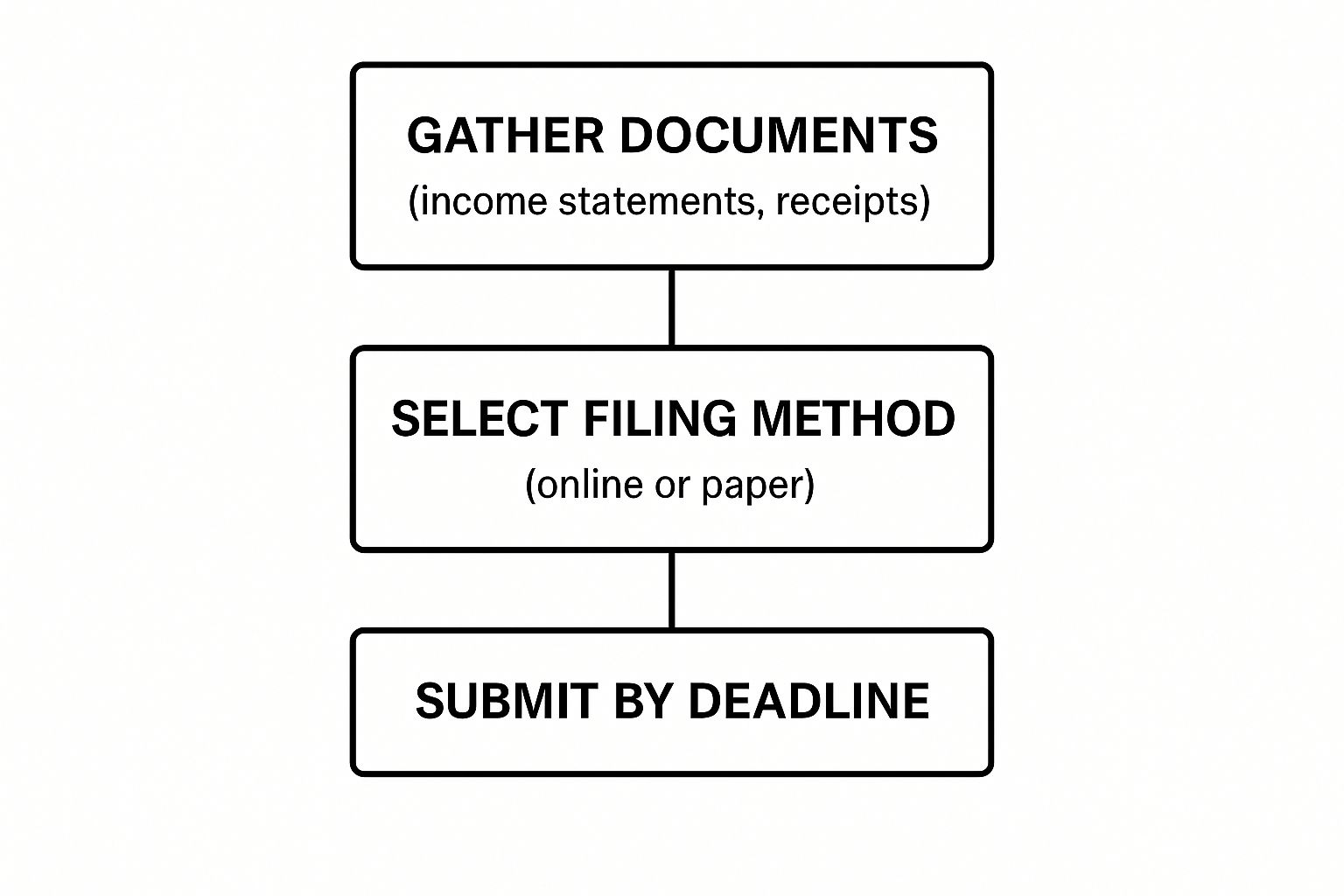
As shown, meeting your deadline is the final step in a process that begins with diligent, year-round record-keeping. To provide a clearer picture, here are the typical deadlines for entities lodging directly with the ATO.
Standard Australian Tax Return Deadlines by Entity Type
| Entity Type | Standard Deadline | Key Considerations |
|---|---|---|
| Individuals | 31 October | This is the fixed date for anyone lodging their own return without an agent. |
| Companies & Trusts | 28 February | Often applies to new entities or those with a poor lodgement history. |
| Partnerships | 31 October | Usually aligns with the individual deadline, but can vary based on circumstances. |
| SMSFs | 28 February | This is the standard date for newly registered funds or those with prior compliance issues. |
These dates are the baseline. Engaging a professional can significantly alter your lodgement timeline.
How a Tax Agent Can Change Your Business Deadline
Just as for individuals, appointing a registered tax agent provides significant flexibility for businesses. The ATO’s agent lodgement program offers extended deadlines, potentially pushing your due date to 15 May—or even later for some entities with an exemplary compliance history.
Practical Example: A newly incorporated company lodges its first tax return and is assigned a 28 February deadline. After several years of lodging on time through its tax agent, the ATO may automatically assign it a later 15 May deadline, reflecting its proven reliability. This demonstrates the direct benefit of maintaining an excellent compliance record.
This is where expert guidance is invaluable. The rules for each structure—company, trust, or SMSF—are complex. A proficient accountant ensures you not only meet the correct Australian tax return deadline but also leverage the system to your best advantage.
If you manage a business, partnership, trust, or SMSF, do not leave your lodgement date to chance. Protect your business by securing expert advice. Contact us to develop a tax compliance strategy that works for you.
How to Request a Lodgement Extension from the ATO

Sometimes, despite careful planning, unforeseen circumstances can disrupt your ability to meet tax deadlines. A serious illness, a natural disaster, or another major event can make timely lodgement impossible. The Australian Taxation Office (ATO) has a formal process for requesting more time, known as a lodgement deferral.
However, this is not a casual request. A lodgement deferral is a formal extension granted only for compelling reasons. You must apply to the ATO before your deadline passes. General disorganisation or forgetting the date is not a valid justification. The ATO requires evidence that circumstances beyond your control have prevented you from lodging on time.
Valid Reasons for an Extension
What does the ATO consider a “valid” reason? We are referring to significant, disruptive life events.
Commonly accepted reasons include:
- A serious illness or accident affecting you or a close family member.
- The impact of a natural disaster, such as a fire, flood, or cyclone, on your home, business, or financial records.
- The death of a family member or another key person is integral to preparing your tax return.
- The loss or destruction of your records due to events you could not prevent.
Here’s a critical point many people miss: an extension to lodge is not an extension to pay. If you have a tax liability, the ATO will still charge interest (General Interest Charge or GIC) from the original payment due date, which is typically 21 November for self-lodgers. A deferral only protects you from the Failure to Lodge penalty.
How to Apply for a Deferral
The application process depends on your lodgement method. If you use a registered tax agent, they will manage this request for you through their dedicated online portal. This is a significant advantage of professional representation—they understand the system and can present your case effectively.
If you are lodging yourself, you must apply directly to the ATO, which usually involves calling them to explain your situation. Be prepared to provide specific details and any supporting evidence. For a more detailed walkthrough, see our guide on how to extend the deadline to lodge a tax return.
Ultimately, proactive communication is your best strategy. Contacting the ATO or your tax agent before the deadline demonstrates that you are taking your obligations seriously. This simple step can significantly improve your chances of receiving an extension and help preserve your compliance record.
If you are facing exceptional circumstances with a tax deadline approaching, do not wait. Contact our experienced team in Ashfield today, and we can help you navigate the process.
Why Do We Even Have Tax Deadlines in Australia?
Have you ever wondered why the tax deadline is so important? It is not an arbitrary date chosen by the Australian Taxation Office (ATO) to create pressure. These deadlines are the functional backbone of Australia’s economy.
The government requires a predictable revenue stream to plan the national budget, which funds essential services like roads, hospitals, schools, and social security. A fixed lodgement cycle creates a reliable flow of funds, which is critical for stable, long-term public planning. Without these deadlines, fiscal forecasting and funding would become chaotic.
Keeping the System Fair and Orderly
Beyond funding public services, deadlines ensure fair and practical administration. Imagine the chaos if taxpayers lodged their returns at any time throughout the year. The ATO would face an unpredictable and unmanageable workload, making it nearly impossible to process returns efficiently.
This is why the 31 October deadline for self-lodgers has been a cornerstone of our tax system. It provides a four-month window after 30 June, the end of the financial year, for individuals to organise their affairs.
The ATO also recognises that complex financial situations require more time. The tax agent lodgement program provides extensions, often until 15 May of the following year, allowing professionals the time needed to prepare complex returns without causing administrative bottlenecks. It is an intelligent, tiered system that balances the government’s need for timely revenue with the practical needs of taxpayers.
This framework is formally established in legislation, such as the Taxation Administration Act 1953. To delve deeper into the history of these dates, you can explore the evolution of Australian tax returns.
Feeling the pressure of an upcoming deadline? Avoid penalties by not waiting until the last minute. Take decisive action and book a consultation with our expert accountants in Ashfield to get your lodgement finalised on time.
Common Questions About Australian Tax Return Deadlines
Even with clear deadlines, specific scenarios can create confusion. Here are answers to some of the most common expert questions we receive from clients, designed to help you manage your tax obligations with confidence.
These are the tricky situations that often trip people up.
What Happens if I Lodge Late but Am Due a Refund?
A common misconception is that if the ATO owes you a refund, lodging late is not an issue. This is incorrect. The Failure to Lodge (FTL) penalty applies to the act of missing the Australian tax return deadline, irrespective of whether you have a tax liability or are due a refund.
While the ATO has the discretion to remit penalties for low-risk taxpayers expecting a refund, this is not guaranteed. Relying on this is a significant gamble. The only certain way to avoid a penalty is to lodge your return on time, every time.
Under the Taxation Administration Act 1953, lodging and paying are two distinct legal obligations. The ATO requires your lodgement to maintain the integrity of the tax system, perform data matching, and ensure universal compliance. You can review the specifics on the government’s legislation reference page.
Does the Deadline Still Apply if I Am Overseas?
Yes, absolutely. Your tax residency status determines your obligations, not your physical location. Being overseas does not provide an automatic exemption from meeting the Australian tax return deadline.
If you plan to be travelling, proactive management is key.
- Lodge before you leave: The simplest solution is to finalise your tax return before your departure.
- Engage a tax agent: By appointing a registered tax agent before 31 October, they can lodge on your behalf and secure access to their extended deadlines, ensuring compliance while you travel.
Can I Get an Extension if I Am Missing Information?
It is a stressful situation: the deadline is near, and you are waiting on a crucial document like an income statement or investment report. The worst course of action is to ignore the due date. This will almost certainly result in a penalty.
Instead, you must communicate proactively. Contact the ATO or your tax agent before the deadline and explain the situation. If you can demonstrate that the delay is due to factors beyond your control and that you have actively sought the missing information, a short deferral may be granted.
Navigating the complexities of the Australian tax return deadline can be challenging, but you don’t have to do it alone. At EndureGo Tax, we provide the expert guidance necessary to meet every obligation without stress. Book a consultation today and experience the confidence that comes from having a trusted local accountant on your side.
