


Receiving a letter from the Australian Taxation Office almost always triggers a wave of panic, a feeling you’ll see echoed all over ato audit Reddit threads. If you’ve just found one in your letterbox, here’s the first and most important thing to do: don’t panic, but act promptly.
That official envelope isn’t a reason to freeze up. It’s your cue to get organised, understand exactly what the ATO is asking for, and plan a structured, professional response. As tax experts, we’re here to guide you through the process with actionable advice.
That Official Letter Arrived. Now What?
An ATO letter can feel intimidating, but it’s a standard part of their compliance process. Your first job is to read it carefully and figure out exactly what kind of contact it is. Not every letter signals a full-blown audit; often, it’s just a preliminary check designed to verify specific information.
The language the ATO uses is incredibly specific, and understanding it is your first win. Are they calling it a ‘review,’ an ‘enquiry,’ or an ‘audit’? These terms are definitely not interchangeable—they signal the seriousness and scope of the investigation.
Decoding ATO Jargon: Review vs. Audit
Most of the time, these interactions start as a ‘review’ or an ‘enquiry’. Think of this as an automated or targeted check on a specific item in your tax return.
- Review: This is the most common and least intense level of contact. The ATO’s systems have likely flagged a simple discrepancy. Practical Example: You declared $75,000 in salary, but your employer’s Single Touch Payroll data reported $76,500 because you forgot about a small bonus. The ATO will send a letter asking you to confirm the correct figure.
- Enquiry: This is a bit more involved. It might focus on a particular area of your return, like your work-from-home deductions or car expense claims, and they’ll want more detailed evidence than you originally provided.
- Audit: This is the most serious of the three. An audit is a formal, comprehensive examination of your financial affairs for a specific period, governed by strict legislative procedures. It goes way beyond a single claim and will require you to produce substantial documentation to prove your compliance.
This flowchart shows the typical progression of an ATO contact, from a simple review all the way up to a formal audit.
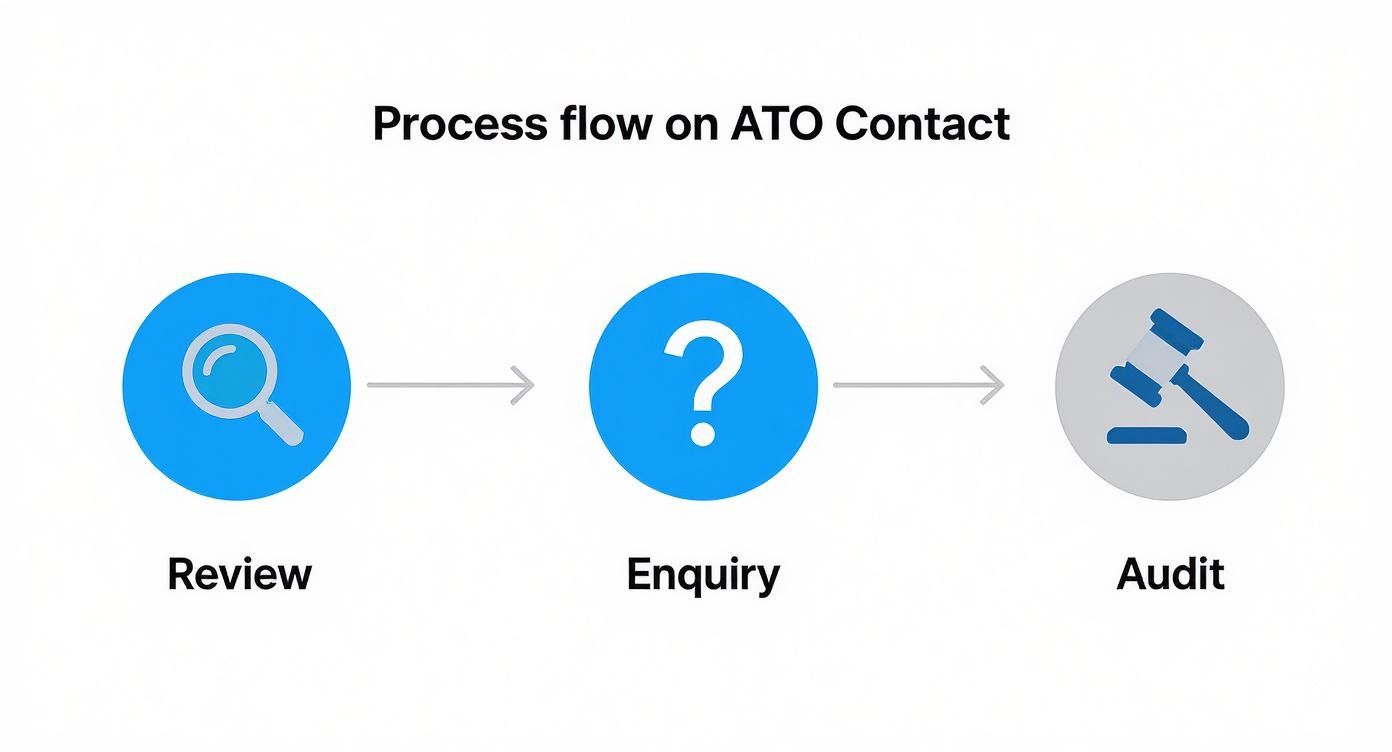
The key takeaway here is that their intervention is staged. This gives you a chance to resolve any issues during the less severe ‘review’ or ‘enquiry’ phase before things escalate.
Common Triggers for an ATO Letter
So, what makes the ATO send that letter in the first place? Reddit discussions and our professional experience point to a few common red flags.
A classic example is a sole trader in the building industry claiming tool and equipment deductions that are way above the industry average. Another frequent trigger is a mismatch between the capital gains you’ve reported from crypto sales and the data the ATO gets directly from digital currency exchanges.
At its core, the issue is almost always data matching. The ATO’s systems are constantly comparing the information you provide with data from third parties like banks, employers, investment platforms, and government agencies. When the numbers don’t line up, a flag is raised.
The ATO has poured a lot of resources into its audit activities lately, backed by nearly $1 billion in extra compliance funding. This investment has supercharged their data-matching technology, which now cross-references information from over 350 sources. This makes undeclared income or unusually high claims much easier to spot.
The table below breaks down some of the most common triggers we see, both officially and in online forums.
ATO Audit Triggers and Focus Areas
| Audit Trigger / Focus Area | What the ATO is Looking For | Common Reddit Experience |
|---|---|---|
| High Work-Related Expenses | Claims that are significantly higher than the average for your occupation or income bracket. | “My WFH claims got flagged because they were way higher than last year, even though my role didn’t change.” |
| Data Mismatches | Discrepancies between your declared income (salary, interest, dividends) and data from employers, banks, or other third parties. | “The ATO sent a letter because I forgot to include the interest from a savings account I barely use.” |
| Undeclared Crypto Gains | Failing to report capital gains or losses from buying, selling, or swapping cryptocurrencies. | “Got a ‘please explain’ letter after the ATO got my transaction data from a crypto exchange.” |
| Cash-Intensive Businesses | Businesses in industries like hospitality, trades, and personal services are watched for under-reporting cash income. | “Our café got a review notice asking for EFTPOS statements and cash deposit records.” |
| Rental Property Deductions | Incorrectly claiming repairs as capital works, claiming interest on the private portion of a loan, or over-claiming expenses. | “My claim for a full kitchen renovation was questioned; they said it was a capital improvement, not a repair.” |
| Gig Economy & Side Hustles | Forgetting to declare income from sources like Uber, Airtasker, or Etsy. | “A mate got audited for not declaring his weekend food delivery income.” |
This isn’t an exhaustive list, but it covers the big ones. The main goal is to avoid looking like an outlier without the records to back it up.
Your first objective is to switch from a mindset of panic to one of practical planning. Understand what the ATO wants, gather the relevant documents, and know your rights. It’s a great idea to familiarise yourself with the Taxpayers’ Charter, which outlines what you can expect from the ATO and what your obligations are in return.
Learning how to be proactive is crucial, and it’s a key part of our guide on how to protect yourself from tax audits and tax scams.
Here’s your actionable call to action:
Your immediate task is to identify the scope of the letter. Is it a simple request for a payslip, or is it a formal notice of a comprehensive audit? Whatever you do, don’t ignore it. Your best move is to contact a registered tax agent immediately to discuss the letter and work out a professional response. That first step can set the tone for the entire process.
Organising Your Records for the Audit
Alright, you’ve received the official letter from the ATO, and you know what they’re looking for. Now comes the real work: gathering and organising your documents. This is more than just tipping out a shoebox of old receipts; it’s about building a clear, professional case file that answers every single one of the auditor’s questions.
Think of it this way: presenting your information in a structured, logical way shows you’re cooperative and on top of your affairs. It sets a positive tone from the get-go. An auditor who receives a neat digital folder or a well-organised binder can follow your financial story without any fuss, which almost always leads to a smoother, faster process.

Creating Your Audit Narrative
Your records are the evidence that tells your financial story for the period under review. Your job is to make that story as simple as possible. A common tip from Reddit users who’ve been through an ATO audit is to use simple tools to create a chronological narrative.
Practical Example: If the ATO is questioning your home office expense claims, don’t just send a pile of Telstra and AGL bills. Create a simple spreadsheet listing each bill by date, the total amount, and the percentage you claimed for work use, with a final column referencing the specific bill. This simple action connects the dots for the auditor, making their job—and your life—much easier.
For more complex business audits, accounting software like Xero or MYOB is your best friend. These platforms can generate detailed reports that line up perfectly with your BAS lodgements or income tax returns, giving the auditor a professional and complete picture.
The Essential Document Checklist
The specific documents you’ll need will depend entirely on what the ATO is looking at. A company GST review requires a completely different set of records than an individual’s deduction claims.
Here’s a quick rundown of the usual suspects for common audit types:
- For Sole Trader Work-Related Expenses:
- Invoices and Receipts: You need one for every single expense you’ve claimed, from a new power drill to a professional development course.
- Bank and Credit Card Statements: Don’t just hand them over—highlight the relevant transactions to show clear proof of payment.
- Vehicle Logbook: If you’re claiming car expenses using the logbook method, this needs to be meticulously detailed for a continuous 12-week period.
- Travel Diary: Essential for any overnight work-related travel, it should detail the purpose and activities of the trip.
- For a Company’s GST or BAS Review:
- Tax Invoices: You’ll need them for both sales (income) and purchases (expenses where you claimed GST credits).
- Bank Statements: Every business account, showing the complete flow of money in and out.
- BAS Worksheets: The actual calculations you used to fill out each Business Activity Statement for the period in question.
- Accounting File: It’s common for them to request a backup of your software file (e.g., from Xero, MYOB, or QuickBooks).
The name of the game is substantiation. Every single figure on your tax return needs to be backed up by verifiable evidence. Under the Taxation Administration Act 1953, you’re legally required to keep records for five years, for this exact reason.
Best Practices for Record Management
Honestly, being organised from day one is your best defence. A recurring theme you’ll see in ato audit Reddit threads is people wishing they had a better system in place before the letter arrived. To make sure your records are audit-proof, it pays to adopt modern document archiving best practices. This isn’t just about storage; it’s about creating a system that actually works for you.
This kind of proactive organisation doesn’t just save you during an audit; it makes doing your tax each year a whole lot less painful. For a deeper dive, check out our detailed guide on Australian record-keeping requirements.
Your Actionable Call to Action:
Right now, create a dedicated folder—physical or digital—just for the audit period. Start putting every relevant document into it. Organise them by financial year, then by category (e.g., “Income,” “Vehicle Expenses,” “Office Supplies”). If you spot any gaps, like a missing invoice, contact the supplier for a copy now. Don’t wait. A complete, well-ordered file is the strongest first move you can make.
When to Call in a Tax Professional
Ah, the classic “should I hire an accountant?” debate. You’ll see it pop up on every ato audit reddit thread, and for good reason. It’s tempting to try and save a few quid by handling a simple review yourself, but making the wrong call here can be an incredibly costly mistake.
Deciding to bring in a professional isn’t about giving up; it’s a strategic move. Think of it like this: trying to handle an audit alone is like representing yourself in court without a lawyer. You might know the facts of your situation, sure, but a tax professional knows the law, the ATO’s internal procedures, and how to speak their language. Their job is to be your shield, managing all the back-and-forth and making sure your rights are protected.
Clear Signs You Need an Accountant
Some situations are genuinely straightforward. If the ATO just needs a missing payslip to finalise your return, you can probably handle that yourself. But the moment things get more complex, the risk of saying or providing the wrong thing skyrockets.
Here are the scenarios where calling a tax agent isn’t just a good idea—it’s essential:
- The Audit Involves a Business: If the ATO is looking at your company, trust, or SMSF, do not go it alone. Audits digging into GST, FBT, or company income tax are a different league of complicated and carry serious financial risks. This is non-negotiable.
- Large Sums of Money Are at Stake: Is the ATO questioning deductions or transactions worth thousands of dollars? The potential tax bill, plus penalties and interest, will almost certainly dwarf an accountant’s fee.
- You’re Facing Big Penalties: If the letter from the ATO mentions penalties for “failure to take reasonable care,” “recklessness,” or anything hinting at fraud, you need an expert in your corner, stat. A good accountant can often negotiate these penalties down, sometimes significantly.
- The Scope is Broad or Vague: Is the ATO asking vague questions or looking at several financial years at once? An accountant will step in to clarify and narrow the scope, preventing a small review from snowballing into a full-blown investigation of your entire financial life.
You don’t have to look far on Reddit to find stories of regret from people who tried to DIY their audit. One user shared how a simple query about work-related expenses blew up into a multi-year audit because they accidentally volunteered information that opened a whole new can of worms. A professional would have kept the conversation focused and precise.
Choosing the Right Professional for Your Audit
Not all accountants are created equal, especially when you’re under the ATO microscope. You need someone with specific experience in tax law and dealing directly with auditors. Your local bookkeeper or the accountant who just does basic tax returns might not have the specialised skills you need right now.
When you’re looking for help, ask these direct questions:
- How much experience do you have with ATO audits specifically?
- Have you handled cases like mine before (e.g., crypto gains, rental property deductions)?
- What’s your strategy for communicating with the ATO?
- How do you structure your fees for audit work? Is it a fixed fee or an hourly rate?
Getting a clear answer on fees is crucial. Most will charge an hourly rate for audit work, which can be anywhere from $150 to over $400 per hour, depending on their experience and how messy your case is. Always ask for a cost estimate and get your agreement in writing.
It might seem steep, but remember this is an investment in damage control. Plus, under the Taxation Administration Act 1953, the cost of managing your tax affairs—including getting professional advice for an audit—is generally tax-deductible.
The Real Value of Having a Pro on Your Side
A good tax agent does so much more than just forward documents. In fact, they’ll review your records, pinpoint the weak spots in your position, and build a proper strategy. They also know how to frame your situation in the most favourable light, all backed by the right tax legislation and rulings.
For example, the ATO disallows a significant repair claim on your rental property, calling it a capital improvement. Your accountant won’t just accept it. Instead, they can prepare a formal objection, citing specific tax rulings like TR 97/23 to argue that the work was to restore the asset to its original state, not improve it. That level of professional advocacy can be the difference between a minor tweak to your tax bill and a financially crushing debt.
Your Actionable Call to Action:
If your audit ticks any of the boxes above, or if you just feel that sinking feeling in your gut, then it’s time to act. Don’t wait until you’re struggling to answer the ATO’s questions. Instead, book a consultation with an experienced tax accountant to go over your letter and map out a plan. That first meeting alone will give you clarity and peace of mind.
Communicating with the ATO Auditor
How you handle conversations with your ATO case officer can be just as important as the paperwork you hand over. Therefore, this is where you need to be strategic and professional, a lesson echoed in countless stories shared across ATO audit Reddit forums. By getting this right, you protect your interests while keeping the relationship cooperative and respectful.
Moreover, the golden rule, repeated by almost everyone who’s been there, is simple: be polite, be professional, and be precise. Additionally, answering questions directly without offering up extra information is an absolute must.

Setting the Right Tone
Your very first interaction sets the stage for the entire audit. Therefore, it’s crucial to stay calm and courteous, even if you’re feeling stressed or think the ATO is being unreasonable. After all, an aggressive or defensive stance will only put the auditor on edge and encourage them to dig deeper.
Additionally, treat every single interaction as if it’s on the record. Whether it’s a phone call or an email, your words carry weight. This is precisely why many tax professionals will tell you to keep communication in writing wherever possible—it creates a clean, documented trail.
Dos and Don’ts of Auditor Communication
Talking to an auditor is a specific skill. Here are the core principles to stick to throughout the audit process.
- DO Answer the Question Asked: Listen carefully and give a direct answer. If they ask for your bank statements for June, give them only the June statements.
- DON’T Volunteer Extra Information: This is the single biggest mistake people make. Never offer up details or documents they didn’t specifically request. You might think you’re being helpful, but you could accidentally open a whole new can of worms.
- DO Say “I Don’t Know”: It is perfectly fine to say you don’t have an answer on the spot. Just follow it up with something like, “I’ll need to check my records and get back to you on that.”
- DON’T Speculate or Guess: Never, ever guess an answer. An incorrect guess can easily be mistaken for a lie, and that comes with serious consequences. It’s always better to confirm the facts first and give them an accurate response later.
A key takeaway from experienced Reddit users is to treat the audit like a legal proceeding. Your job is to respond to specific requests with verified facts, not have a casual chat about your business.
Practical Scripts for Common ATO Questions
Having a few prepared responses in your back pocket can help you stay on track and avoid the trap of saying too much.
Scenario 1: The auditor asks a broad, open-ended question.
- Auditor: “Can you tell me about your business income for the last financial year?”
- Your Response: “My business income is detailed in the profit and loss statement I’ve provided. Was there a particular entry you wanted me to clarify?”
- Why this works: It’s polite and helpful, but it cleverly redirects the auditor back to the documents they already have.
Scenario 2: The auditor asks a question you can’t answer immediately.
- Auditor: “Why was there a large payment made to this supplier in October?”
- Your Response: “I don’t recall the specific details for that transaction off the top of my head. Let me review the invoice, and I’ll get you a precise answer by the end of the day.”
- Why this works: It shows you’re cooperating without resorting to guesswork.
Requesting an Extension
If you genuinely need more time to gather documents, don’t be afraid to ask for an extension. Fortunately, the ATO is usually quite reasonable about it, provided you have a valid reason and you ask promptly.
When you ask, be specific. For instance, explain why you need more time and propose a new, realistic deadline. Practical Example: “I am currently waiting on my bank to provide archived statements for the 2022 financial year. They’ve advised it will take ten business days. Could I please request an extension until [date] to provide these documents?”
Overall, clear, professional communication is your best defence for getting through an audit smoothly. Additionally, if you feel overwhelmed or unsure how to respond, that’s a massive sign it’s time to call in a tax professional. Contact us today at EndureGo Tax, and we can handle all communications with the ATO for you, making sure your rights are protected every step of the way.
What to Do When the Audit Decision Lands
This is it. The part of an ATO audit that feels the most intense. After what feels like an eternity of digging up documents and answering questions, finally, a thick envelope arrives. Inside is the ATO’s position paper or an amended notice of assessment. This isn’t just another letter; rather, it’s the culmination of their entire investigation, and what it says will dictate your next move.
Suddenly, all the theoretical back-and-forth becomes very real. Moreover, the document lays out any tax adjustments, penalties, and interest charges in black and white. It’s a moment often dissected on ATO audit Reddit threads, where people share the good, the bad, and the ugly of their outcomes.
Making Sense of the Final Decision
When you get the ATO’s findings, it usually goes one of three ways. Each path requires a different response.
- The “No Change” Result: This is the unicorn of audit outcomes. It means the ATO has gone through everything and agrees your original tax return was spot on. You can finally exhale—the audit is over, and you don’t owe a cent more.
- An Agreed Adjustment: This is pretty common. The ATO finds a few things, you look at their reasoning and realise they have a point—maybe you made a genuine mistake or overlooked something. You agree to their assessment and the adjusted tax.
- A Disputed Assessment: This is the tough one. You get the notice of assessment and flat-out disagree with the ATO’s interpretation and the tax debt they’ve calculated. This is where you need to steel yourself for the next round.
Whatever the outcome, read the notice carefully. It won’t just be the primary tax adjustment; it will detail any penalties and interest, which can seriously inflate the final bill. Penalties can be slapped on for anything from making a false statement to not taking “reasonable care.” To understand what you might be up against, it pays to know the different types of ATO audit penalties and how they are calculated.
The Formal Objection and Appeals Process
If you’re in the disputed assessment camp, you absolutely have the right to fight the decision. However, this isn’t about firing off an angry email. Rather, it’s a formal, legal process with strict rules.
Your first official move is, therefore, to lodge a formal objection. You typically have just 60 days from the date the assessment was issued to get this done. Importantly, your objection has to be in writing and must clearly spell out why you disagree, backing up your claims with facts, figures, and points of tax law. Also, don’t try to wing this—a weak, poorly structured objection is almost guaranteed to be dismissed.
A recurring theme on Reddit is that a winning objection is built on evidence, not emotion. You need to systematically take apart the ATO’s position with your own well-supported arguments. This is where a sharp tax professional becomes your most valuable player.
What if the ATO disallows your objection? You’re not out of options. The next step is to appeal to an external body, most commonly the Administrative Appeals Tribunal (AAT). The AAT acts as an independent umpire, reviewing the ATO’s decision from a fresh perspective. If things still don’t go your way, then you could take it all the way to the Federal Court, but be warned—that’s a much more complex and expensive fight.
How to Handle the Tax Debt
Here’s a kicker: even if you’re disputing the assessment, the ATO usually requires you to pay 50% of the disputed primary tax just to keep your appeal in play. Therefore, if you accept the debt or need to manage the part you don’t dispute, you must be proactive.
Ignoring a tax debt is the worst thing you can do. Interest will keep piling up, and the problem will only get bigger. The good news is the ATO is generally willing to negotiate with people who are making a genuine effort. You can apply for a payment plan to break the debt down into manageable instalments. This shows good faith and helps you dodge more aggressive recovery actions. It’s also wise to stay on top of broader legislative shifts, like Australia’s evolving crypto regulations, as these can influence how certain assets are treated during compliance and debt discussions.
Although it can be stressful, an audit is a powerful learning experience. Use it to find the weak spots in your record-keeping. By implementing better systems now, you significantly reduce your chances of having to go through this process again.
With that in mind, your actionable call to action: Have you received an audit outcome you disagree with? Or are you facing a tax debt you can’t pay all at once? Don’t wait. Contact a tax professional at EndureGo Tax immediately to discuss your options for lodging an objection or setting up a payment plan. Ultimately, moving quickly is the best strategy for a better outcome.
Your Top ATO Audit Questions, Answered
When that official ATO letter lands in your inbox or mailbox, your mind immediately starts racing. It’s natural. Over on forums like Reddit, you see the same urgent questions pop up again and again from people in the same boat.
So, let’s cut through the noise and tackle the most common questions we hear. Getting straight answers is the first step to feeling back in control.
How Far Back Can the ATO Actually Audit?
This is the big one, and the answer isn’t as simple as you might hope. The ATO has a standard time limit, which they call the period of review, to go back and amend your tax assessment.
For most individuals and small businesses, that period is two years. However, if your financial affairs are a bit more complex—think larger businesses or certain trust structures—it stretches out to four years.
But here’s the critical part: these time limits go out the window if the ATO suspects fraud or tax evasion. In those cases, there is no time limit. They can dig as far back as they need to. Additionally, it’s worth remembering that the clock starts ticking from the date your notice of assessment is issued, not the end of the financial year. This is precisely why the law requires you to keep financial records for at least five years after you lodge. Those records are your first and best line of defence. For the nitty-gritty, the ATO lays it all out in their official guidance on amendment time limits.
What Happens if I Can’t Find All My Receipts?
We’ve all been there. That one crucial receipt seems to have vanished into thin air. It’s a classic taxpayer headache and a huge source of stress during an audit.
But before you panic, a missing receipt doesn’t automatically mean a lost deduction. You can often prove the expense with other evidence. In addition, bank or credit card statements are your best friend here, as long as they clearly show the supplier, the date, and the amount. Another smart move is to contact the supplier and ask for a copy of the invoice—many businesses are happy to help.
The key is to be upfront about it. Don’t try to hide it. Explain the situation to the auditor and show them all the alternative proof you have. A single missing receipt for a small expense usually isn’t a deal-breaker, but a complete lack of evidence for a major claim? That’s almost guaranteed to be disallowed.
Does Using a Tax Agent Make an Audit More Likely?
Let’s bust this myth once and for all. Hiring a registered tax agent does not increase your chances of being audited. In fact, you could argue it has the opposite effect.
The ATO knows that registered agents are held to high professional standards and a code of conduct, which generally leads to more accurate returns. However, audits are almost always triggered by sophisticated data-matching programs that flag numbers that look odd compared to industry benchmarks. The system is looking at the data, not who lodged it.
And if your return does get flagged, then having the professional who prepared it on your side is a massive advantage. They have the working papers and the logic behind every figure, making it far easier to answer the ATO’s questions quickly and correctly.
Feeling overwhelmed by an ATO letter or have more questions spinning in your head? You don’t have to face this alone. At EndureGo Tax, we specialise in navigating ATO audits and objections, protecting your rights, and working towards the best possible outcome.
Whether you’re in Ashfield, the Inner West, Belrose, or the Northern Beaches, our team is ready to provide the expert guidance you need. Peace of mind starts with a conversation. Book a consultation with EndureGo Tax today and let our experienced accountants take the weight off your shoulders.
