


Let's get straight to it. That new ute, laptop, or bit of machinery you just bought for your business? It started losing value the moment you paid for it. In Australian-style language, its value is dropping faster than a lead balloon. This isn't just a sad fact of life for your equipment; it's a powerful tax deduction opportunity known as depreciation.
As an expert in Australian tax law, I can tell you that understanding this is crucial. The Australian Taxation Office (ATO) understands that the tools you need to earn an income don’t last forever. So, they let you claim a portion of their cost back each year as they wear out. It’s a game-changer for managing your taxable income and cash flow. For example, a carpenter's power saw, which costs $800, won't last forever. Depreciation allows the carpenter to claim a part of that $800 cost as a tax deduction each year over the saw's useful life.
So, What Exactly Are Depreciating Assets?
In simple terms, a depreciating asset is any item you use for your business that has a limited lifespan and is expected to decline in value over time. Instead of claiming the full cost in the year you buy it (unless specific rules like the instant asset write-off apply), you claim the wear-and-tear over its effective life.
The effective life is the ATO's official estimate of how long an asset can be used to produce income. This allows you to spread the tax deduction over several years, helping you systematically recover the cost of significant business purchases.
Common Examples of Depreciating Assets
Most tangible items you buy to run your business will eventually depreciate. The specifics can vary, but here’s a quick look at what we see most often with our clients in Sydney.
To make it easier, here’s a quick-reference table showing typical depreciating assets across different business types.
| Business Type | Common Depreciating Assets |
|---|---|
| Tradies (Plumbers, Electricians, Builders) | Utes and vans, power tools, ladders, diagnostic equipment, trailers, computers for invoicing. |
| Cafes & Restaurants | Coffee machines, commercial ovens, refrigerators, point-of-sale (POS) systems, tables and chairs. |
| Office-Based Businesses | Laptops and desktop computers, printers, office desks, ergonomic chairs, servers, monitors. |
| Property Investors | Carpets, blinds, air conditioning units, hot water systems, ovens, and dishwashers in a rental. |
As you can see, the list is long. It covers everything from the vehicle you drive to a client's site to the carpet in your investment property. For property investors, understanding what counts is crucial, as detailed in guides like Depreciating Airbnb Vacation Rentals.
The ATO doesn't just make this up as they go. There’s a legal basis for all of this.
The official definition comes from Division 40 of the Income Tax Assessment Act 1997. It defines a depreciating asset as something with a limited effective life that can reasonably be expected to decline in value over the time it is used.
This piece of legislation is what turns a simple business purchase into a strategic tool for tax planning. For any savvy business owner in Australia, getting your head around these rules isn't just helpful—it’s essential for maximising your financial position.
To ensure your business assets are delivering maximum tax benefits, book a consultation with our expert accountants in Ashfield or Belrose. We'll build a depreciation strategy that saves you money.
Choosing Your Depreciation Calculation Method
So, you've invested in a new asset for your business. Great! But now comes the important part: figuring out how to claim that expense on your tax return.
The Australian Taxation Office (ATO) gives you two main ways to calculate depreciation. The method you pick isn't just a box to tick—it's a strategic decision that can seriously impact your business's cash flow for years to come.
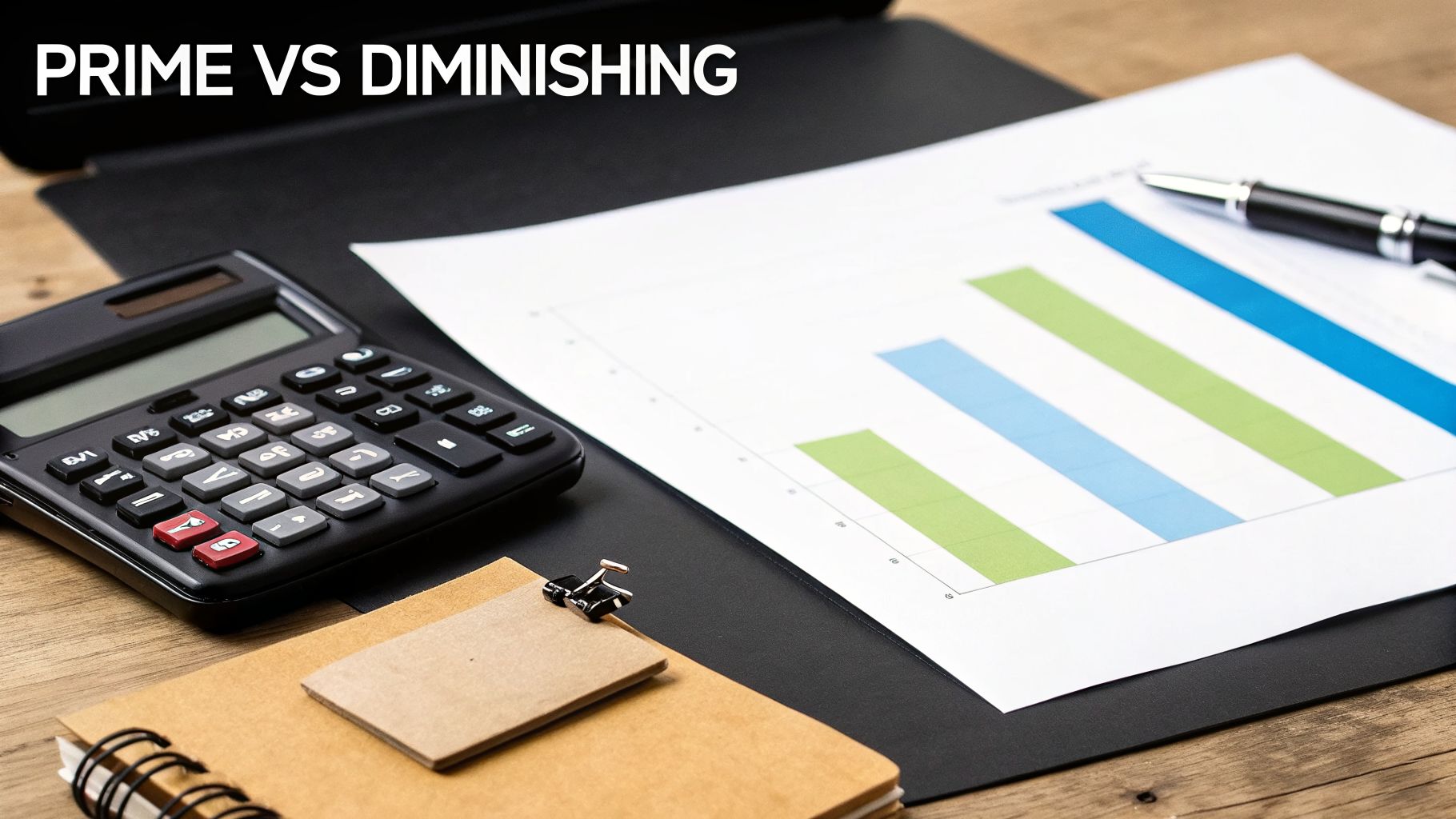
Let's walk through it with a practical, real-world example. Imagine you're a tradie who just bought a new piece of machinery for $30,000. The ATO gives it an effective life of five years.
How do you play it?
The Prime Cost Method
Think of the Prime Cost method as the slow-and-steady approach. It's often called the "straight-line" method because it spreads the deduction evenly across the asset's life.
This method is perfect if you value predictability. You get the same tax deduction every single year, making your profit forecasts stable and your budgeting straightforward.
The formula looks like this:
Asset's cost × (Days held ÷ 365) × (100% ÷ Asset's effective life)
For our $30,000 machine, you’d claim a neat $6,000 each year for five years (20% of $30,000). Simple and consistent.
The Diminishing Value Method
On the other hand, the Diminishing Value method is all about getting a bigger tax win upfront. It’s an accelerated approach that gives you the largest deductions in the early years of an asset’s life.
This is a powerful strategy if you want to maximise your tax savings now and boost your immediate cash flow, especially right after a major purchase.
Here’s the formula:
Base value × (Days held ÷ 365) × (200% ÷ Asset's effective life)
For that same $30,000 machine, your first-year deduction would be a massive $12,000 (40% of $30,000). But in year two, the claim drops to $7,200 (40% of the remaining $18,000 value). You get a big initial benefit, but the deductions shrink over time.
It's crucial to get this right from the start. Under the Income Tax Assessment Act 1997, once you choose a method for an asset, you’re generally stuck with it for its entire lifespan. For a closer look at the numbers, check out our detailed guide on how to calculate depreciation.
Making the right choice depends entirely on your business goals. Do you want stable, predictable deductions, or a bigger cash injection right now? An experienced accountant can help you model both scenarios to see which one puts you in a better financial position. Contact our team today to analyse your asset purchases and choose the optimal depreciation method for your business.
How Australian Depreciation Rules Have Evolved
Think the tax rules you used a few years ago are still good to go? Think again, mate.
Tax laws aren’t set in stone. They shift with the economy, and the rules around how you claim deductions for your depreciating assets have changed dramatically. A strategy that saved you a bundle five years ago might actually be costing you money today.
This is a powerful reminder that for any savvy business owner, staying on top of the latest ATO changes isn’t just good practice—it’s essential.
A Look Back at Aggressive Depreciation
To see just how much things can change, you only have to rewind to the 1980s. In a bold move to fire up business investment, the government rolled out an aggressive system called '5/3' accelerated depreciation. This policy let businesses write off assets way faster than their actual lifespan.
For example, plant and equipment that might normally take a decade to depreciate could be written off at a flat 20% per year over just five years. This policy, which kicked off after July 19, 1982, supercharged investment by letting businesses claim massive deductions upfront and slash their taxable income almost instantly. If you're curious about the economic thinking behind it, the Reserve Bank of Australia has a fascinating analysis on depreciation and business investment.
The Shift to Effective Life
But here's the thing: aggressive schemes like that don't last forever. The '5/3' system was eventually scrapped and replaced with the model we use today, which is all based on an asset's 'effective life'.
An asset's 'effective life' is the period it can be used to produce income. This modern approach, laid out in the Income Tax Assessment Act 1997, is designed to match your tax deductions more closely to the real-world wear and tear of an asset. It creates a far more realistic and sustainable system.
This massive shift—from rapid, government-driven write-offs to a more measured, reality-based model—highlights one critical point: tax laws are always adapting. Relying on old knowledge is a surefire way to miss out on new opportunities or, worse, fall foul of the current rules.
This history lesson makes one thing crystal clear: the value of having an expert accountant in your corner. A professional doesn't just plug numbers into a form; they navigate these legislative twists and turns for you, making sure your depreciation strategy is always compliant and optimised for the current financial year.
Don't let outdated advice put your finances at risk. Contact EndureGo Tax today, and our specialists in Ashfield and Belrose will make sure your approach to depreciating assets is built for today's rules, not yesterday's.
How to Use Modern Depreciation & Write-Offs to Your Advantage
While the old-school methods of depreciation are good to know, the real power lies in the concessions available to businesses right now. Modern rules like the instant asset write-off are designed to give your business a serious cash flow boost by letting you claim deductions much, much faster.
Think of it this way: instead of claiming a small slice of an asset's cost each year, these rules let eligible businesses claim a 100% deduction for the entire cost in the year you buy and use it. It’s a massive shift.
The Instant Asset Write-Off: A Game-Changer for Small Business
The instant asset write-off (IAWO) is one of the most powerful tools in a small business owner’s tax kit. Instead of slowly chipping away at an asset's value over its "effective life," you can deduct the whole cost from your taxable income immediately. The result? A direct and immediate cut to your tax bill.
Let's use a practical example: say you run a landscaping business and buy a new commercial-grade mower for $15,000. With the IAWO, you could potentially claim the full $15,000 as a deduction on this year’s tax return. That’s cash that stays in your bank account, ready to be reinvested.
If you want to get into the nitty-gritty, our guide on the instant asset write-off for Inner West Sydney businesses breaks down all the specifics. Just remember, the rules and eligibility thresholds for these schemes change often, so it’s vital to have the latest info.
What About Smaller Items? Say Hello to the Low-Value Pool
So, what happens to all those smaller assets that might not qualify for an immediate write-off on their own? This is where the low-value pool comes in. It’s a handy simplification from the ATO that lets you bundle low-cost assets together and depreciate them at a faster, fixed rate.
An asset can generally be added to the pool if its value is less than $1,000 at the beginning of the financial year.
The real beauty of the pool is its simplicity. Assets are depreciated at a rate of 18.75% in the year you add them (even if it's on June 30th!) and then at a flat 37.5% every year after. This cuts down on headaches and speeds up your deductions for all those minor but necessary items. A practical example is an office buying ten new desk chairs for $150 each. Instead of tracking each chair's depreciation separately, they can all be bundled into the low-value pool for a simplified, accelerated claim.
This infographic really shows how much the government’s thinking on business investment has changed over the years.
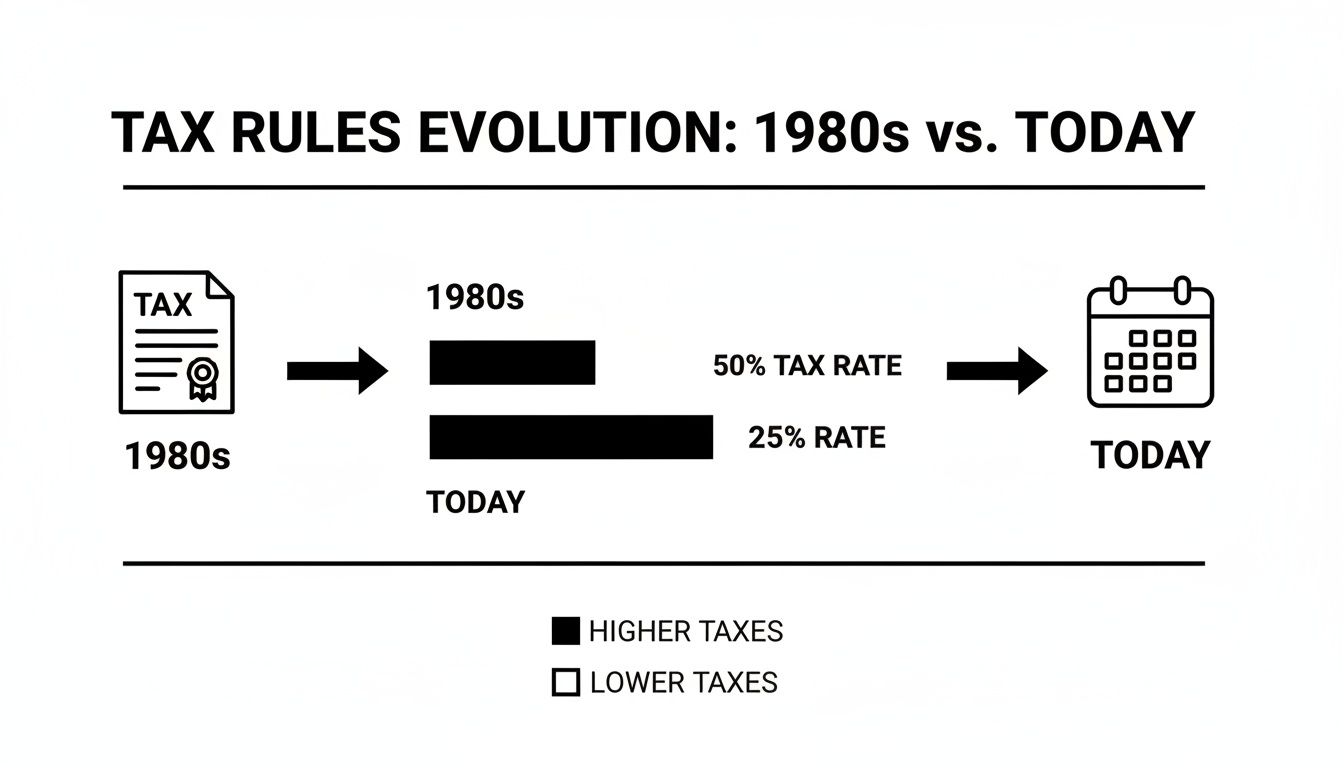
We've moved from broad-stroke tax policies to much more generous, targeted incentives designed to get businesses spending. Knowing how to use these modern rules is key. For those who love the fine print, the ATO lays this all out under Subdivision 40-E of the Income Tax Assessment Act 1997.
But let’s be honest, navigating these rules can feel like a minefield. The eligibility criteria and asset limits seem to change with every federal budget. Don't risk missing out on thousands in deductions or, worse, making a costly mistake.
Contact EndureGo Tax in Ashfield or Belrose today. Take the proactive step to let our experts ensure you’re taking full advantage of every single write-off you're entitled to.
Depreciation Tips for Tradies and Property Investors
General rules are one thing, but making depreciation work for you means getting specific. For tradies and property investors, this is where the real money is saved. Mastering the unique assets that depreciate in your line of work isn't just a box-ticking exercise; it’s the key to unlocking major tax savings and steering clear of costly ATO mistakes.
Let’s get practical.

If you're a tradie, your ute, tools, and tech are your lifeblood—and your biggest depreciating assets. Getting the claims right here is make-or-break. Just look at the bigger picture: Australian industry data for 2023-24 showed a huge $66.7 billion (27.4%) drop in operating profit for the mining sector, an industry built on heavy depreciating gear.
For a local Ashfield sparky, that financial pressure translates directly to maximising every dollar. Think about their work van. It might have a 12-year effective life, depreciating at 8.33% a year (prime cost) or up to 16.67% using the diminishing value method, as detailed in releases like these insights from the Australian Bureau of Statistics. That’s a significant deduction you don’t want to miss.
Maximising Claims for Tradies
To make sure you’re claiming every cent you're owed, focus on these three things:
- Compliant Logbooks: Your ute or van is your number one asset. Keeping a detailed, ATO-compliant logbook for at least 12 straight weeks is non-negotiable. It’s the only way to prove your business-use percentage, and without it, your claim is on shaky ground.
- Smart Tool Categorisation: Don't just throw all your tools into one bucket. Cheaper hand tools might fall under the instant asset write-off for an immediate deduction. That expensive new power saw or generator, however, will need to be depreciated properly over its effective life.
- Tech and Software: That job management app on your phone? Your Xero subscription? The laptop you use for invoicing? They are all depreciating assets. Keep good records of these expenses, because they add up fast.
Unlocking Value for Property Investors
For property investors, the gold is hidden in the details. The single biggest mistake we see is investors failing to understand the two main types of deductions they can claim on a rental.
The key is knowing the difference between Capital Works (Division 43) for the building’s structure and Plant & Equipment (Division 40) for all the removable items inside. So many investors leave thousands on the table by not properly identifying and claiming depreciation on things like ovens, blinds, carpet, and air conditioners.
Honestly, a Quantity Surveyor’s Report is one of the best investments you can make. These specialists inspect your property, identify every single qualifying asset, and create a full depreciation schedule you can hand straight to your accountant. It maximises your claims for years to come.
For more handy tips, check out our guide on rental property tax write-offs. And if you're looking to streamline your record-keeping, it’s worth exploring some of the best property management apps out there.
Whether you're on the tools or managing a growing property portfolio, don’t leave your hard-earned money on the table. Contact EndureGo Tax in Ashfield or Belrose to get an expert review of your assets and ensure your depreciation strategy is built for your specific situation.
Your Blueprint for Claiming Depreciation
Knowing what assets that depreciate are is one thing. Actually claiming them on your tax return is a whole different ball game.
This is your practical guide to getting depreciation claims right, making sure you get every deduction you’re entitled to without getting on the wrong side of the Australian Taxation Office (ATO).
The Golden Rule: Records, Records, Records
Let’s be blunt: the ATO doesn’t do guesswork. A successful claim lives and dies by your record-keeping. For every single asset you claim, you need a clear paper trail to back it up.
This isn’t just about shoving a receipt in a shoebox. It's about building a complete financial story for each item. Be ready to show:
- Proof of Purchase: The original receipt or invoice that shows what you paid.
- Asset Details: A clear description of the item. For example, instead of "computer", write "Dell XPS 15 Laptop, Serial #12345".
- Date of Purchase: The exact day you bought it.
- Start-Use Date: The day you first started using the asset for your business. This is the date depreciation officially kicks off.
There’s also a big decision you have to make early on. Once you choose a depreciation method for an asset—either Prime Cost or Diminishing Value—you’re generally stuck with it. This is a key rule under the Income Tax Assessment Act 1997, so choose wisely.
Reporting and Staying Out of Trouble
Once you've got your depreciation figures, you have to report them correctly on your tax return or Business Activity Statement (BAS).
Getting these numbers wrong or making claims you can't prove is one of the fastest ways to attract an ATO audit. That’s a time-consuming and stressful headache no business owner needs.
The final, most critical step is getting expert guidance. An experienced accountant doesn't just fill in forms; they build a forward-thinking strategy that ensures you are compliant, maximised, and prepared for the future.
This blueprint gives you the framework, but professional advice applies it perfectly to your unique situation. Don't leave your financial peace of mind to chance.
Ready to put this plan into action? Contact EndureGo Tax today. Our expert accountants in Ashfield and Belrose will ensure your depreciation claims are rock-solid, maximising your returns and keeping you compliant.
Your Depreciation Questions, Answered
When it comes to the nitty-gritty of depreciation, a lot of the same questions pop up. Whether you’re a tradie in Ashfield or a property investor in Belrose, understanding the finer points can make a huge difference to your tax outcome.
Here are the answers to some of the most common queries we get from an expert standpoint.
Can I Claim Depreciation on a Second-Hand Asset?
Absolutely. If you’ve bought a second-hand ute or used equipment for your business, you can definitely claim depreciation on it.
The price you paid for the used asset becomes its starting value for tax purposes. What’s more, you can often reassess its ‘effective life’ to be shorter than what the ATO lists for a brand-new version, reflecting its pre-loved condition. This can mean bigger deductions, sooner. A practical example: a new commercial oven might have a 10-year effective life, but a three-year-old second-hand model might only have a 7-year effective life remaining, allowing for faster claims.
A word of caution, though: eligibility for special rules like the instant asset write-off has changed over the years for second-hand goods. It’s critical to check the specific ATO rules for the financial year you made the purchase.
What Happens If I Sell a Depreciating Asset?
So, you’ve sold your work vehicle or an old piece of machinery. What now? The ATO requires you to do a ‘balancing adjustment’ to square things up.
Think of it like this: If you sell the asset for more than its book value (the original cost minus the depreciation you’ve already claimed), that profit is considered taxable income. For instance, if you bought a machine for $10,000, claimed $4,000 in depreciation (book value is $6,000), and sold it for $7,000, you have a $1,000 taxable profit.
On the flip side, if you sell it for less than its book value, you can claim the difference as a tax deduction. As set out in the Income Tax Assessment Act 1997, this ensures that over the life of the asset, you’ve only claimed a deduction for its actual drop in value.
How Do I Choose the Right Depreciation Method?
Picking between the Prime Cost and Diminishing Value methods isn’t just about ticking a box; it's a strategic business decision.
Diminishing Value: This is the fast-and-furious option. It gives you much bigger deductions in the first few years, which is perfect for boosting cash flow when you’re a new business or have just made a major purchase.
Prime Cost: This method is the slow-and-steady choice. It delivers the exact same deduction amount year after year, offering predictability. It’s a great fit for established businesses with stable profits who value consistency.
Be warned: once you pick a method for an asset, you’re generally stuck with it. The best move is to sit down with a tax advisor and map out your business goals. We can help you model which option leaves you in a stronger financial position over the long run.
Navigating the complexities of depreciation doesn't have to be a solo journey. The expert team at EndureGo Tax can provide the clarity and strategy you need. Book your consultation at our Ashfield or Belrose offices by visiting us at https://www.endurego.com.au.
